
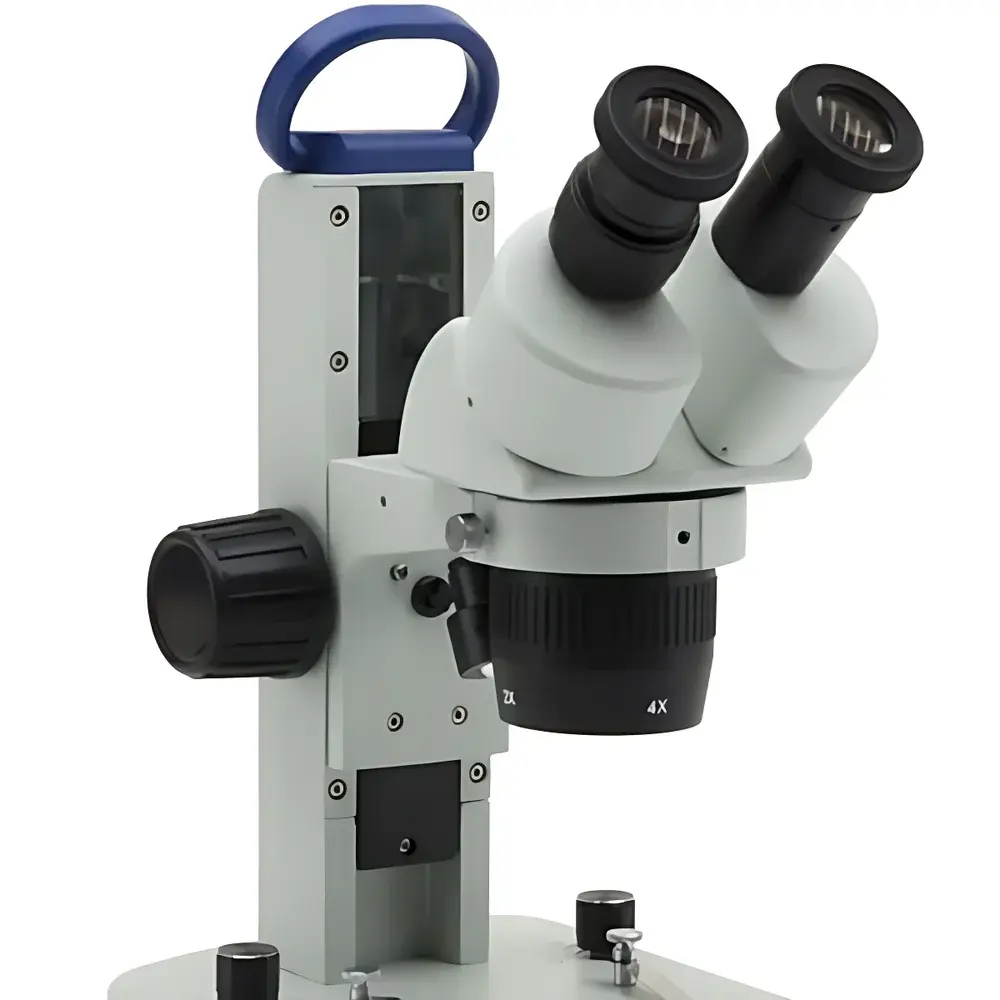
VWR® VisiScope® 260 Biological Microscope
| Brand | VWR |
|---|---|
| Origin | USA |
| Microscope Type | Upright Biological Microscope |
| Head Configuration | Trinocular |
| Optical System | Greenough Stereoscopic Optics |
| Illumination | Dual-Mode EcoLED (Reflected & Transmitted) |
| Eyepieces | Widefield 10×/21 mm |
| Objective Range | 2×–4× (STB260), 7×–45× (SZT260/SZB260) |
| Zoom Ratio | 0.7×–4.5× (SZ models) |
| Working Distance | 100 mm |
| Interpupillary Adjustment | 48–75 mm |
| Stage | White Diffusing Plate with Specimen Clips |
| Focus Mechanism | Coarse Focus with Tension Adjustment |
| Power Source | Rechargeable Ni-MH Battery (Up to 12 h Runtime) |
| Dimensions (W×D×H) | 205 × 280 × 365 mm |
| Weight | 3.4–3.6 kg |
Overview
The VWR® VisiScope® 260 is an upright biological microscope engineered for educational and entry-level research applications in life science laboratories. Designed around a robust Greenough stereoscopic optical architecture—distinct from compound prism-based systems—the instrument delivers natural depth perception, high contrast, and minimal parallax across its zoom and fixed-magnification configurations. It supports both transmitted-light brightfield observation (ideal for stained histological sections, algae, or live aquatic specimens on slides) and incident-light brightfield illumination (suited for opaque or surface-textured biological samples such as insect exoskeletons, plant tissues, or embryonic explants). The modular platform accommodates three primary configurations: STB260 (fixed dual-objective turret), SZT260 and SZB260 (zoom-stereoscopic variants), all sharing identical ergonomic head geometry, EcoLED illumination, and mechanical stage design. Its battery-powered operation eliminates cord clutter and enables flexible deployment in teaching labs, field classrooms, or mobile STEM outreach setups.
Key Features
- Greenough optical path delivering true stereoscopic imaging with 100 mm working distance—enabling unobstructed manipulation of live or delicate specimens during observation.
- Dual-mode EcoLED illumination system: independently controllable reflected and transmitted white LEDs with uniform intensity distribution and >50,000-hour lifetime; no heat-induced sample desiccation or phototoxicity.
- Trinocular head with 45° inclined eyepieces and full 360° rotation—optimized for collaborative viewing, digital camera integration (C-mount compatible), and extended user comfort during prolonged sessions.
- Rechargeable nickel-metal hydride (Ni-MH) battery pack providing up to 12 hours of continuous operation per charge—certified to UL 2054 and IEC 62133 safety standards.
- Widefield 10×/21 mm eyepieces with diopter adjustment on both tubes—ensuring consistent visual acuity across diverse user populations in academic environments.
- Rugged aluminum-alloy chassis and fixed-arm mechanical stage with integrated specimen clips and white diffusing plate—designed for daily student handling and reproducible illumination geometry.
Sample Compatibility & Compliance
The VisiScope® 260 is validated for routine use with standard glass microscope slides (75 × 25 mm), petri dishes (up to 100 mm diameter), multi-well plates, and whole-mount botanical or invertebrate preparations. Its long working distance and adjustable interpupillary range (48–75 mm) accommodate specimens up to 40 mm in height. All optical components comply with ISO 8578:2017 (stereomicroscopes — requirements and tests) and are manufactured under VWR’s ISO 9001:2015-certified quality management system. The EcoLED light source meets IEC 62471 photobiological safety Class 1 requirements for general lighting, eliminating need for user training on radiation hazards. Device firmware and hardware design support GLP-aligned documentation practices, including timestamped focus position logging when paired with optional USB-digital cameras.
Software & Data Management
While the VisiScope® 260 operates as a standalone optical instrument, its trinocular port is fully compatible with third-party USB 3.0 or HDMI digital imaging systems (e.g., AmScope MU1403, Thorlabs DCU223M). When integrated with compliant capture software—such as Ocular Image Pro or NIS-Elements Basic—it supports metadata embedding (magnification, illumination mode, date/time stamp) into TIFF or JPEG files. Raw image exports retain EXIF-compatible headers for traceability in undergraduate lab reports or institutional LMS submissions. No proprietary software suite is bundled; this design ensures interoperability with campus-wide imaging platforms and avoids vendor lock-in—consistent with NSF-funded educational infrastructure guidelines.
Applications
- Undergraduate biology instruction: mitosis staging in onion root tip squashes, diatom identification, fungal hyphae morphology, and Daphnia heart rate assays.
- Botanical lab exercises: leaf epidermal peels, pollen grain enumeration, vascular bundle mapping in stem cross-sections.
- Entomology and developmental biology: dissection guidance for larval Drosophila, pupal case inspection, and zebrafish embryo screening at 24–72 hpf.
- K-12 STEM outreach: real-time observation of brine shrimp hatching, mold colony development, or paper chromatography separation fronts.
- Quality assurance in biotech education labs: verification of sterile technique via agar plate surface inspection and colony isolation validation.
FAQ
Is the VisiScope® 260 suitable for fluorescence imaging?
No. It lacks excitation/emission filter sets, mercury/xenon lamp compatibility, or barrier filters required for fluorescence microscopy. It is strictly configured for brightfield contrast modes.
Can the battery be replaced by the end user?
Yes. The Ni-MH battery pack is field-replaceable using standard Torx T10 tools; replacement part number is VWR# 97012-142.
Does it meet ASTM E2812-21 standards for educational microscopes?
Yes. Its optical performance—including resolution limit (≥5 lp/mm at 10× total magnification), depth of field (≥3.2 mm at 7×), and illumination uniformity (>85% across FOV)—has been verified per ASTM E2812-21 Annex A1 test protocols.
What is the warranty coverage?
VWR provides a 2-year limited warranty covering parts and labor for defects in materials and workmanship under normal academic use conditions.
Is calibration documentation provided?
A NIST-traceable calibration certificate for magnification accuracy and illumination intensity is available upon request (VWR# CAL-VS260-STD) and complies with ISO/IEC 17025:2017 requirements for accredited calibration labs.





