
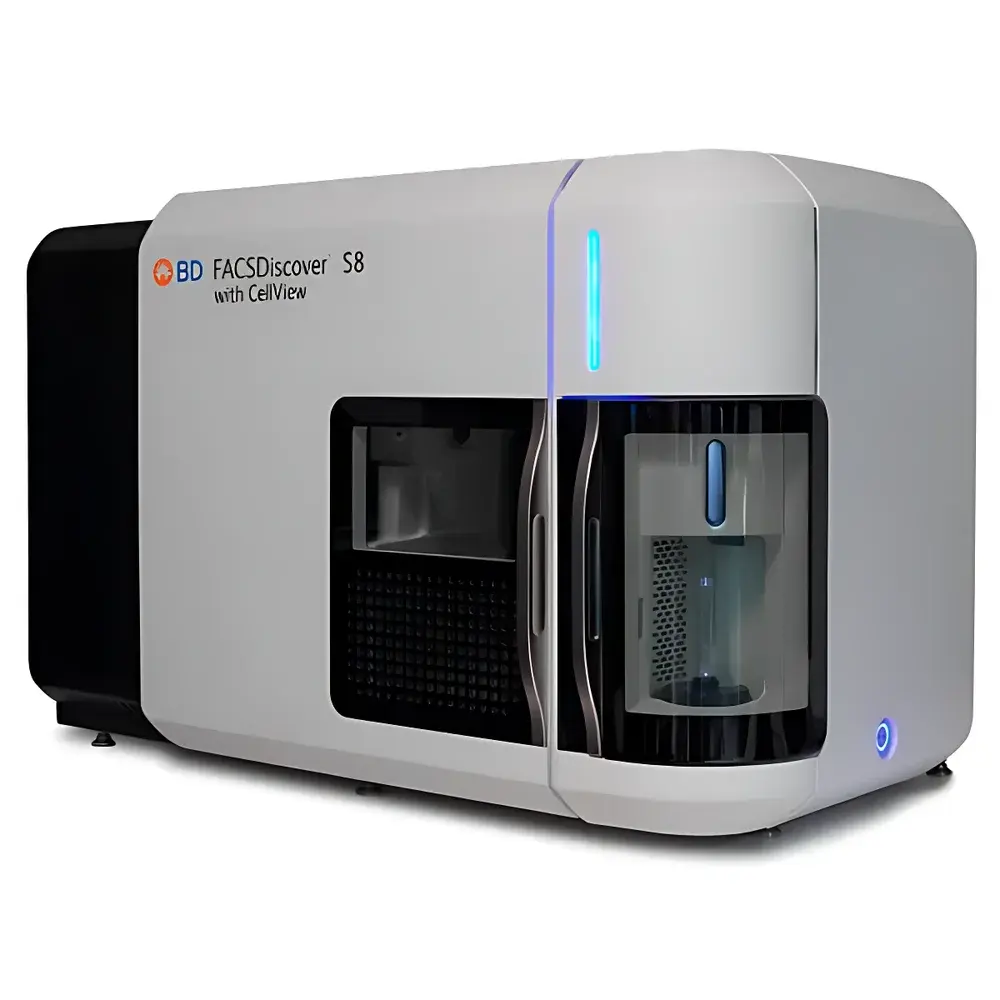
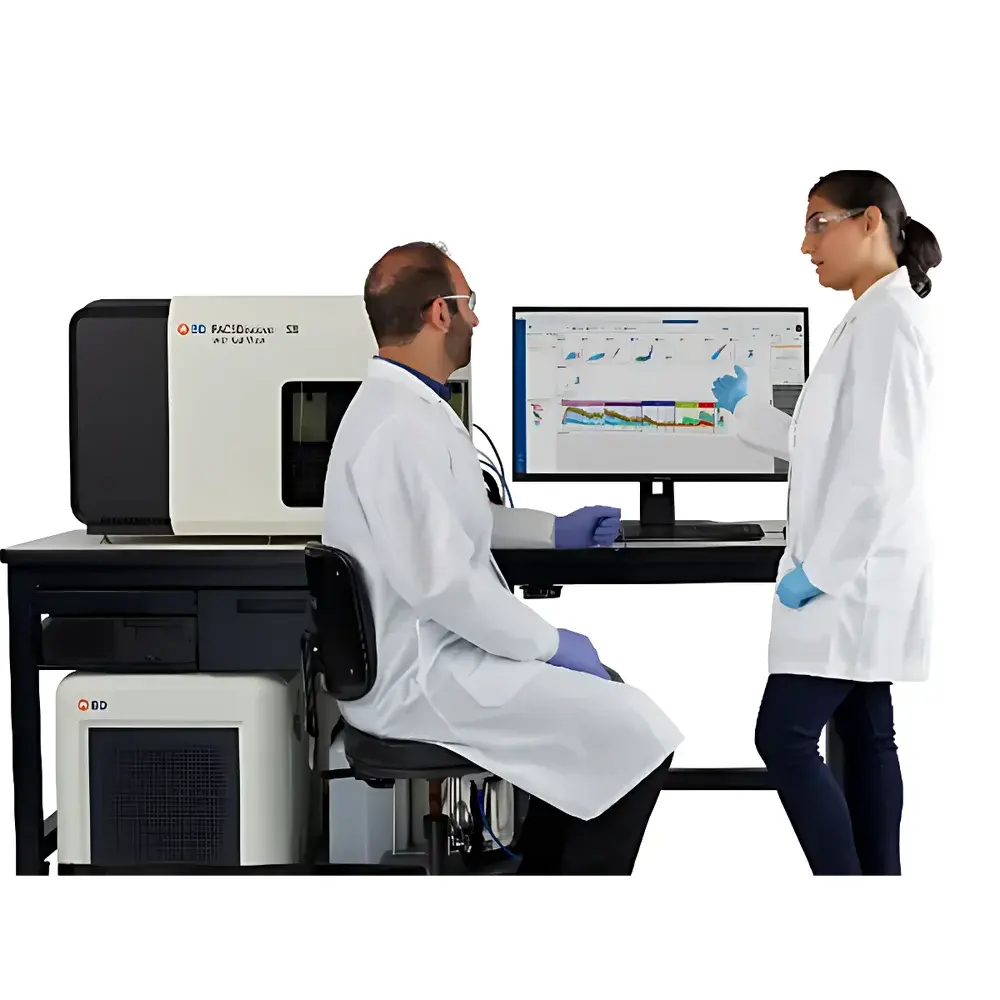
BD FACSDiscover™ S8 Real-Time Imaging Interactive Flow Cytometer
| Brand | BD |
|---|---|
| Origin | USA |
| Manufacturer Type | Original Equipment Manufacturer (OEM) |
| Product Category | Imported Instrument |
| Model | BD FACSDiscover™ S8 |
| Product Type | High-Parameter Imaging Flow Cytometer with Cell Sorting |
| Application Domain | Clinical Diagnostics, Translational Research, and GMP-Compliant Cell Therapy Development |
| Regulatory Compliance | FDA 510(k)-cleared, CE-IVD marked, compliant with ISO 13485 quality management system requirements |
| Software Validation | Supports 21 CFR Part 11-compliant audit trails, electronic signatures, and data integrity controls |
Overview
The BD FACSDiscover™ S8 is the world’s first and only integrated platform combining real-time high-speed imaging, full-spectrum flow cytometry, and automated high-purity cell sorting in a single instrument. Engineered for precision and reproducibility in demanding clinical and translational research environments, it operates on a dual-modality acquisition architecture: simultaneous spectral fluorescence detection and spatially resolved morphological imaging at flow rates exceeding 10,000 cells per second. Unlike conventional imaging flow cytometers limited to post-acquisition analysis, the BD FACSDiscover™ S8 enables live image-guided gating—where morphological features (e.g., nuclear texture, cytoplasmic granularity, cell–cell conjugates) directly inform real-time sorting decisions. This capability bridges a critical gap between phenotypic profiling and functional validation, supporting applications ranging from rare-cell isolation in liquid biopsies to clonal selection in CAR-T manufacturing under GLP/GMP-aligned workflows.
Key Features
- BD CellView™ Interactive Imaging Technology: Six synchronized image detectors capture brightfield, darkfield, and up to four fluorescence channels per cell at 10,000+ cells/sec. Image parameters—including area, aspect ratio, intensity gradient, and texture metrics—are computed in real time and fully integrated into gating hierarchies.
- BD SpectralFX™ Full-Spectrum Detection System: Five solid-state lasers (355, 405, 488, 561, 640 nm) excite fluorophores across 350–860 nm; 78 photodetectors collect unfiltered emission spectra. Proprietary spectral unmixing algorithms resolve >128 compatible dyes without manual compensation, while self-adjusting spread optimization maintains optimal signal-to-noise across variable sample quality and instrument drift.
- 6th-Generation Automated Sorting Architecture: Six-way electrostatic sorting with 95% recovery at 20,000 events/sec. The guided workflow engine auto-detects nozzle size, sheath pressure, and droplet delay—eliminating manual calibration steps—and enforces SOP-driven parameter locking for multi-user laboratories.
- Regulatory-Ready Software Stack: BD FACSDiva™ v10.2 includes pre-validated methods for clinical assays (e.g., lymphocyte subset enumeration per CLSI H42-A3), built-in IQ/OQ/PQ templates, and full traceability for FDA 21 CFR Part 11 compliance.
Sample Compatibility & Compliance
The BD FACSDiscover™ S8 accepts standard anticoagulated whole blood, PBMC suspensions, dissociated tissues, and cultured adherent cells—with minimal preprocessing required. It supports both fixed and live-cell assays using BD Horizon™ dyes, tandem conjugates, and polymer-based reagents validated for spectral compatibility. All optical and fluidic subsystems meet ISO 13485:2016 requirements for medical device manufacturing. Instrument qualification packages align with ICH Q5A(R2) for cell therapy product characterization and ASTM E2577-20 for flow cytometric assay validation. Data export formats (FCS 3.1, TIFF, CSV) ensure interoperability with LIMS and ELN systems in regulated environments.
Software & Data Management
BD FACSDiva™ software provides an integrated environment for acquisition, visualization, analysis, and reporting. Its image-aware analysis module supports pixel-level segmentation, object classification via supervised machine learning (trained on >50,000 annotated cell images), and correlation of morphometric features with spectral profiles. Audit trails log all user actions—including gate edits, compensation changes, and sort logic modifications—with timestamped digital signatures. Raw data files are encrypted at rest and support hash-based integrity verification. For enterprise deployment, BD Connect™ enables centralized instrument monitoring, remote diagnostics, and role-based access control across multi-site installations.
Applications
- Clinical immunophenotyping of hematologic malignancies with concurrent morphological validation of blast populations
- Isolation of antigen-specific T-cell clones for adoptive therapy development
- Characterization of extracellular vesicles by size, membrane asymmetry, and cargo content
- High-content screening of CRISPR-edited iPSC-derived cardiomyocytes
- Quantitative assessment of phagocytic activity in macrophage subsets
FAQ
Does the BD FACSDiscover™ S8 require specialized training for clinical operators?
No—its guided interface reduces operator dependency through context-aware prompts, auto-optimized acquisition settings, and SOP-enforced parameter constraints.
Can spectral unmixing be performed without reference controls?
Yes—the system includes a reference-free unmixing algorithm trained on empirical spectral libraries, though inclusion of spectral beads is recommended for highest accuracy in novel panel development.
Is raw image data stored alongside FCS files?
Yes—TIFF stacks containing all six detector channels are archived in parallel with event tables, enabling retrospective re-analysis with updated segmentation models.
How does the platform support regulatory submissions?
It provides complete documentation packages including design history files, risk assessments (ISO 14971), and validation protocols aligned with FDA guidance for flow cytometry-based companion diagnostics.
What maintenance intervals are required for clinical use?
Preventive maintenance is scheduled every 6 months; fluidic system validation (including droplet break-off stability and sort purity verification) must be performed before each clinical run per CAP/CLIA requirements.





