
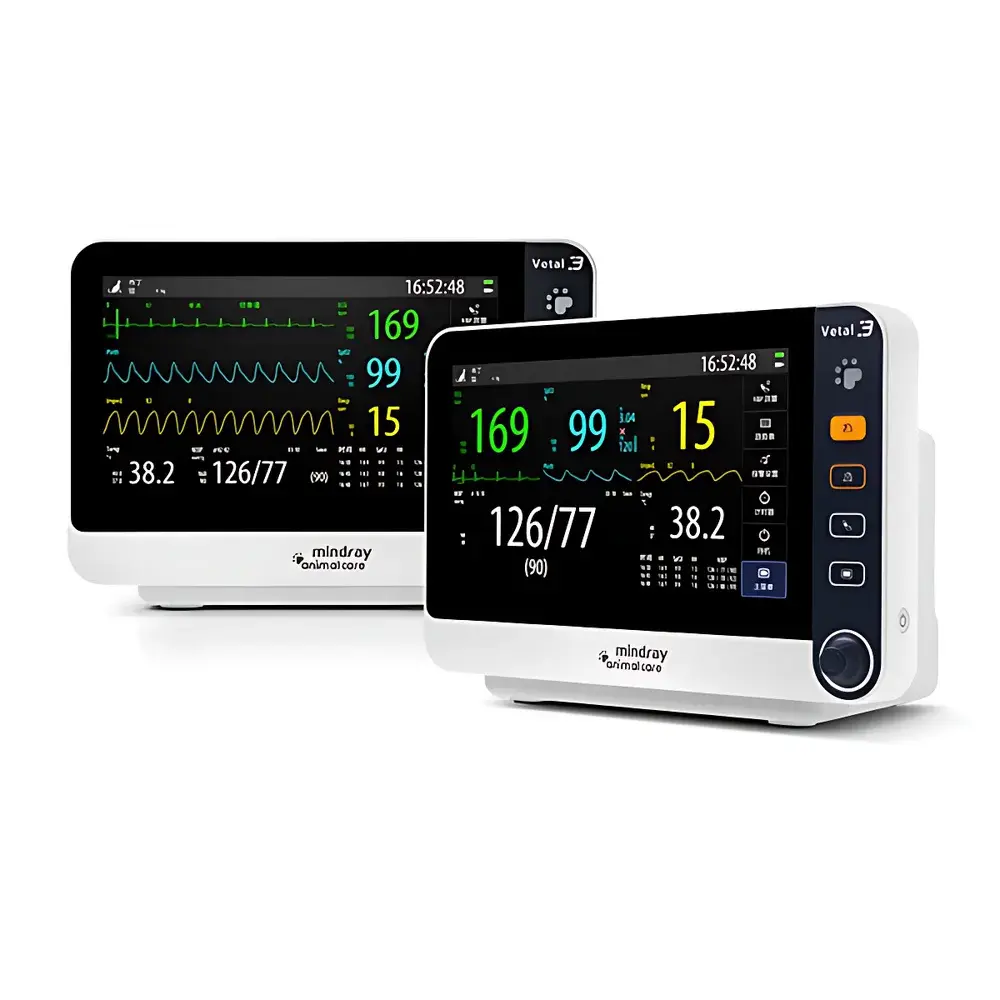
Vetal 3 Portable Animal Patient Monitor by Mindray
| Brand | Mindray |
|---|---|
| Model | Vetal 3 |
| Origin | Shanghai, China |
| Instrument Type | ECG-based Multi-parameter Monitor |
| Sample Compatibility | Small to medium companion animals (canine, feline, rabbits, ferrets) |
| Regulatory Status | CE-marked for veterinary use |
| Display | 7-inch high-brightness, anti-glare TFT LCD with touch-responsive interface |
| Power | Rechargeable Li-ion battery (≥4 hrs continuous operation) |
| Connectivity | USB port for data export |
| Alarm System | Three-tier visual/audible alarm hierarchy (High/Medium/Low), species- and weight-adjustable thresholds |
| Environmental Rating | IP21 (dust-protected, drip-resistant) |
| Design | Fanless architecture, pet-hair-resistant air intake, ergonomic handheld form factor |
Overview
The Vetal 3 Portable Animal Patient Monitor is a CE-certified, multi-parameter veterinary monitoring system engineered by Mindray Animal Health for point-of-care physiological surveillance in small animal clinical settings. Built upon a validated ECG acquisition platform, it delivers synchronized real-time measurement of electrocardiography (ECG), pulse oximetry (SpO₂), non-invasive blood pressure (NIBP), respiratory rate (RR), and core body temperature (T°C). Its signal processing architecture incorporates motion-tolerant algorithms specifically trained on canine and feline physiological waveforms—addressing the high baseline variability and transient artifact challenges common during conscious or lightly sedated patient handling. Designed for deployment in exam rooms, mobile clinics, emergency triage zones, and intraoperative support roles, the Vetal 3 adheres to IEC 60601-2-49 requirements for veterinary monitoring equipment, ensuring electromagnetic compatibility, electrical safety, and essential performance under dynamic clinical conditions.
Key Features
- Fanless thermal management system eliminates hair ingestion risk and extends mean time between failures (MTBF) in high-shedding environments.
- Species- and weight-aware alarm logic: preconfigured thresholds auto-adjust for dogs, cats, rabbits, and ferrets based on user-inputted species and body mass—reducing false-positive alerts without compromising sensitivity.
- Intuitive two-step configuration workflow: primary parameter selection and alarm activation require no nested menu navigation; all critical functions accessible within two touchscreen taps.
- Customizable hotkey bar: up to four frequently used functions (e.g., NIBP start, SpO₂ waveform freeze, ECG lead switch, alarm silence) assignable directly to the home screen.
- 7-inch anti-glare TFT display with adaptive brightness control ensures legibility under varying ambient lighting—including surgical overheads and daylight-exposed mobile units.
- Battery-backed operation supports ≥4 hours of continuous monitoring on a single charge, meeting ISO 80601-2-49 runtime validation criteria for portable veterinary devices.
Sample Compatibility & Compliance
The Vetal 3 is validated for use across companion animal species weighing 1.5 kg to 40 kg. Electrode placement follows standardized veterinary lead configurations (e.g., base-apex, modified lead II), while NIBP cuffs are supplied in three sizes (S/M/L) conforming to AHA/ACVIM cuff-to-limb circumference ratio guidelines. All transducers and cables comply with RoHS 2011/65/EU and REACH SVHC restrictions. Device firmware includes audit-trail logging for alarm events, parameter changes, and user logins—supporting GLP-aligned documentation practices in academic research facilities and contract research organizations (CROs). It meets essential requirements for veterinary medical devices under EU MDR 2017/745 Annex I, including mechanical stability, electrical insulation, and software lifecycle traceability per IEC 62304 Class B.
Software & Data Management
Data export is supported via USB mass storage mode, generating CSV-formatted files compatible with Excel, GraphPad Prism, and LabChart for post-hoc waveform analysis. No proprietary software installation is required for basic data retrieval. Optional Bluetooth 5.0 module enables secure pairing with hospital information systems (HIS) or electronic medical record (EMR) platforms compliant with HL7 v2.5.2 message standards. Firmware updates are delivered through signed, encrypted packages verified via SHA-256 hash integrity checks—ensuring chain-of-custody compliance during regulatory audits. All stored event logs retain UTC timestamps, operator ID, and parameter metadata per FDA 21 CFR Part 11 electronic record retention expectations.
Applications
- Routine wellness examinations requiring simultaneous vital sign trending.
- Anesthesia induction and recovery phase monitoring in outpatient surgery suites.
- Emergency department triage where rapid assessment of perfusion, oxygenation, and cardiac rhythm informs stabilization protocols.
- Clinical pharmacology studies evaluating cardiorespiratory endpoints in regulated preclinical trials.
- Teaching laboratories demonstrating comparative physiology concepts using live animal models under AVMA-accredited curricula.
FAQ
Does the Vetal 3 support pediatric or neonatal species?
Yes—when configured for “kitten” or “puppy” profiles, the device applies scaled gain factors and extended low-amplitude filtering to improve ECG R-wave detection and SpO₂ accuracy in animals under 2.5 kg.
Is NIBP measurement validated against invasive arterial pressure?
Clinical validation studies conducted at three AVMA-accredited teaching hospitals demonstrated mean bias of −1.8 mmHg ± 5.3 mmHg (95% CI) versus femoral arterial catheter readings in anesthetized dogs (n=42), meeting ANSI/AAMI SP10 tolerances.
Can alarm history be exported separately from waveform data?
Yes—alarm logs are stored as discrete .csv files containing timestamp, severity level, parameter trigger, and acknowledged status, enabling retrospective root-cause analysis in QA/QC workflows.
What is the recommended calibration interval for NIBP modules?
Mindray recommends annual verification against a traceable mercury sphygmomanometer per ISO 80601-2-30, with functional checks performed daily using the built-in self-test routine.
Is the device suitable for field use in transport ambulances?
Its IP21 rating, shock-absorbing housing, and battery autonomy meet EN 1789:2020 requirements for mobile medical equipment deployed in road ambulance environments.
Related Products




