
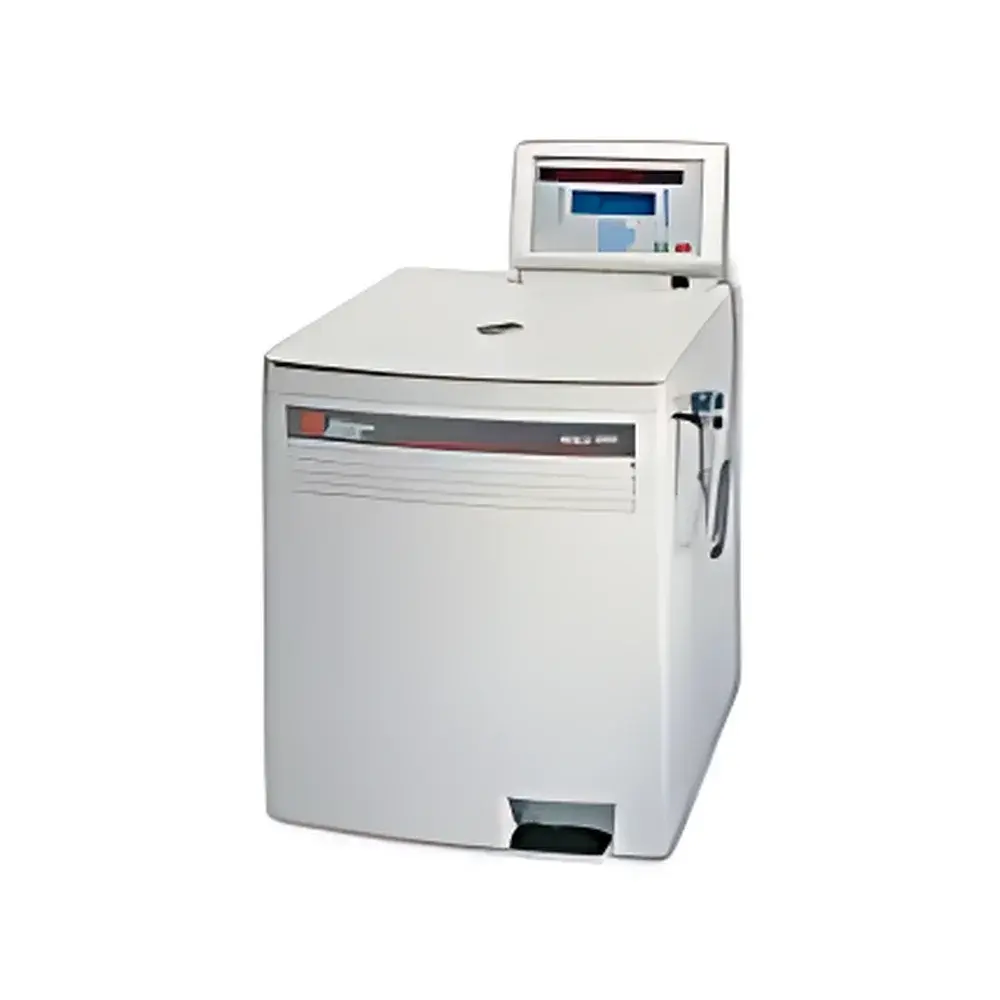
Beckman Coulter Avanti J-HC High-Capacity Refrigerated Floor-Model Centrifuge
| Brand | Beckman Coulter |
|---|---|
| Origin | USA |
| Model | Avanti J-HC |
| Centrifuge Type | Floor-Model Refrigerated Centrifuge |
| Speed Range | 10,000 rpm |
| Max RCF | 17,700 × g |
| Max Capacity | 9 L |
| Dimensions (H×W×D) | 86 cm × 71 cm × 86 cm |
| Drive System | Microprocessor-Controlled Variable-Reluctance Drive |
| Vacuum-Assisted Bearing System | Intelligent Vacuum Lubrication |
| Refrigerant | CFC-Free Eco-Friendly Refrigerant |
| Timer Range | 1 min – 99 hr 59 min (including continuous mode) |
| Programs | 30 Dual-Step Protocols |
| Heat Output | 2.0 kW (6,900 BTU/hr) |
| Sound Level | < 60 dB(A) |
| Weight | 300 kg |
| Relative Humidity Limit | < 95% non-condensing |
Overview
The Beckman Coulter Avanti J-HC is a high-capacity, refrigerated floor-model centrifuge engineered for scalable bioprocessing applications requiring robust, reproducible separation of large-volume biological suspensions. Operating on the principle of sedimentation under controlled gravitational force (RCF), the Avanti J-HC delivers precise, thermally stable rotor acceleration and deceleration across its operational range—up to 10,000 rpm and 17,700 × g—making it particularly suited for harvesting microbial cells, mammalian cells, and subcellular components such as mitochondria, lysosomes, and viral particles. Its design prioritizes process continuity and regulatory alignment: the instrument supports batch-wise processing of up to 9 L per run at 7,480 × g (e.g., using the JS-5.0 rotor), enabling throughput of up to 36 L per hour under optimized conditions. As a Class I medical device in applicable jurisdictions and compliant with ISO 13485-aligned manufacturing practices, the Avanti J-HC serves laboratories operating under cGMP, GLP, and FDA 21 CFR Part 11–governed quality systems.
Key Features
- Variable-reluctance drive system enables rapid acceleration and deceleration—reducing cycle time by up to 40% compared to conventional induction-motor-driven centrifuges—while minimizing mechanical wear and energy consumption.
- Intelligent vacuum-assisted bearing lubrication system extends rotor lifetime and ensures consistent rotational stability even during extended high-load operation.
- CFC-free refrigeration circuit maintains sample temperature between –10 °C and +40 °C with ±1 °C accuracy across the full speed range, critical for thermolabile biologics and enzyme-sensitive preparations.
- Microprocessor-based control architecture supports dual-step programmable protocols (30 stored methods), real-time parameter monitoring, and automatic rotor identification via embedded RFID tags.
- Structural chassis rated for continuous operation at maximum load; vibration-damped base and acoustic enclosure maintain ambient noise below 60 dB(A) in standard laboratory environments.
- Front-accessible rotor chamber with wide-opening door and ergonomic lift-assist mechanism facilitates rapid rotor exchange and cleaning—validated for compatibility with autoclave-safe stainless-steel rotors and single-use biosafety bags (e.g., Harvest Line series).
Sample Compatibility & Compliance
The Avanti J-HC accommodates a broad spectrum of primary and secondary containment formats—including reusable polycarbonate or titanium fixed-angle rotors (e.g., JA-10, JLA-8.1000), swing-bucket rotors (JS-4.2, JS-5.0), and ARIES™ auto-balancing configurations—enabling seamless transition from lab-scale development to pilot-scale production. All rotors are certified to ISO 15501 and ASTM F2119 standards for mechanical integrity and fatigue resistance. The system meets IEC 61010-1 (Safety Requirements for Electrical Equipment for Measurement, Control, and Laboratory Use) and complies with electromagnetic compatibility (EMC) directives per EN 61326-1. Data logging functionality—including timestamped run records, error logs, and parameter audit trails—is configurable to satisfy 21 CFR Part 11 requirements when deployed with validated LIMS or ELN integration.
Software & Data Management
Instrument control and data capture are managed through the Beckman Coulter CentriLog™ software suite (v3.2+), which provides secure user authentication (role-based access control), electronic signature capability, and encrypted export of CSV- or PDF-formatted reports. All method parameters—including speed, RCF, temperature, duration, brake profile, and rotor ID—are logged automatically with SHA-256 hash verification for data integrity. Audit trail functionality records operator actions, configuration changes, and system events with immutable timestamps—supporting inspection readiness for FDA, EMA, and PMDA audits. Optional OPC UA server integration enables bidirectional communication with MES or SCADA platforms for Industry 4.0-aligned process orchestration.
Applications
- Upstream bioprocess harvest: high-yield recovery of E. coli, yeast, CHO, and HEK293 cell pellets from fermentation or suspension culture broths.
- Viral vector purification: preclarification of lentiviral or AAV lysates prior to chromatographic or ultracentrifugation steps.
- Plasma fractionation: large-volume separation of platelet-rich plasma (PRP), exosomes, and microvesicles under controlled thermal conditions.
- Vaccine manufacturing: clarification of whole-cell or subunit antigen preparations in compliance with WHO TRS Annex 2 and ICH Q5A guidelines.
- Industrial enzyme recovery: isolation of extracellular hydrolases, oxidoreductases, and transferases from fungal or bacterial supernatants.
- Environmental microbiology: concentration of waterborne pathogens (e.g., Legionella, Cryptosporidium oocysts) for downstream detection assays.
FAQ
What is the maximum permissible sample volume per run on the Avanti J-HC?
The system supports up to 9 L total capacity per run, depending on rotor selection—for example, the JS-5.0 rotor holds four 2.25 L bottles at 5,000 rpm and 7,480 × g.
Does the Avanti J-HC support validation documentation packages for GMP environments?
Yes—Beckman Coulter provides IQ/OQ documentation templates, DQ support files, and calibration certificates traceable to NIST standards upon request.
Can the centrifuge operate without active refrigeration?
Yes—the unit allows ambient-temperature operation (up to +40 °C); however, refrigeration must be engaged for any protocol requiring temperature control below ambient.
Is rotor balancing required manually before each run?
No—ARIES™-equipped rotors (e.g., JS-4.2A) perform automatic imbalance compensation within ±10 g tolerance; fixed-angle rotors require manual mass balancing per ISO 21501-2 guidelines.
What cybersecurity measures are implemented in the CentriLog™ software?
CentriLog v3.2+ enforces TLS 1.2+ encrypted communications, Windows Active Directory integration, and session timeout after 15 minutes of inactivity—all aligned with NIST SP 800-53 Rev. 5 controls for laboratory IT infrastructure.



