
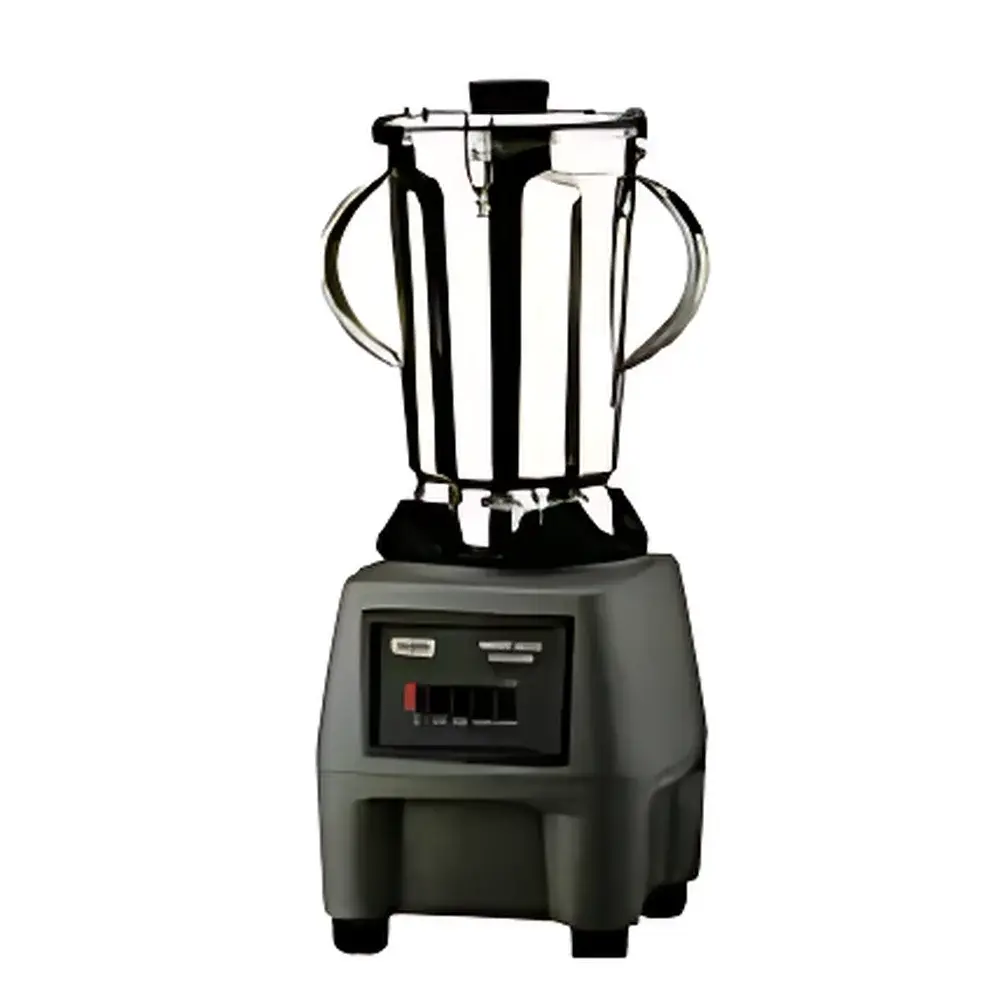
Waring CB15E 4L Heavy-Duty Laboratory Homogenizer
| Brand | Waring |
|---|---|
| Origin | USA |
| Model | CB15E |
| Capacity | 4 L |
| Motor Power | 3.75 HP |
| Speed Range | 0–21,500 rpm (5-step: Off–Low–Medium–High–Pulse) |
| Construction | Stainless Steel Vessel & Blades, Epoxy-Coated Base, High-Performance Spherical Bearings |
| Compliance | UL, NSF, CE Certified |
| Noise Level | Industry-Leading Low-Noise Operation |
| Stability | Wide-Base Rubber Non-Slip Feet |
| Dimensions (H) | 56.5 cm |
| Net Weight | 17.24 kg |
| Electrical | 230 V, 50/60 Hz, Single-Phase AC, 7.5 A |
| Accessories Available | Temperature Controller (2610T4L), Foam Suppressor (2610F), Cooling Base (2610C4L), Dual-Handle Vessels (CAC70/CAC72), Heat-Resistant Polycarbonate Lid (017442), Stainless Steel Lid (501697), Carbide-Tipped Blade Assembly with Synthetic Rubber Seal (CBL10), 4L Adapter (AD1) |
Overview
The Waring CB15E 4L Heavy-Duty Laboratory Homogenizer is an engineered solution for high-volume, high-shear mechanical homogenization of heterogeneous biological, pharmaceutical, food, and chemical samples. Based on high-speed rotor-stator shearing mechanics, the system delivers consistent particle size reduction through controlled fluid dynamics—generating intense cavitation, turbulent flow, and mechanical impact within the stainless steel vessel. Designed for reproducible batch processing of up to 4 liters per cycle, the CB15E operates across a calibrated speed range (0–21,500 rpm) with five discrete settings—including a dedicated pulse mode—to accommodate variable sample rheology and thermal sensitivity. Its sealed spherical bearing architecture, precision-machined stainless steel cutting assembly, and vibration-damped epoxy-coated base ensure long-term operational stability under repeated load cycling—a critical requirement for GLP-compliant laboratories performing routine tissue homogenization, emulsion preparation, or cell lysis protocols.
Key Features
- 3.75 HP brushless induction motor delivering sustained torque at all speed settings, optimized for low acoustic emission without compromising shear intensity
- Ergonomic dual-handle stainless steel vessel (CAC70/CAC72 options) enabling safe manual handling, controlled pouring, and rapid cleaning between batches
- Five-position control panel (Off–Low–Medium–High–Pulse) with tactile feedback and fail-safe interlock circuitry preventing unintended activation
- Deep-profile non-slip rubber feet providing enhanced static and dynamic stability during high-RPM operation, minimizing lateral displacement and resonance
- Sealed high-load spherical bearing system rated for >10,000 hours MTBF, eliminating lubrication maintenance and reducing particulate contamination risk
- UL-, NSF-, and CE-certified electrical architecture compliant with IEC 61010-1 safety standards for laboratory equipment in regulated environments
Sample Compatibility & Compliance
The CB15E accommodates hard-to-process biological matrices including fibrous plant tissues, frozen animal organs, hydrated hydrogels, and viscous suspensions. Its robust blade geometry and high tip-speed capability support effective disruption of cellular structures while maintaining sample integrity for downstream nucleic acid or protein extraction. The system meets key regulatory expectations for equipment qualification: documented design traceability, repeatable performance verification via RPM calibration logs, and compatibility with standard validation protocols (e.g., IQ/OQ/PQ). When integrated with optional accessories—such as the 2610C4L cooling base or 2610T4L temperature controller—the unit supports thermally sensitive applications aligned with USP , ISO 13485, and FDA 21 CFR Part 11 data integrity requirements when paired with validated software interfaces.
Software & Data Management
While the CB15E operates as a standalone analog-controlled instrument, its modular architecture enables integration into networked lab environments via third-party digital controllers (e.g., LabVIEW-compatible DAQ modules or PLC-based supervisory systems). Optional accessories like the 2610T4L temperature controller provide analog output signals (0–10 V or 4–20 mA) suitable for time-stamped logging in LIMS or ELN platforms. All operational parameters—including runtime, speed setting, and pulse duration—are manually recorded per batch; for full audit trail compliance, users may implement standardized SOPs requiring operator sign-off and timestamped entry into electronic batch records.
Applications
- Life Sciences: Homogenization of liver, brain, muscle, and tumor tissues for proteomic profiling, RNA-seq library prep, and immunoassay antigen extraction
- Pharmaceutical Development: Preparation of suspension formulations, wet granulation intermediates, and excipient-blend uniformity testing per USP <<1059>
- Food & Beverage R&D: Emulsification of dairy-based sauces, dispersion of functional ingredients in plant-based meat analogs, and viscosity stabilization trials
- Chemical Processing: Production of colloidal dispersions, polymer blend homogenization, and catalyst slurry conditioning prior to filtration or spray drying
- Clinical Diagnostics: Standardized lysis of whole blood, saliva, or swab specimens for molecular pathogen detection workflows
FAQ
What types of samples are compatible with the CB15E’s 4L capacity?
The system is validated for semi-solid and viscous biological matrices (e.g., minced tissue, organ homogenates, yeast pastes) and non-corrosive chemical slurries. Avoid highly abrasive solids or materials exceeding Shore D 80 hardness.
Is the CB15E suitable for GMP-regulated manufacturing environments?
Yes—when operated per documented SOPs and maintained according to Waring’s service schedule, the CB15E supports equipment qualification activities required under Annex 15 and EU GMP guidelines.
Can the unit be validated for temperature-sensitive protocols?
With the optional 2610C4L cooling base or external recirculating chiller integration, temperature control within ±2°C is achievable over 30-minute continuous operation.
What maintenance intervals are recommended for the spherical bearing system?
No scheduled lubrication is required; annual visual inspection of bearing housing seals and blade concentricity is advised per Waring Technical Bulletin TB-CB15E-03.
Are replacement blades available with alternative metallurgy?
Yes—carbide-tipped blade assemblies (CBL10) are offered for extended service life when processing silica-rich or mineral-loaded samples.



