
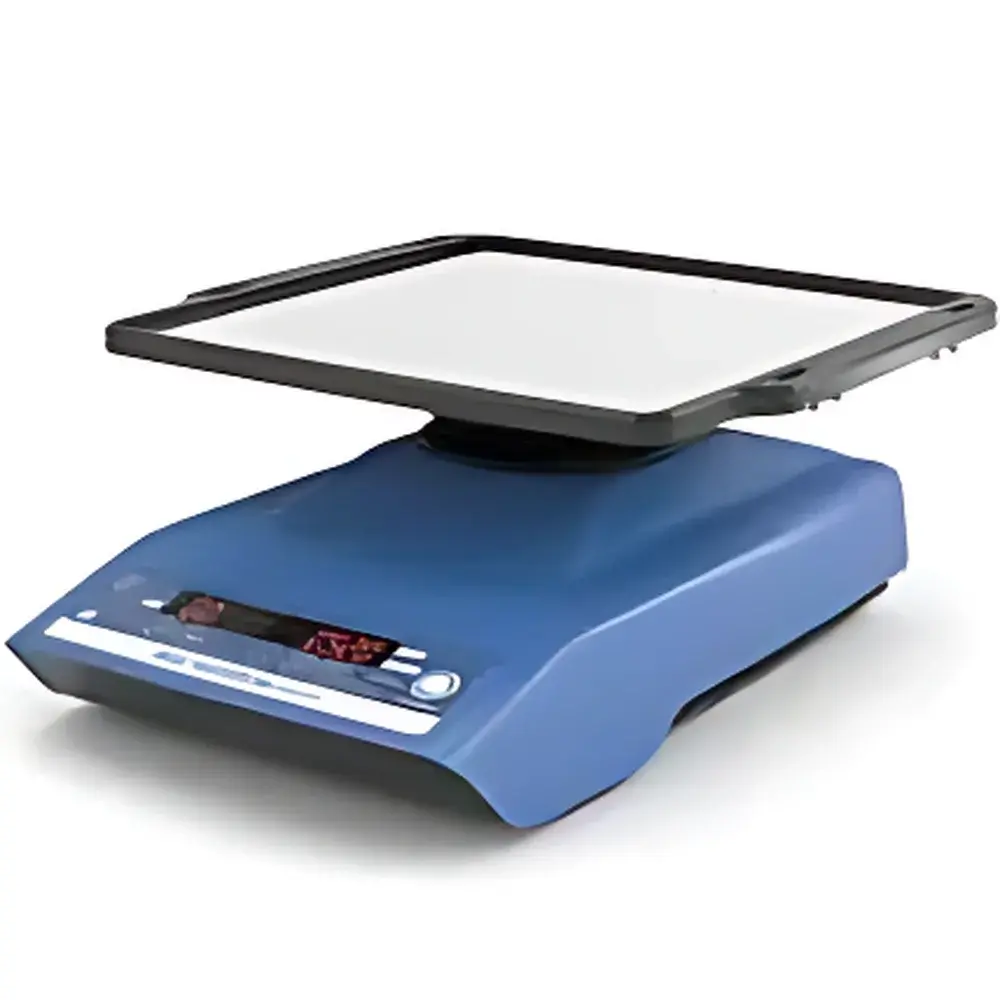
IKA ROCKER 3D digital Rocking Mixer
| Brand | IKA |
|---|---|
| Origin | Germany |
| Model | ROCKER 3D digital |
| Timer Range | 1–5999 s |
| Oscillation Speed | 0–80 rpm |
| Oscillation Amplitude | 30 mm |
| Temperature Range | 4–50 °C |
| Platform Quantity | 1 |
| Input Power | 24 W |
| Dimensions (W×D×H) | 280 × 185 × 330 mm |
| Weight | 2.3 kg |
| Protection Rating | IP21 |
| Operating Ambient Temperature | 4–50 °C |
| Relative Humidity Limit | 80 % |
| Voltage | 100–240 V AC, 50/60 Hz |
| Tilt Angle Adjustment | 0–15° |
| Max Load Capacity (incl. clamps) | 2 kg |
| Speed Resolution | 1 rpm |
| Display | LED 7-segment |
| Control Interface | Touch-sensitive buttons |
| Continuous Operation | 100 % duty cycle |
| Platform Stackable | Yes (height per layer: 30 mm) |
| Slip-resistant Rubber Mat | Included |
| Error Code Indication | Yes |
Overview
The IKA ROCKER 3D digital is a precision-engineered rocking mixer designed for gentle, uniform sample homogenization in life science laboratories. Unlike orbital or vortex shakers, it employs a controlled 3D rocking motion—combining longitudinal tilting and lateral oscillation—to generate low-shear, laminar fluid displacement ideal for delicate biological samples. This motion mimics natural sedimentation and diffusion dynamics, minimizing cellular stress, preventing foam formation, and ensuring reproducible mixing across heterogeneous suspensions. The device operates within a temperature-compatible range of 4–50 °C, enabling direct integration into incubators or cold rooms without thermal interference. Its robust brushless DC motor maintains consistent rotational velocity under variable load conditions and minor line voltage fluctuations—a critical feature for long-duration protocols such as overnight hybridization or slow-phase cell dissociation.
Key Features
- Gentle 3D rocking motion with adjustable tilt angle (0–15°) and amplitude (30 mm), optimized for shear-sensitive applications including primary cell handling and nucleic acid isolation.
- Digital speed control from 0 to 80 rpm in 1-rpm increments, displayed on a high-contrast 7-segment LED screen for real-time monitoring and repeatability.
- Precision timer with programmable duration from 1 second to 5999 seconds (up to 1 h 40 min), supporting both timed and continuous operation modes.
- Touch-sensitive control panel with intuitive interface; no mechanical switches to wear out over time.
- Integrated error code display for rapid diagnostics—including motor stall, overtemperature, or power anomaly detection.
- Stackable platform design (30 mm vertical spacing per unit) enables space-efficient multi-tier configurations in constrained lab environments.
- Included anti-slip rubber mat ensures stable placement on smooth surfaces and prevents migration during extended runs.
- Compliant with DIN EN 60529 IP21 rating for protection against vertically falling droplets and solid objects ≥12.5 mm—suitable for standard laboratory bench use.
Sample Compatibility & Compliance
The ROCKER 3D digital accommodates a broad range of standard labware: Erlenmeyer flasks (up to 1 L), tissue culture flasks (T25–T175), Petri dishes (up to 150 mm diameter), microcentrifuge tubes (in compatible holders), and multi-well plates (with optional plate clamps). Its low-vibration architecture meets ISO 14644-1 Class 8 cleanroom compatibility requirements when operated outside containment enclosures. While not certified for GMP manufacturing environments, the instrument supports GLP-aligned workflows through traceable parameter logging (when paired with external data acquisition systems) and adheres to general electrical safety standards per IEC 61010-1. It is routinely deployed in academic and industrial labs performing protocols referenced in ISO 15189, CLSI EP15-A3, and USP for reagent mixing validation.
Software & Data Management
The ROCKER 3D digital operates as a standalone hardware platform with no embedded software stack, USB, RS232, or analog output interfaces. All operational parameters are set locally via tactile controls and retained in non-volatile memory across power cycles. For laboratories requiring electronic record retention, third-party environmental monitoring systems (e.g., TempTale, DicksonOne) may be used to log ambient temperature and runtime metadata adjacent to the unit. Though lacking FDA 21 CFR Part 11-compliant audit trails natively, its deterministic behavior—fixed speed resolution, repeatable timing, and visible error codes—facilitates manual SOP compliance documentation per ALCOA+ principles (Attributable, Legible, Contemporaneous, Original, Accurate).
Applications
- Cell culture maintenance: Uniform suspension of adherent cells during passaging and gentle resuspension post-trypsinization.
- Nucleic acid purification: Efficient lysis buffer mixing and binding/wash step agitation in column- and magnetic bead-based DNA/RNA extraction kits.
- Immunostaining and histochemistry: Consistent antibody incubation and wash steps across slides and membrane blots.
- Protein blotting: Enhanced transfer efficiency during semi-dry and wet electroblotting procedures.
- Enzyme kinetics assays: Controlled reagent mixing prior to spectrophotometric or fluorometric measurement initiation.
- Cold-chain sample equilibration: Gradual temperature adjustment of cryopreserved samples within 4–10 °C refrigerated environments.
FAQ
Can the ROCKER 3D digital be used inside a CO₂ incubator?
Yes—it is rated for continuous operation at 4–50 °C and 80 % relative humidity, making it suitable for placement inside standard humidified CO₂ incubators. Ensure adequate ventilation around the unit to prevent localized heat buildup.
Is it possible to synchronize multiple units for parallel processing?
No native synchronization protocol exists; however, identical timing and speed settings can be manually replicated across units for batch consistency.
What is the maximum flask size supported without custom clamps?
Standard configuration supports up to 1 L Erlenmeyer flasks using the included universal clamp; larger vessels require optional heavy-duty fixtures.
Does the device retain settings after power interruption?
Yes—speed, timer value, and mode selection are stored in non-volatile memory and restored upon reboot.
How often does maintenance require servicing?
Under normal use, no scheduled maintenance is required beyond periodic cleaning of the platform surface and inspection of the rubber mat integrity every 6 months.




