
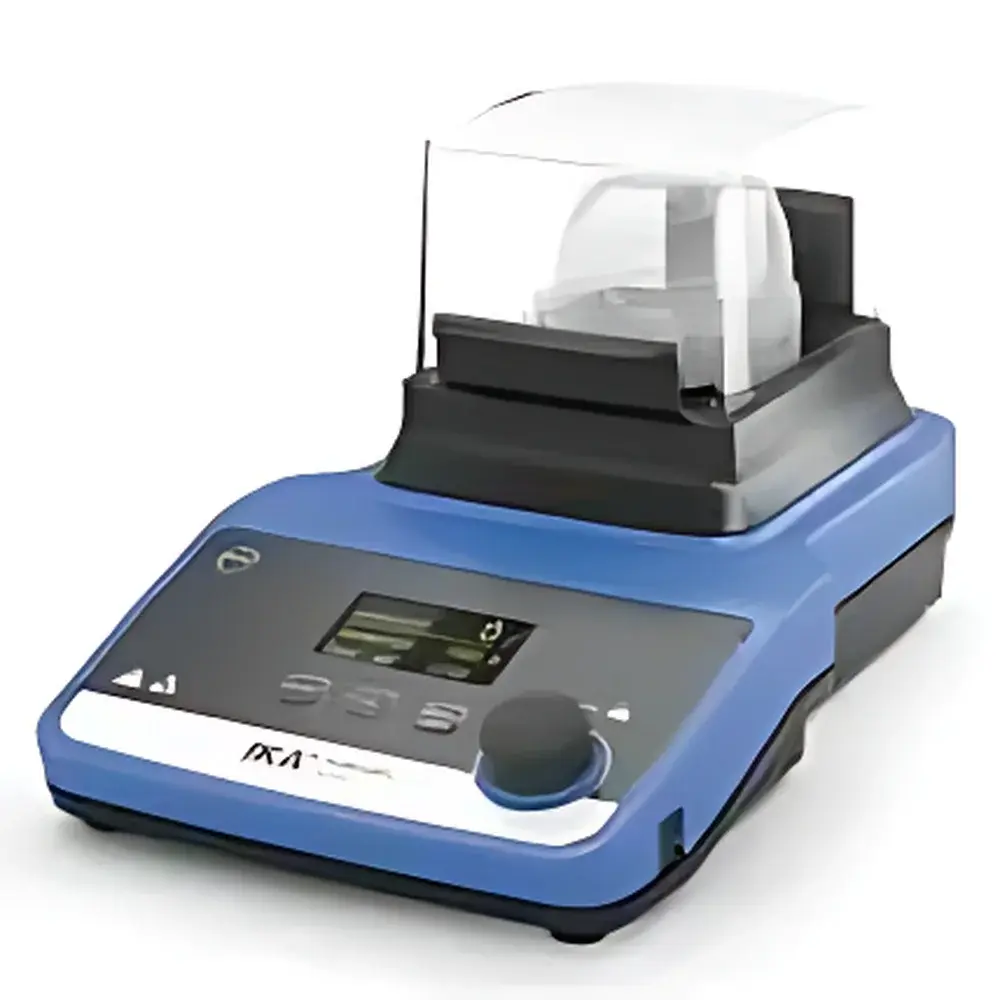
IKA Tube Mill control Batch-Mode Tube Grinder
| Brand | IKA |
|---|---|
| Origin | Germany |
| Model | Tube Mill control |
| Instrument Type | Grinder |
| Sample Type | Soft to moderately hard (up to 5 Mohs) |
| Feed Size | ≤10 mm |
| Output Particle Size | ≥0.5 mm |
| Batch Volume | 40 mL |
| Speed Range | 5,000–25,000 rpm |
| Motor Output Power | 80 W |
| Input Power | 100 W |
| Max. Peripheral Speed | 65 m/s |
| Cooling Options | Dry ice compatible (grinding chamber), not liquid nitrogen |
| Dimensions (W×D×H) | 180 × 170 × 300 mm |
| Weight | 2.7 kg |
| Ambient Operating Conditions | 5–40 °C, ≤80% RH |
| Protection Rating | IP30 |
| Interface | USB (for remote control & data logging), no RS232 or analog output |
| Voltage/Frequency | 100–120 V / 220–240 V, 50/60 Hz |
Overview
The IKA Tube Mill control is a precision-engineered, batch-mode tube grinder designed for reproducible, contamination-free comminution of soft to moderately hard biological and organic samples in research and quality control laboratories. Its operating principle combines high-speed rotational shear and impact forces generated by a stainless steel 1.4034 cutting head rotating within a disposable polycarbonate grinding cup. The system employs a sealed, interlocked architecture where mechanical operation is only enabled when the transparent safety cover is fully closed and the grinding cup is correctly seated—ensuring compliance with IEC 61000-6-2 (EMC) and basic functional safety requirements for laboratory equipment. With a maximum hardness tolerance of 5 Mohs and feed particle size up to 10 mm, it is especially suited for seed processing (e.g., maize, wheat), plant tissues, dried herbs, polymers, and pharmaceutical excipients. Unlike continuous-feed mills, its batch design enables strict sample traceability, full process visibility through optically clear consumables, and elimination of carryover between runs—critical for GLP-compliant workflows.
Key Features
- Interlocked safety system: Operation permitted only when safety cover is closed and grinding cup is properly installed; immediate motor stop if cover is opened mid-cycle
- Disposable polycarbonate grinding cups and lids: Eliminate cross-contamination and reduce cleaning validation burden—ideal for regulated environments
- OLED multi-language display with intuitive touch controls: Supports real-time parameter monitoring and error code diagnostics (e.g., E01 = cup misalignment, E03 = overtemperature)
- Programmable operation: Adjustable speed (5,000–25,000 rpm, ±500 rpm accuracy), time (5 s–3 min), safety speed limit, and safety time limit; up to 10 user-defined protocols stored internally
- Dust-tight labyrinth seal between motor shaft and grinding chamber: Prevents particulate ingress into drive components and minimizes airborne dust emission (IP30-rated enclosure)
- Dry ice-compatible grinding chamber cooling: Enables cryogenic grinding of thermolabile samples without liquid nitrogen integration risks
- Low-noise operation (<65 dB(A) at 1 m): Achieved via balanced rotor dynamics and vibration-damped housing—suitable for shared lab spaces
- USB interface for firmware updates, remote start/stop, and timestamped data export (speed, duration, error logs) compatible with LIMS and ELN systems
Sample Compatibility & Compliance
The Tube Mill control accommodates a defined range of sample physical properties: dry, brittle, or fibrous materials with Mohs hardness ≤5—including cereal grains, freeze-dried cells, mycelia, starch granules, and certain pharmaceutical tablets. It is not intended for wet, oily, highly elastic, or abrasive mineral samples exceeding its hardness threshold. All consumables comply with EU Regulation (EC) No 1935/2004 for food-contact materials. While not certified to ISO/IEC 17025, the instrument supports method validation per ASTM D7482 (standard practice for grinding of botanicals) and USP <1172> on particle size reduction. Its programmable parameters and audit-ready USB log files facilitate alignment with FDA 21 CFR Part 11 requirements when integrated into validated electronic record systems.
Software & Data Management
No proprietary software installation is required. The built-in USB interface exposes the device as a virtual COM port, enabling direct communication with custom Python, LabVIEW, or MATLAB scripts for automated protocol execution and metadata capture. Timestamped operational logs—including start/stop time, set speed, actual speed profile (sampled at 10 Hz), elapsed runtime, and fault events—are exported as CSV files. These records support retrospective analysis, deviation investigation, and audit trail generation for internal QA reviews or regulatory inspections. Firmware updates are delivered via signed .bin files through the same interface, with version rollback capability and checksum verification.
Applications
- Routine homogenization of cereal seeds prior to DNA extraction or NIR spectroscopy
- Preparation of uniform powder blends for dissolution testing (USP <711>)
- Particle size reduction of botanical extracts for HPLC sample preparation
- High-reproducibility grinding of reference standards used in calibration workflows
- Cryogenic milling of temperature-sensitive biopolymers using dry ice–cooled chambers
- QC release testing of herbal powder consistency across manufacturing batches
FAQ
Is the Tube Mill control suitable for grinding wet or pasty samples?
No. It is engineered exclusively for dry, free-flowing, or friable solids. Moisture content above 10% may cause caking, uneven grinding, and motor overload.
Can I use non-IKA grinding cups?
No. Only original IKA-certified polycarbonate cups (Cat. No. 0002120000) ensure dimensional accuracy, thermal stability, and proper interlock engagement—substitution voids warranty and compromises safety compliance.
Does the device meet FDA 21 CFR Part 11 requirements?
The hardware and firmware provide foundational capabilities (audit trails, electronic signatures via external systems, data integrity safeguards); however, full Part 11 compliance depends on how the device is deployed within your validated IT infrastructure and procedural controls.
What maintenance is required?
Annual visual inspection of the labyrinth seal and cutting head wear; no routine lubrication needed. Replace cutting head after ~500 h of cumulative operation or if visible pitting occurs.
Is remote monitoring possible without a PC?
No. Real-time remote control and data logging require a host computer connected via USB. Standalone operation uses only onboard programming and OLED feedback.
Related Products



