
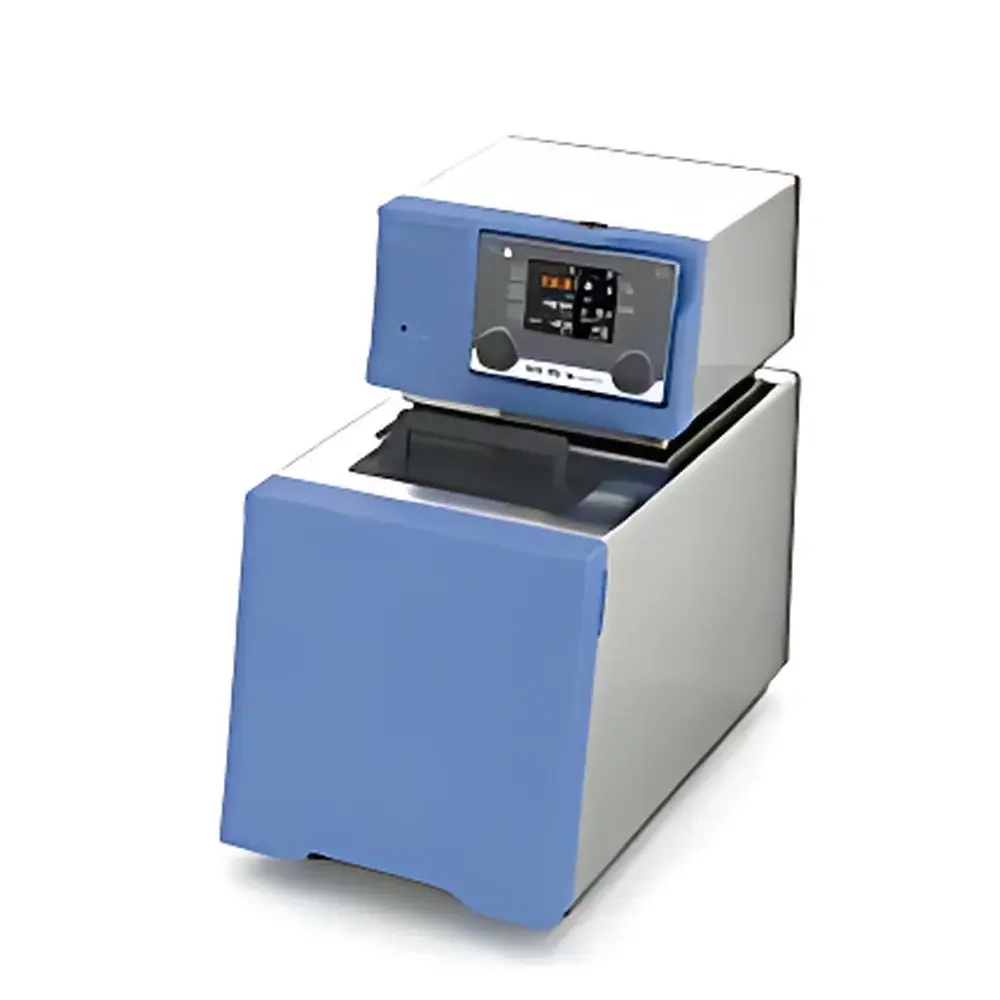
IKA HBC 10 Controlled Heating Circulator
| Brand | IKA |
|---|---|
| Origin | Germany |
| Model | HBC 10 |
| Instrument Type | Constant-Temperature Bath Circulator |
| Circulation Mode | Internal Circulation Only |
| Temperature Control | Heating-Only |
| Bath Volume | 11 L |
| Temperature Range | 0–260 °C |
| Temperature Stability | ±0.1 K |
| Display | Color TFT Screen |
| Pump Type | Adjustable Pressure/Suction Pump |
| Integrated Cooling Coil | Yes |
| Safety Circuit | Adjustable |
| Safety Certification | DIN 12876 Class III (FL), UL Listed |
| Sensor Included | PT100 Resistance Thermometer |
| Timer Range | 0–99 h 59 min |
| Communication Interfaces | USB, RS232 |
| Remote Control | WiCo Wireless Controller (up to 10 m range) |
| Drain Valve | Integrated |
| Alarm System | Visual and Audible |
Overview
The IKA HBC 10 Controlled Heating Circulator is a precision-engineered thermal management system designed for laboratory applications requiring stable, controllable heating of external equipment or internal bath media. Operating on resistive heating principles with integrated thermal feedback via a calibrated PT100 sensor, the HBC 10 delivers high reproducibility in temperature maintenance across a wide operational range—from ambient up to 260 °C. Its stainless-steel bath construction ensures chemical resistance and long-term structural integrity under prolonged thermal stress. Unlike open-bath heaters, the HBC 10 incorporates an internal circulation pump and an integrated cooling coil, enabling dynamic heat dissipation during overshoot correction or process cooldown phases—critical for applications where thermal inertia must be actively managed. The unit complies with DIN 12876-1 Class III (FL) safety standards for flammable liquid handling, reflecting its suitability for use with silicone oils, glycols, and other high-boiling-point heat transfer fluids.
Key Features
- Stainless-steel bath tank (11 L capacity) with integrated drain valve and hose connection for safe, contact-free fluid removal
- Color TFT display showing real-time values for setpoint/actual temperature, pump speed, bath level, and active safety limit
- WiCo wireless controller enabling remote operation up to 10 meters—ideal for use inside fume hoods or behind shielding barriers
- Adjustable pressure/suction pump with continuous speed regulation for optimized flow dynamics in closed-loop external systems
- Dual-mode temperature control: seamless switching between internal bath regulation and external jacket/sensor feedback mode
- Programmable electronic timer (0–99 h 59 min) with automatic shutdown and alarm-triggered hold functionality
- Configurable safety circuit with user-defined upper temperature limit and independent hardware-based cutoff
- Optical and acoustic alarm system for overtemperature, low-level, pump failure, and communication loss events
- USB and RS232 interfaces supporting bidirectional communication with lab automation software such as labworldsoft®
Sample Compatibility & Compliance
The HBC 10 is compatible with a broad spectrum of heat transfer media—including water, ethanol/water mixtures, silicone oils (e.g., DC200 series), and polyethylene glycol-based fluids—provided their flash points exceed the maximum operating temperature and viscosity remains within the pump’s operational envelope (≤500 mm²/s at 20 °C). Its DIN 12876 Class III (FL) certification confirms design compliance for use with flammable liquids under controlled laboratory conditions. UL listing verifies adherence to North American electrical safety requirements (UL 61010-1). The device supports GLP/GMP-aligned workflows through audit-trail-capable software integration and firmware update logging via labworldsoft®.
Software & Data Management
Via USB or RS232, the HBC 10 connects to labworldsoft®, IKA’s proprietary laboratory software platform. This enables full remote parameter configuration, real-time data streaming (temperature, pump RPM, alarm status), and time-stamped event logging—including safety limit triggers and manual interventions. Firmware updates are performed securely through the same interface, ensuring traceability and version control. All logged data comply with FDA 21 CFR Part 11 requirements when used in conjunction with validated labworldsoft® configurations, including electronic signatures, audit trails, and user-access permissions.
Applications
- Heating and temperature stabilization of rotary evaporators, jacketed reactors, and condenser systems
- Thermal conditioning of viscometers, rheometers, and calorimeters requiring precise bath coupling
- Accelerated stability testing in pharmaceutical development (ICH Q1A–Q5C compliant protocols)
- Material testing setups involving thermal expansion, softening point, or glass transition measurements
- Calibration of temperature-sensitive analytical instruments using NIST-traceable reference fluids
- Process validation studies where thermal ramp rate, dwell time, and uniformity must be documented and audited
FAQ
What types of heat transfer fluids are recommended for use with the HBC 10?
Silicone oils (e.g., Dow Corning DC200), polyalkylene glycols, and high-purity mineral oils are preferred above 100 °C; aqueous solutions may be used below 100 °C but require corrosion mitigation.
Does the HBC 10 support external temperature feedback control?
Yes—the device offers dual-sensor mode: users may select either internal bath temperature or an external PT100 input for closed-loop control of connected apparatus.
Is the WiCo wireless controller included as standard equipment?
Yes—the WiCo controller is supplied with every HBC 10 unit and requires no additional licensing or pairing setup.
Can the HBC 10 be integrated into a centralized lab automation network?
Yes—via RS232 or USB, it supports Modbus RTU and ASCII command protocols compatible with most LIMS and SCADA platforms.
What maintenance intervals are recommended for optimal performance?
Annual verification of PT100 calibration and inspection of pump seals and cooling coil integrity are advised; bath fluid replacement frequency depends on usage intensity and thermal degradation indicators.



