
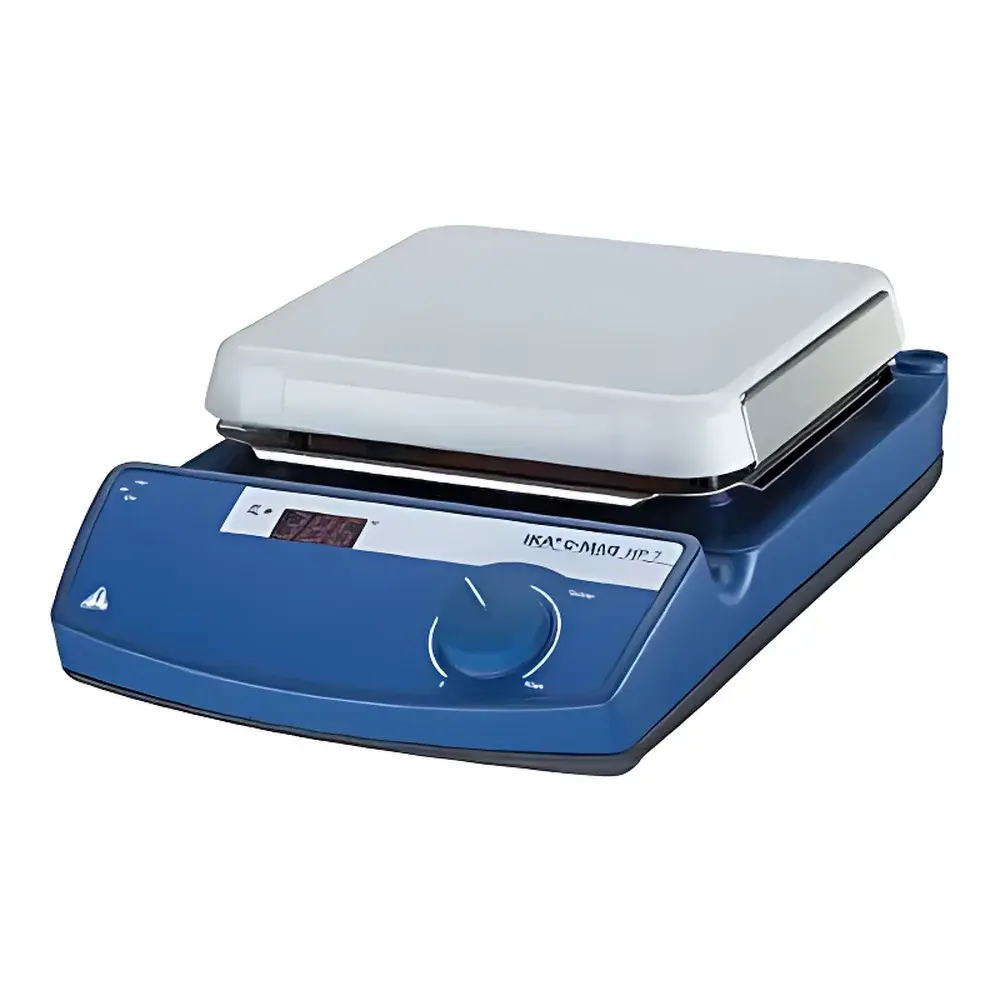
IKA C-HP4/7/10 Digital Ceramic Heating Plate
| Brand | IKA |
|---|---|
| Origin | Germany |
| Model | C-HP4/7/10 |
| Heating Power | 1000 W |
| Temperature Range | 50–500 °C |
| Temperature Control Accuracy (with ETS-D5 sensor) | ±3 K |
| Medium Temperature Stability | ±3 K |
| Heating Rate (1 L H₂O) | 5 K/min |
| Working Surface | 200 × 200 mm ceramic plate |
| Dimensions (W×H×D) | 220 × 330 × 105 mm |
| Weight | 5 kg |
| Ambient Operating Conditions | 5–40 °C, ≤80 % RH |
| Protection Class | IP21 |
| Voltage | 230 V, 50/60 Hz |
| Input Power | 1005 W |
| Safety Cut-off | 550 °C |
| External Sensor Interface | ETS-D4/D5 compatible |
| Display | LED digital |
| Panel Design | Elevated control surface |
| Certifications | DIN EN 60529 compliant |
Overview
The IKA C-HP4/7/10 Digital Ceramic Heating Plate is a precision-engineered laboratory heating platform designed for reproducible, safe, and chemically resistant thermal treatment of samples during sample preparation, digestion, evaporation, and solvent removal workflows. Utilizing resistive heating embedded beneath a monolithic ceramic top plate, the system delivers uniform heat distribution across its 200 × 200 mm active surface. Unlike traditional stainless-steel or aluminum hotplates, the seamless ceramic surface offers exceptional resistance to aggressive reagents—including concentrated acids (e.g., HNO₃, HCl, HF), alkalis, and organic solvents—making it suitable for EPA Method 3050B, ISO 11466, and ASTM D5177-compliant digestion protocols. The unit operates within a precisely regulated temperature range of 50–500 °C, with an automatic thermal cut-off at 550 °C to prevent overheating and ensure equipment integrity under unattended operation.
Key Features
- Monolithic ceramic working surface: Chemically inert, scratch-resistant, and non-porous—eliminates risk of reagent infiltration and cross-contamination between runs.
- Elevated control panel design: Minimizes exposure to splashes and improves ergonomics for clear LED display reading and intuitive parameter adjustment.
- Digital LED temperature display: Enables precise setpoint entry and real-time monitoring; supports repeatable method execution in GLP/GMP environments.
- Integrated safety logic: Visual thermal warning (flashing LED indicator during heating) and hardwired overtemperature cutoff at 550 °C comply with IEC 61000-4-2 and DIN EN 60529 (IP21) requirements.
- External temperature sensor compatibility: Supports IKA ETS-D4 and ETS-D5 contact probes for closed-loop medium temperature control—critical for applications requiring thermal accuracy beyond ambient surface readings.
- Optimized thermal dynamics: Achieves a heating rate of 5 K/min when warming 1 L of water, balancing rapid ramp-up with stable plateau maintenance (±3 K stability).
Sample Compatibility & Compliance
The C-HP4/7/10 accommodates standard laboratory vessels including borosilicate glass beakers (50–1000 mL), PTFE digestion tubes, quartz crucibles, and ceramic evaporating dishes. Its ceramic surface remains dimensionally stable up to 500 °C and shows no degradation after repeated exposure to boiling aqua regia or 65 % nitric acid. The device meets DIN EN 60529 for ingress protection (IP21), ensuring operational safety in typical analytical lab environments with moderate dust and non-vertical dripping moisture. While not intrinsically rated for hazardous area use, its robust construction and fail-safe thermal architecture support compliance with ISO/IEC 17025 internal quality procedures and FDA 21 CFR Part 11–aligned documentation practices when paired with validated SOPs and audit-trail-capable data loggers.
Software & Data Management
The C-HP4/7/10 operates as a standalone analog-digital hybrid instrument with no embedded microprocessor or network interface. Temperature setpoints and real-time surface readings are displayed locally via LED. For traceable temperature recording, users integrate external calibrated sensors (e.g., IKA ETS-D5) with third-party data acquisition systems supporting RS232/USB or 4–20 mA output. When used in conjunction with IKA’s lab software suite (e.g., Labworldsoft), the unit supports time-stamped logging, user-defined alarm thresholds, and exportable CSV reports—facilitating audit readiness per ISO 17025 clause 7.7 and USP analytical instrument qualification frameworks.
Applications
- Acid digestion of environmental soils and sediments prior to ICP-MS or AAS analysis.
- Controlled evaporation of extraction solvents in pesticide residue testing (AOAC 2007.01).
- Pre-concentration of aqueous standards in trace metal laboratories.
- Heating reaction mixtures in synthetic chemistry where magnetic stirring is not required.
- Pre-drying of filter papers or gravimetric precipitates under defined thermal conditions.
- Supporting ASTM D129, D842, and ISO 3104 kinematic viscosity sample conditioning protocols.
FAQ
Is the C-HP4/7/10 compatible with temperature probes other than IKA ETS-D4/D5?
Yes—any PT100 or thermistor-based probe with 0–1 V or 4–20 mA analog output can be interfaced via external signal conditioners, though full functional integration (e.g., auto-setpoint override) requires IKA-specific protocol support.
Does the unit support programmable ramp-soak profiles?
No—the C-HP4/7/10 provides only manual setpoint control; programmable thermal profiles require external PID controllers or IKA’s more advanced RET cordless hotplate series.
Can the ceramic plate be replaced if cracked?
The ceramic top is permanently bonded to the heater assembly and is not a field-replaceable part; units with structural damage to the plate must undergo factory service or replacement.
What is the recommended calibration frequency for routine QC use?
Per ISO/IEC 17025, verify surface temperature accuracy against a NIST-traceable reference thermometer at least daily for critical applications, and perform full calibration annually using accredited metrology services.
Is the unit suitable for use inside a fume hood?
Yes—its IP21 rating, absence of moving parts, and low electromagnetic emissions permit safe installation in ventilated enclosures; however, airflow must not impinge directly on the ceramic surface to avoid measurement drift.



