
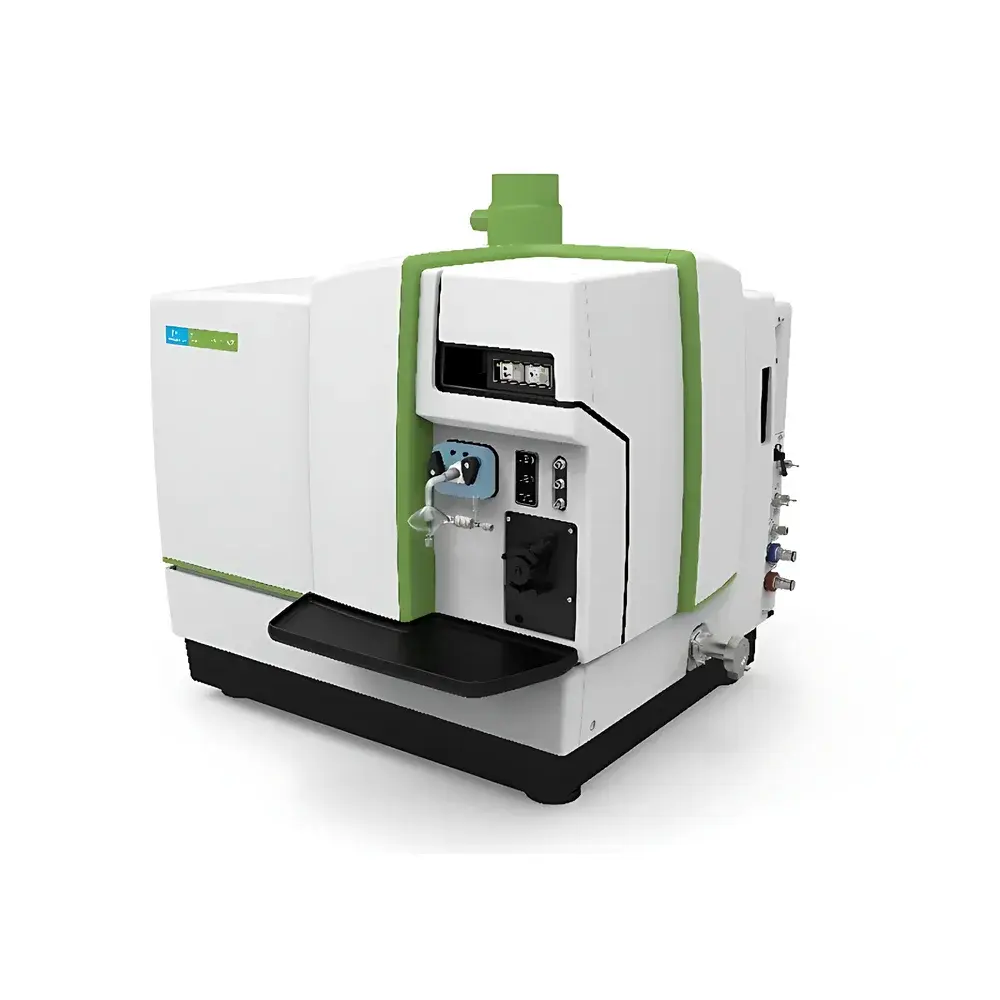
PerkinElmer NexION 1000G Inductively Coupled Plasma Mass Spectrometer
| Brand | PerkinElmer |
|---|---|
| Origin | Singapore |
| Manufacturer | PerkinElmer |
| Import Status | Imported |
| Model | NexION 1000G |
| Instrument Type | Quadrupole ICP-MS |
| Interface Configuration | Triple-cone interface with UltraConic™ design |
| RF Generator | Self-excited solid-state generator with LumiCoil™ technology |
| Ion Optics Architecture | Three-quadrupole tandem mass spectrometry platform (quadrupole ion deflector, quadrupole universal cell, quadrupole mass analyzer) |
| Application Scope | Environmental, geological, food & pharmaceutical, industrial QA/QC, speciation analysis |
Overview
The PerkinElmer NexION 1000G is a high-performance, triple-quadrupole inductively coupled plasma mass spectrometer engineered for robust elemental and isotopic analysis across complex matrices. It operates on the fundamental principle of coupling a high-temperature argon plasma (ICP) — serving as an efficient atomization and ionization source — with a tandem mass spectrometry architecture to resolve polyatomic, isobaric, and doubly charged interferences that limit accuracy in conventional single-quadrupole ICP-MS systems. Unlike traditional instruments relying solely on collision/reaction cells, the NexION 1000G integrates three physically distinct quadrupole stages: a front-end ion deflector for energy filtering and beam shaping; a pressurized universal cell capable of both collision-induced dissociation (CID) and reaction chemistry (e.g., O₂, CH₄, NH₃); and a final mass-resolving quadrupole for precise m/z selection. This architecture enables method-driven interference removal without compromising sensitivity or dynamic range, making it suitable for regulatory-compliant trace element quantification at sub-pg g⁻¹ levels in challenging sample types.
Key Features
- Tandem quadrupole mass spectrometry platform: Eliminates spectral interferences through sequential mass filtering and controlled gas-phase reactions — no reliance on mathematical correction or instrument-specific tuning compromises.
- LumiCoil™ RF generator with self-excited solid-state design: Delivers rapid impedance matching (<100 ms), exceptional plasma stability across variable matrix loads (0–25% TDS), and extended operational lifetime under continuous duty cycles.
- Triple-cone interface with UltraConic™ geometry: Features enlarged orifice diameters and optimized ion optics to maintain high transmission efficiency while minimizing cone clogging and internal deposition — reducing maintenance frequency by up to 40% compared to standard dual-cone systems.
- Universal cell technology: Supports multi-gas operation (He, H₂, O₂, CH₄, NH₃) with real-time switching and pressure control, enabling flexible interference management strategies tailored to analyte-specific challenges (e.g., ⁴⁰Ar³⁵Cl⁺ on ⁷⁵As⁺, ⁴⁰Ca²⁺ on ²⁰Ca⁺).
- Integrated electronic dilution capability: Enables automated, high-precision dilution of concentrated samples (e.g., Na, Ca, Mg) directly within the sample introduction path — eliminating manual preparation errors and extending linear dynamic range beyond 12 orders of magnitude.
Sample Compatibility & Compliance
The NexION 1000G demonstrates broad compatibility with liquid samples spanning environmental waters (groundwater, seawater, wastewater), digested geological solids (soils, sediments, ores), biological tissues (food, clinical), pharmaceutical excipients, and high-TDS industrial process streams. Its plasma robustness accommodates organic solvents (up to 30% methanol, acetonitrile), alkaline digestates (e.g., NaOH fusion leachates), and high-salt matrices without signal suppression or torch degradation. From a regulatory standpoint, the system supports audit-ready workflows compliant with EPA Methods 6020B and 6025B, ISO/IEC 17025:2017 accreditation requirements, and FDA 21 CFR Part 11–enabled data integrity protocols when operated with Syngistix™ software. All hardware configurations meet CE, UL, and RoHS directives, and the instrument architecture facilitates GLP/GMP validation through documented IQ/OQ/PQ procedures.
Software & Data Management
Controlled exclusively via PerkinElmer’s Syngistix™ for ICP-MS software, the NexION 1000G provides a unified environment for method development, acquisition, processing, and reporting. The software includes embedded compliance tools such as electronic signatures, full audit trails, user-access-level permissions, and secure data archiving with SHA-256 hashing. Advanced features include automated interference correction libraries, real-time background subtraction, isotope ratio uncertainty propagation, and integrated speciation workflow templates (e.g., As, Se, Cr, Hg). Raw data files are stored in vendor-neutral .d format, fully compatible with third-party statistical packages (e.g., R, Python pandas) and laboratory information management systems (LIMS) via ASTM E1384-compliant export modules.
Applications
- Environmental monitoring: Quantification of U, Th, Pu isotopes in nuclear forensics; ultra-trace Cd, Pb, Tl in drinking water per WHO guidelines; long-term stability testing (>10 h) using NIST SRM 1643e certified reference material.
- Geochemical analysis: High-precision REE patterns in zircon and monazite; low-level Os isotopic ratios in mantle-derived rocks using Carius tube digestion and micro-distillation.
- Food & pharma safety: Speciation of inorganic vs. organic arsenic in rice flour (6-species separation in <6 min using O₂ reaction mode); selenium species profiling (selenomethionine, selenocystine) in dietary supplements with CH₄ reaction gas.
- Industrial QA/QC: Sub-ppt level Hg detection in tungsten alloys; %-level Na quantification in semiconductor-grade silicon wafers via electronic dilution; multi-element screening of catalyst residues in polymer synthesis batches.
FAQ
Does the NexION 1000G support hyphenated techniques such as HPLC-ICP-MS?
Yes — the instrument features standardized LC-ICP-MS interfaces with adjustable dwell times, peak-shape optimization algorithms, and time-resolved acquisition modes compatible with all major HPLC/UHPLC platforms.
Can it perform isotope ratio measurements for geochronology applications?
It delivers precision of ≤0.1% RSD for ²⁰⁶Pb/²⁰⁷Pb and ²³⁸U/²³⁵U ratios in static multi-collection mode when equipped with high-sensitivity detector options and Faraday cup arrays.
Is remote diagnostics and service support available?
PerkinElmer offers 24/7 remote instrument health monitoring, predictive maintenance alerts, and secure technician access via encrypted TLS 1.3 channels — subject to customer network policy approval.
What consumables require routine replacement?
Standard maintenance intervals include torch replacement every 6–12 months (depending on matrix load), cones every 3–6 months, and universal cell filters every 2 years — all tracked automatically within Syngistix™ usage logs.
How does the triple-quadrupole design improve detection limits versus single-quadrupole ICP-MS?
By removing >99.9% of polyatomic interferences prior to final mass analysis, the system achieves effective background-equivalent concentrations (BECs) up to 10× lower than conventional instruments — particularly critical for As, Se, Fe, and K in saline or organic-rich samples.





