
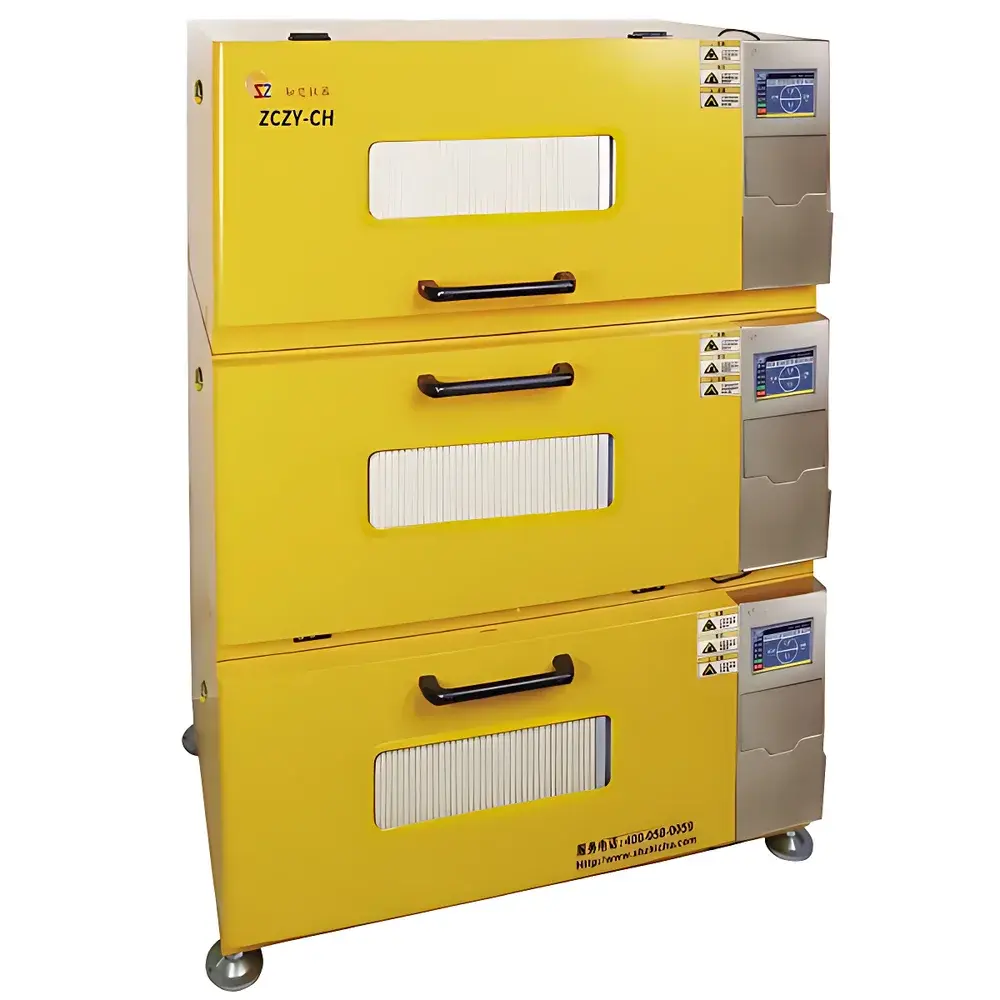
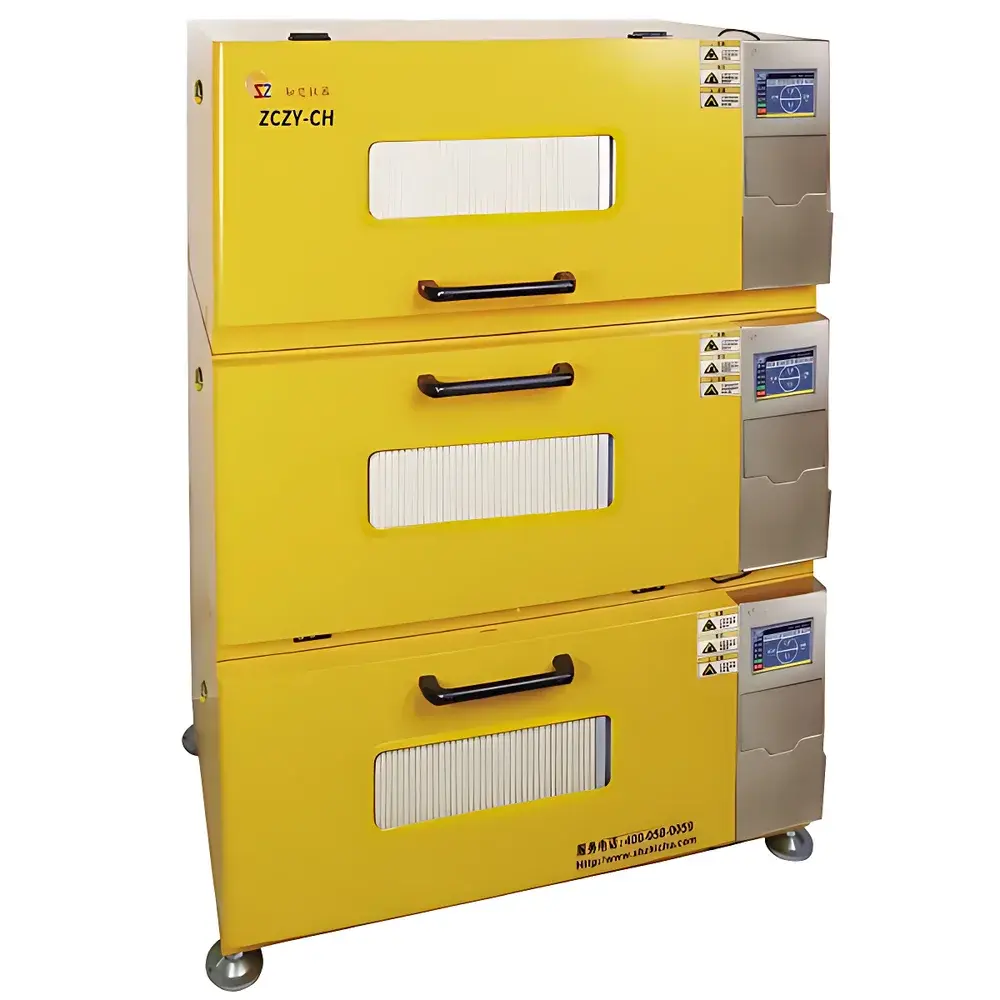
Zhichu ZCZY-CH Compact High-Speed CO₂ Incubator Shaker
| Brand | Zhichu |
|---|---|
| Origin | Guangdong, China |
| Manufacturer Type | Authorized Distributor |
| Product Category | Domestic |
| Model | ZCZY-CH |
| Instrument Type | CO₂-Controlled Temperature-Shaking Incubator |
| Timer Range | 0–999.9 h |
| Oscillation Frequency | 10–800 rpm (optional up to 1200 rpm) |
| Frequency Accuracy | ±1 rpm |
| Orbit Diameter | Ø3 mm (Ø1.5 mm selectable) |
| Temperature Range | 4–60 °C (ambient 23–25 °C) |
| Temperature Uniformity | ±0.5 °C at 37 °C |
| Temperature Control Accuracy | ±0.1 °C |
| CO₂ Range | 0–20% |
| CO₂ Control Accuracy | ±0.1% |
| CO₂ Sensor Type | Imported NDIR Infrared Sensor |
| Internal Chamber Humidity | Up to ≥90% RH at 37 °C (via dual-stage humidification tray) |
| Defrost Interval | 30–600 min |
| Defrost Duration | 1–250 s |
| Viewing Window | Heated double-layer tempered glass with anti-fog door heating |
| Drive System | High-performance servo motor |
| Display | Full-color LCD touchscreen with real-time multi-parameter overlay (temp, speed, CO₂, time) |
| Data Logging | 5-year internal storage with temperature/speed/CO₂ trend curves |
| Data Export | USB port |
| Chamber Geometry | R-cornered interior |
| Noise Level | <55 dB(A) |
| Stackable Configuration | 3-tier shaker platform |
| Standard Tray Size | 575 mm × 435 mm per shelf |
| Power Supply | AC 220 V ±10%, 50–60 Hz |
| External Dimensions (W×D×H) | 990 mm × 845 mm × 1740 mm |
| Net Weight | ~462 kg |
Overview
The Zhichu ZCZY-CH is a compact, high-speed CO₂-controlled incubator shaker engineered for precision cell culture, microbial fermentation, and suspension-based bioprocess development under tightly regulated environmental conditions. It integrates three critical control domains—temperature, CO₂ concentration, and orbital agitation—within a single robust stainless-steel chamber featuring R-cornered geometry for seamless cleaning and contamination control. The system operates on a P.I.D. microcomputer control architecture with forced-air convection and a high-efficiency refrigeration module capable of dynamic cooling power modulation, enabling stable operation across the full 4–60 °C range—even during extended low-temperature shaking protocols. CO₂ regulation employs an imported non-dispersive infrared (NDIR) sensor offering real-time feedback with ±0.1% accuracy and rapid response kinetics; validated CO₂ retention performance shows a decay from 5.0% to 4.5% requiring ≥30 minutes, confirming superior chamber gas-tightness essential for long-term mammalian or stem cell culture.
Key Features
- Triple-layer stackable platform design supporting independent parameter control per shelf (ZCZY-CH configuration)
- Heated, anti-fog double-glazed observation window with integrated door heating—enables continuous visual monitoring without thermal disturbance or condensation
- Dual-stage evaporation humidification system achieving ≥90% RH at 37 °C; chamber base features full-access sloped drainage for CIP-compatible rinsing
- Intelligent defrost management: user-definable defrost duration (1–250 s) and interval (30–600 min), preventing evaporator icing during sub-ambient operation
- High-torque servo motor drive delivering precise speed control (10–800 rpm, optional 1200 rpm) with ±1 rpm stability and reversible rotation programming
- Full-color LCD touchscreen interface displaying real-time temperature, speed, CO₂ concentration, and remaining time simultaneously—no mode-switching required
- Operational security via password-protected interface lockout to prevent accidental parameter modification
- Onboard data logger storing five years of timestamped records; graphical visualization of temporal trends for temperature, speed, and CO₂
Sample Compatibility & Compliance
The ZCZY-CH accommodates standard microplate formats (e.g., 96-well, deep-well plates), Erlenmeyer flasks (up to 2 L), and custom vessel arrays via configurable column-type clamping fixtures (16-position deep-well plate support per shelf, scalable to two layers). Its R-cornered interior and removable perforated stainless-steel shelves facilitate ISO 14644-compliant cleaning validation and meet GLP laboratory infrastructure requirements. While not certified to IEC 61010-1 or UL 61010-1 out-of-box, the unit conforms to electromagnetic compatibility (EMC) Class B limits and incorporates over-temperature, over-speed, and CO₂ sensor failure safeguards aligned with risk-based instrument qualification (IQ/OQ/PQ) frameworks. Optional humidity control (environmental RH to 90% RH) and light-blocking retractable fabric curtains further extend suitability for photophobic cultures—including cyanobacteria, circadian rhythm studies, and light-sensitive recombinant protein expression systems.
Software & Data Management
All operational parameters and sensor outputs are logged internally with millisecond-level timestamp resolution. Trend curves for temperature, rotational speed, and CO₂ concentration are rendered directly on the display for immediate interpretation. Historical datasets—including alarm events, setpoint changes, and maintenance alerts—are exportable via USB 2.0 to standard CSV or Excel-compatible formats. Though no proprietary PC software is bundled, the exported files comply with FDA 21 CFR Part 11 audit-trail prerequisites when stored within validated laboratory information management systems (LIMS) or electronic lab notebooks (ELN). Firmware updates are performed offline via USB, preserving data integrity and eliminating network exposure risks.
Applications
- Mammalian and insect cell line expansion under controlled CO₂ and agitation (e.g., CHO, HEK293, Sf9)
- High-density microbial cultivation for enzyme production, metabolic engineering, or bioremediation screening
- Suspension-based organoid and spheroid formation protocols requiring precise oxygenation and shear stress modulation
- Antibiotic susceptibility testing (AST) in liquid-phase broth microdilution assays
- Long-term stability studies of biologics in solution under accelerated shaking stress
- Environmental microbiology applications involving aerobic/anaerobic gradient simulation via programmable CO₂ ramping
FAQ
What is the maximum recommended flask volume per shelf?
Standard configuration supports up to two 2 L Erlenmeyer flasks or sixteen 50 mL conical tubes per shelf, depending on fixture selection.
Does the system support GLP-compliant electronic record retention?
Yes—when integrated with a validated LIMS or ELN, the USB-exported CSV logs satisfy ALCOA+ principles for attributable, legible, contemporaneous, original, and accurate data.
Can the CO₂ sensor be recalibrated in-house?
The NDIR sensor includes zero-point and span calibration routines accessible via service menu; certified reference gases (e.g., 5% CO₂ in N₂) are required for traceable adjustment.
Is remote monitoring available without third-party middleware?
The optional Wi-Fi-enabled APP module provides authenticated access to real-time status and alarms via TLS-encrypted HTTP(S); no cloud dependency or vendor-hosted infrastructure is required.
How is chamber decontamination performed between runs?
The R-cornered interior, sloped drain pan, and removable shelves allow full immersion in EPA-approved sporicidal agents; autoclavable clamps and trays are available as accessories.



