
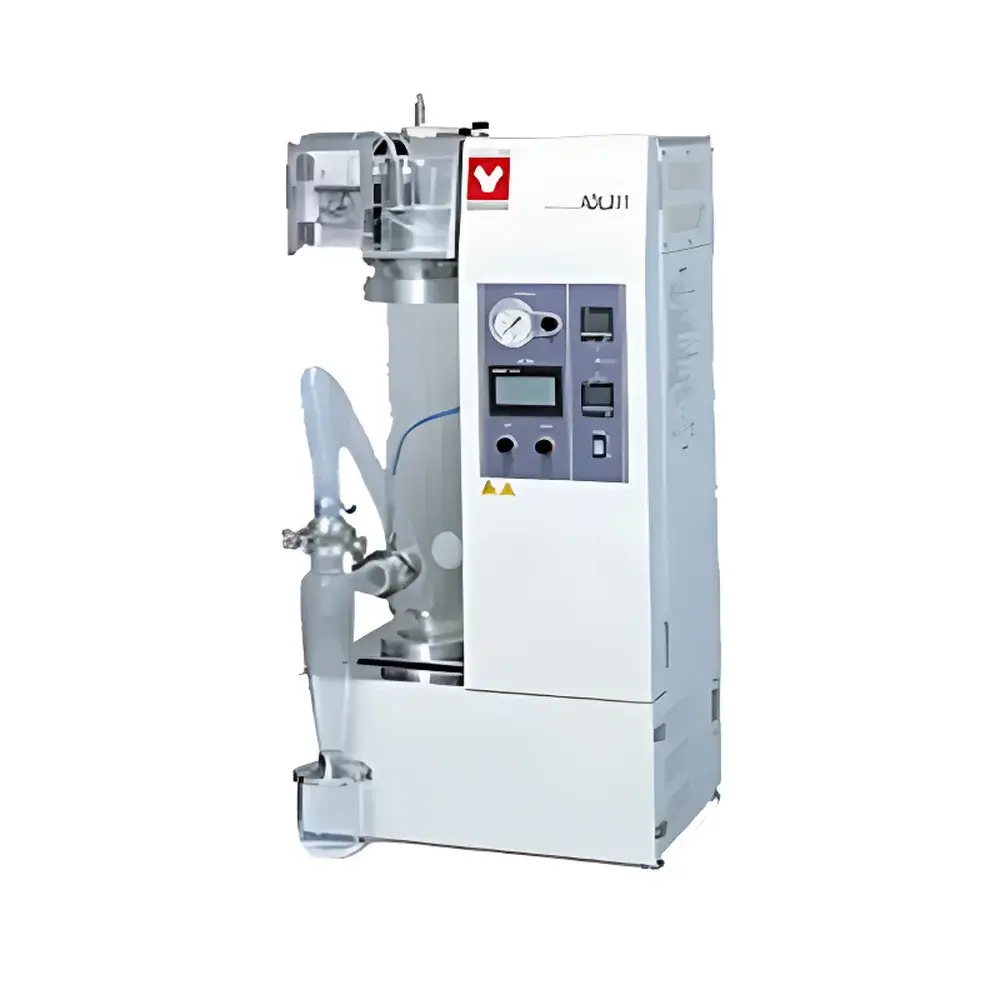
Yamato ADL311 Advanced Laboratory Spray Dryer
| Brand | Yamato |
|---|---|
| Origin | Japan |
| Model | ADL311 |
| Sample Types | Food, Pharmaceuticals, Organic & Inorganic Chemicals |
| Max. Feed Rate | 26 mL/min |
| Inlet Temp. Range | 40–220 °C |
| Outlet Temp. Range | 0–60 °C |
| Particle Size Range | 40–100 µm |
| Evaporation Capacity | Up to 1300 mL/h |
| Air Flow | 0–0.7 m³/min |
| Atomizing Air Pressure | 0–0.6 MPa |
| Power Supply | 200–240 V AC, 50/60 Hz |
| Weight | 80 kg |
| Dimensions (W×D×H) | 580×420×1150 mm |
Overview
The Yamato ADL311 is a precision-engineered laboratory-scale spray dryer designed for reproducible, scalable conversion of liquid feedstocks—including aqueous solutions, suspensions, and organic solvent-based formulations—into free-flowing, low-moisture micro-powders. Operating on the principle of rapid evaporative drying via two-fluid nozzle atomization, the ADL311 subjects feed material to controlled hot air flow within a stainless-steel drying chamber, enabling millisecond-level residence time (< 10 s) and minimizing thermal degradation. This makes it especially suitable for thermolabile compounds common in pharmaceutical active pharmaceutical ingredient (API) development, functional food ingredient encapsulation, and catalyst precursor synthesis. Unlike conventional tray or freeze-drying methods, the ADL311 eliminates intermediate filtration, centrifugation, or milling steps—reducing cross-contamination risk and preserving particle morphology integrity. Its modular architecture supports integration with optional solvent recovery systems (e.g., GAS410), aligning with ISO 14001 environmental management practices and OSHA-compliant lab safety protocols.
Key Features
- Integrated PID-controlled inlet/outlet temperature regulation with ±1 °C accuracy at inlet and real-time K-type thermocouple monitoring;
- Dual-mode temperature control: selectable inlet- or outlet-temperature setpoint operation for process optimization under varying feed viscosities;
- Peristaltic feed pump with pulse-cleaning mechanism and anti-clogging needle (manual purge), ensuring stable flow rates from 0.5 to 26 mL/min;
- Nozzle cooling jacket (dual Φ10.5 mm coolant ports) prevents thermal buildup during extended operation with heat-sensitive solvents;
- Quick-release drying chamber and cyclone separator—tool-free disassembly in under 90 seconds for cleaning or maintenance;
- Touchscreen HMI with tri-language support (English, Japanese, Chinese), configurable alarm logic, and 4–20 mA analog output for external data logging;
- Onboard 2 A AC220 V power socket for inline magnetic stirrer synchronization during suspension feeding;
- Comprehensive safety suite: overheat cutoff (inlet/outlet), feed pump reverse rotation detection, earth-leakage circuit breaker, and GAS410 interlock sensing.
Sample Compatibility & Compliance
The ADL311 accommodates water-soluble matrices by default (ADL311 variant) and—when coupled with the optional GAS410 solvent recovery unit—handles flammable organic media including ethanol, acetone, chloroform, and ethyl acetate. All wetted parts are electropolished SUS316L stainless steel or FDA-compliant fluoropolymer-lined components. The system meets key regulatory design considerations for GMP-aligned R&D environments: traceable temperature calibration (NIST-traceable thermocouples), audit-ready operational logs (via optional temperature recorder), and compatibility with 21 CFR Part 11-compliant data acquisition software when interfaced externally. It conforms to IEC 61000-6-3 (EMC emissions) and IEC 61000-6-2 (immunity), and its exhaust filtration (HEPA-class optional) supports ISO 14644-1 Class 7 cleanroom integration.
Software & Data Management
While the ADL311 operates autonomously via its embedded touchscreen controller, its 4–20 mA analog outputs (inlet/outlet temperature) enable seamless integration with third-party SCADA, LabVIEW, or DeltaV systems for centralized process monitoring. Optional accessories—including the GF300 spray nozzle kit, ODL21C sample collection stand, and COV20C explosion-proof enclosure—extend functionality for specialized workflows. For full digital traceability, users may pair the unit with a validated temperature data logger compliant with GLP documentation standards. No proprietary cloud platform is required; raw process parameters remain accessible via local USB export or analog signal capture.
Applications
- Pharmaceutical R&D: Production of inhalable dry powders, amorphous solid dispersions, and nanoparticle-loaded microparticles;
- Food science: Encapsulation of probiotics, vitamins, flavors, and omega-3 oils into stable, oxidation-resistant powders;
- Materials chemistry: Synthesis of metal oxide precursors (e.g., LiCoO₂, TiO₂), MOF nanoparticles, and battery cathode materials;
- Agrochemical formulation: Conversion of pesticide emulsions into dustable powders with consistent particle size distribution;
- Academic research: Method development for continuous manufacturing, QbD-based drying parameter mapping, and DOE-driven optimization.
FAQ
What types of solvents can be processed with the ADL311?
Aqueous solutions are supported natively; organic solvents require the GAS410 solvent recovery system to ensure safe vapor handling and explosion prevention.
Is the ADL311 compliant with Good Manufacturing Practice (GMP) requirements?
While classified as a research-grade instrument, its construction, temperature traceability, and optional data-logging accessories support alignment with GMP Annex 15 and ICH Q5C stability testing protocols.
Can particle size be controlled independently of feed concentration?
Yes—particle size distribution (40–100 µm typical) is modulated via atomizing air pressure, inlet temperature, feed rate, and nozzle geometry—not solely dependent on solids content.
Does the system include built-in moisture analysis?
No; moisture content must be verified post-drying using external Karl Fischer titration or loss-on-drying (LOD) instrumentation per USP <731>.
What maintenance intervals are recommended for the peristaltic pump tubing?
Silicone feed tubing should be inspected after every 20 hours of operation and replaced every 100 hours under continuous use to maintain volumetric accuracy and prevent particulate shedding.



