
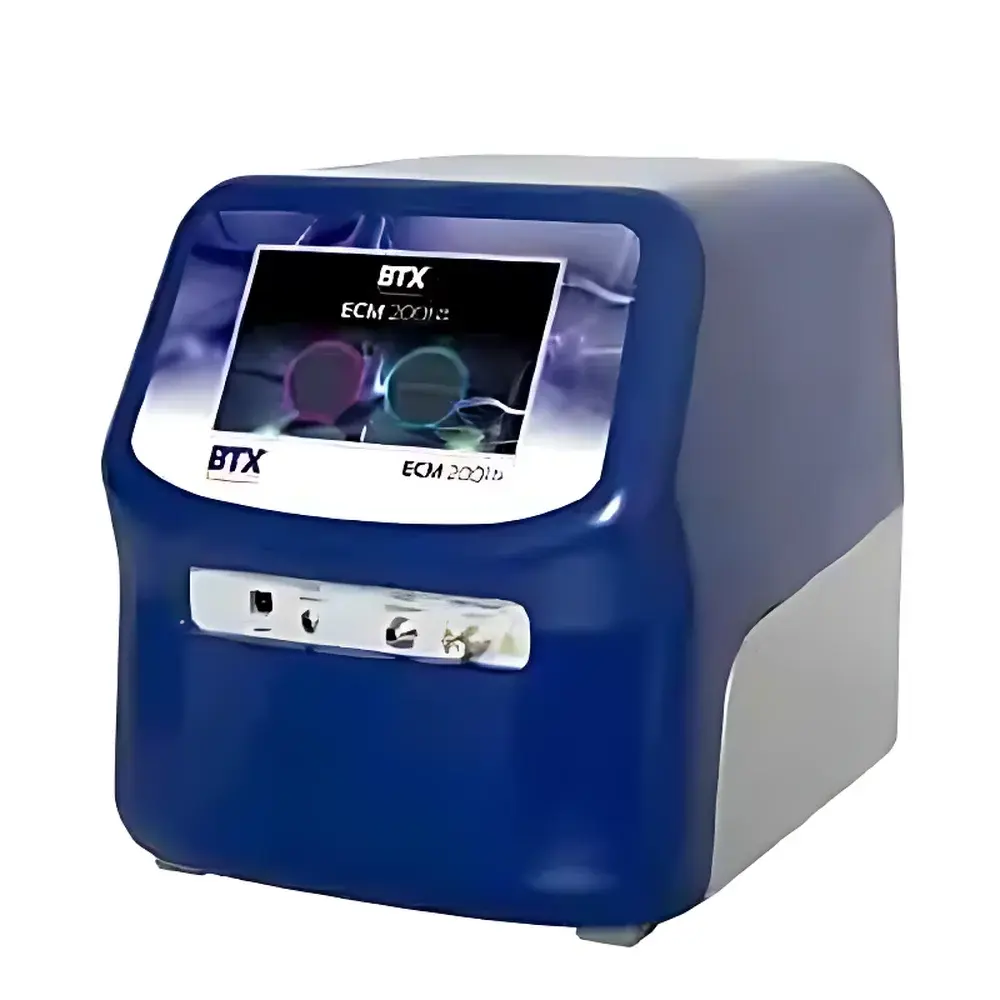
BTX ECM2001+ Multifunctional Electroporator and Electrofusion System
| Brand | BTX |
|---|---|
| Origin | USA |
| Model | ECM2001+ |
| High-Voltage Range | 505–3000 V |
| Low-Voltage Range | 5–500 V |
| Pulse Duration | 10 µs–999 ms |
| Resistance Setting | 1 Ω |
| Compliance | CE, FDA-listed device for research use only |
Overview
The BTX ECM2001+ is a research-grade, multifunctional electroporation and electrofusion system engineered for high-precision manipulation of biological cells and subcellular structures. Based on controlled capacitive discharge and programmable AC/DC waveform generation, the instrument delivers reproducible electric field delivery across diverse sample formats—from suspension cultures to adherent monolayers and intact tissues. Its dual-mode architecture supports both transient membrane permeabilization (electroporation) and controlled membrane destabilization followed by lipid bilayer reorganization (electrofusion), making it uniquely suited for hybridoma development, somatic cell nuclear transfer (SCNT), embryonic stem cell reprogramming, and protoplast fusion in plant biotechnology. Designed and manufactured in the United States, the ECM2001+ meets international safety and electromagnetic compatibility standards (CE-marked) and is registered with the U.S. FDA as a Class II research-use-only (RUO) device—fully compatible with GLP-compliant laboratory workflows.
Key Features
- 7-inch high-resolution resistive touchscreen interface with intuitive graphical navigation and real-time parameter visualization
- Preloaded library of >120 validated protocols covering primary mammalian cells, stem cells (iPSCs, ESCs), immune cells, insect cells, yeast, bacteria, and plant protoplasts
- Onboard storage for up to 1,000 user-defined protocols with versioned naming, timestamping, and parameter locking options
- Advanced electrofusion capability: independent AC waveform programming (0.2–2 MHz sine wave, 5–75 V peak-to-peak; constant or linear ramp mode) followed by up to 19 configurable DC pulses per fusion cycle
- Precision DC pulse control: 1 V resolution over 5–3000 V range; selectable pulse count (1–99) and inter-pulse delay (10 ms–10 s)
- Integrated pre-pulse impedance measurement circuitry that dynamically detects short-circuit conditions and disables unsafe discharges before pulse initiation
- Real-time analog monitoring of voltage, current, and sample resistance during each pulse event—logged at 100 kHz sampling rate
- Robust arc suppression design with active current limiting and thermal cutoff protection for electrode longevity and operator safety
Sample Compatibility & Compliance
The ECM2001+ accommodates volumes from 10 µL to 9 mL using interchangeable electrode systems—including standard cuvettes (0.1–4 mm gap), specialized fusion chambers (e.g., BTX Fusion Chamber FC-10), and in vivo applicators (e.g., needle-type and paddle electrodes). It enables direct electroporation of excised tissue slices, embryonic explants, and even superficial dermal layers in rodent models. All protocols are developed and validated in accordance with ISO 13485-aligned quality practices. While not intended for clinical diagnostics or therapeutic use, the system’s audit trail functionality—including full experimental metadata logging (operator ID, date/time stamp, parameter set, hardware ID)—supports compliance with FDA 21 CFR Part 11 requirements when integrated into validated LIMS environments. Documentation packages include IQ/OQ templates aligned with ASTM F2696-22 (Standard Guide for Electroporation-Based Gene Transfer).
Software & Data Management
Data acquisition and protocol management are handled via the embedded firmware platform, which records all operational parameters and real-time electrical traces in standardized CSV and binary .BTX formats. Exported logs contain calibrated voltage/current waveforms, calculated field strength (V/cm), energy deposition (J/mL), and post-pulse recovery metrics. Optional BTX ControlLink software (Windows-based) provides remote instrument control, batch protocol deployment, statistical analysis of transfection efficiency (e.g., flow cytometry correlation), and automated report generation compliant with ALCOA+ principles (Attributable, Legible, Contemporaneous, Original, Accurate, Complete, Consistent, Enduring, Available). Audit trails are immutable and timestamped to UTC; no data overwrite or deletion is permitted without administrator-level authentication.
Applications
- Hybridoma generation via electrofusion of antibody-producing B-cells and myeloma lines
- Somatic cell nuclear transfer (SCNT) in livestock and model organisms
- CRISPR-Cas9 RNP delivery into hard-to-transfect primary T cells and hematopoietic stem cells
- Reprogramming of fibroblasts into induced pluripotent stem cells (iPSCs) using episomal vectors
- Fusion of plant protoplasts for interspecific hybrid development (e.g., Solanaceae, Brassicaceae)
- In ovo electroporation for spatially resolved gene expression studies in avian embryos
- Ex vivo electroporation of skin, muscle, and tumor explants for immunotherapy vector delivery
FAQ
Is the ECM2001+ suitable for GMP-regulated manufacturing processes?
The ECM2001+ is designated for research use only and does not carry GMP certification; however, its traceability features, electronic signatures, and protocol validation tools support early-stage process development under ICH Q5A/Q5B guidelines.
Can the system be integrated with automated liquid handlers?
Yes—via RS-232 and Ethernet interfaces, the ECM2001+ supports bidirectional communication with third-party robotics platforms using ASCII command protocols defined in the BTX Developer SDK.
What electrode types are compatible with large-volume fusion (up to 9 mL)?
The BTX Fusion Chamber FC-10 and custom-designed parallel-plate electrodes with 1 mm inter-electrode spacing are certified for 5–9 mL fusion reactions under low-conductivity buffer conditions.
Does the instrument provide calibration certificates traceable to NIST standards?
Factory calibration reports—including voltage accuracy (±1.5% of reading), pulse width tolerance (±2%), and impedance measurement linearity—are supplied with each unit and traceable to NIST-traceable references.
How is data integrity ensured during power interruption?
All active experiments write to non-volatile memory every 500 ms; unsaved logs are recovered automatically upon reboot without loss of waveform fidelity or timestamp continuity.
Related Products




