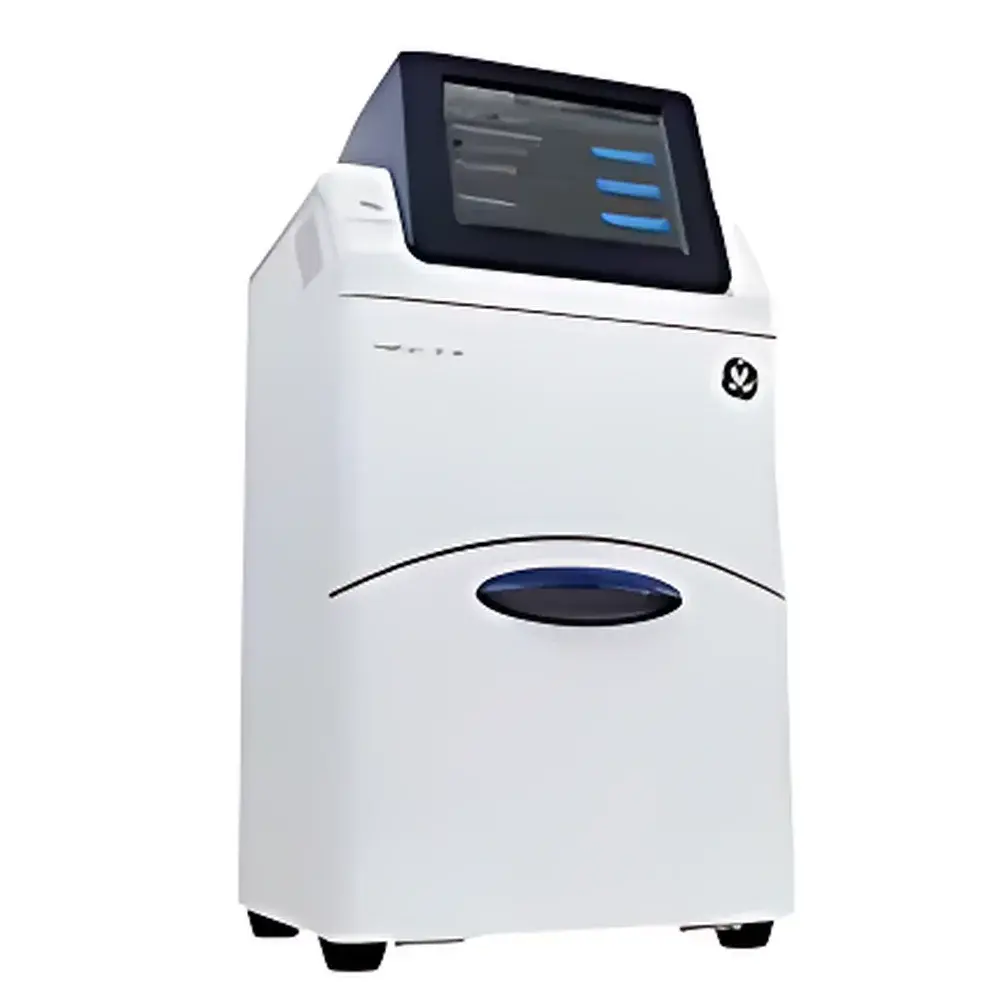
Cytiva ImageQuant LAS 500 Gel Imaging System
| Brand | Cytiva |
|---|---|
| Origin | USA |
| Model | ImageQuant LAS 500 |
| Instrument Type | Multicolor Fluorescent Gel Imager |
| CCD Resolution | 8.3 MP |
| Bit Depth | 16-bit |
| Dynamic Range | 4.8 orders of magnitude |
| CCD Sensor Size | 1/4-inch |
| Detection Sensitivity | ≥0.02 ng protein (chemiluminescence), ≥0.1 ng DNA (ethidium bromide) |
| Signal-to-Noise Ratio | ≥56 dB |
| Optical Field of View | 105 × 105 mm |
| Illumination Sources | Dual-side blue reflectance (470 nm), UV reflectance (302 nm), white reflectance (470–630 nm) |
Overview
The Cytiva ImageQuant LAS 500 Gel Imaging System is a compact, integrated digital imager engineered for high-sensitivity detection and quantitative analysis of nucleic acids and proteins in electrophoretic gels and blots. Based on cooled CCD imaging technology with active thermoelectric cooling, the system captures low-intensity chemiluminescent, fluorescent, and visible-light signals without requiring darkroom processing or film development. Its optical architecture employs fixed-focus, wide-field illumination combined with a high quantum efficiency 8.3-megapixel monochrome CCD sensor operating at 16-bit depth, enabling linear signal digitization across a dynamic range exceeding four decades (≥10⁴.⁸). Designed for routine molecular biology laboratories, the LAS 500 eliminates dependency on external computing hardware—featuring an embedded Linux-based operating system and a 7-inch capacitive color touchscreen for standalone instrument control, image acquisition, annotation, and basic quantification.
Key Features
- Integrated thermoelectric cooling: CCD cools to –25°C within five minutes from ambient temperature, reducing thermal noise and improving signal fidelity for low-abundance target detection.
- Triple-wavelength illumination module: Independently switchable blue reflectance (470 nm), UV transillumination/reflection (302 nm), and white reflectance (470–630 nm) sources support broad-spectrum applications including SYBR® Green, ethidium bromide, Deep Purple™, Coomassie Brilliant Blue, and silver-stained gels.
- Standalone operation: No PC required—full instrument control, real-time preview, exposure optimization, background subtraction, and region-of-interest (ROI) quantification are executed directly via the built-in touchscreen interface.
- Optimized optical path: Fixed 105 × 105 mm field-of-view lens with f/1.2 aperture ensures uniform illumination and minimal distortion across the entire imaging area; no manual focusing or alignment needed.
- Data portability & interoperability: Images saved in TIFF or PNG format can be exported directly to USB flash drives; optional Ethernet connectivity enables secure transfer to networked storage or LIMS environments.
- Automated overlay functionality: Chemiluminescent blot images can be precisely registered and overlaid with pre-stained molecular weight markers acquired under visible light—enabling accurate band assignment without manual alignment.
Sample Compatibility & Compliance
The LAS 500 accommodates standard mini- and midi-format gels (up to 13 × 13 cm), Western/Northern/Southern blots, microplates (96-well), and membrane strips. It supports common nucleic acid dyes (e.g., SYBR Safe, GelRed, ethidium bromide) and protein stains (Coomassie R-350, Deep Purple, silver nitrate). All optical components comply with IEC 61000-6-3 (EMC) and IEC 61000-6-2 (immunity) standards. The system meets laboratory safety requirements per ANSI Z87.1 for UV shielding and includes interlocked UV source cutoff. While not validated for clinical diagnostics, its consistent acquisition parameters and audit-ready metadata export support GLP-aligned workflows and internal QC documentation.
Software & Data Management
The embedded ImageQuant TL software provides intuitive tools for exposure time optimization, auto-exposure bracketing, background correction, lane/band detection, and relative quantification using integrated density (ID) or volume-based algorithms. All acquisitions retain full metadata—including exposure time, gain, temperature, illumination mode, and timestamp—in EXIF-compliant headers. Exported TIFF files preserve raw 16-bit data for downstream analysis in third-party platforms (e.g., ImageJ/Fiji, GraphPad Prism). Optional ImageQuant TL Network Edition enables centralized instrument management, user access control, and electronic lab notebook (ELN) integration. Audit trail functionality logs all acquisition and processing events, satisfying basic FDA 21 CFR Part 11 requirements for non-GMP research use.
Applications
- Quantitative Western blotting: Detection of low-abundance phosphoproteins and transcription factors using HRP- or AP-conjugated secondary antibodies.
- DNA fragment analysis: High-resolution sizing and relative quantification of PCR products, restriction digests, and CRISPR editing outcomes.
- Protein expression profiling: Comparative analysis of Coomassie- or silver-stained 1D/2D gels across treatment conditions.
- RNA integrity assessment: Visualization and semi-quantitative evaluation of ribosomal RNA bands in denaturing agarose gels.
- Quality control of purified nucleic acids and recombinant proteins prior to sequencing or structural studies.
FAQ
Does the LAS 500 require a dedicated computer for operation?
No—the system operates autonomously via its onboard processor and touchscreen interface. A computer is only needed for advanced post-processing or network integration.
Can the LAS 500 perform multi-channel fluorescence imaging?
It supports sequential single-channel fluorescence detection using discrete excitation sources (blue and UV), but does not provide simultaneous multi-wavelength acquisition or spectral unmixing.
What is the minimum detectable signal for chemiluminescence?
Under optimized conditions (e.g., HRP-conjugated antibody, enhanced luminol substrate), the system reliably detects ≥1 pg of target protein on PVDF membranes.
Is the CCD sensor cooled during standby mode?
The thermoelectric cooler activates only during acquisition or when the “Pre-cool” function is manually engaged; it does not maintain sub-ambient temperature continuously.
Are calibration standards or validation protocols included?
Cytiva supplies a reference gel and certified sensitivity test kit (Cat. No. 28-9563-28) for periodic performance verification in accordance with ISO/IEC 17025-aligned internal procedures.