
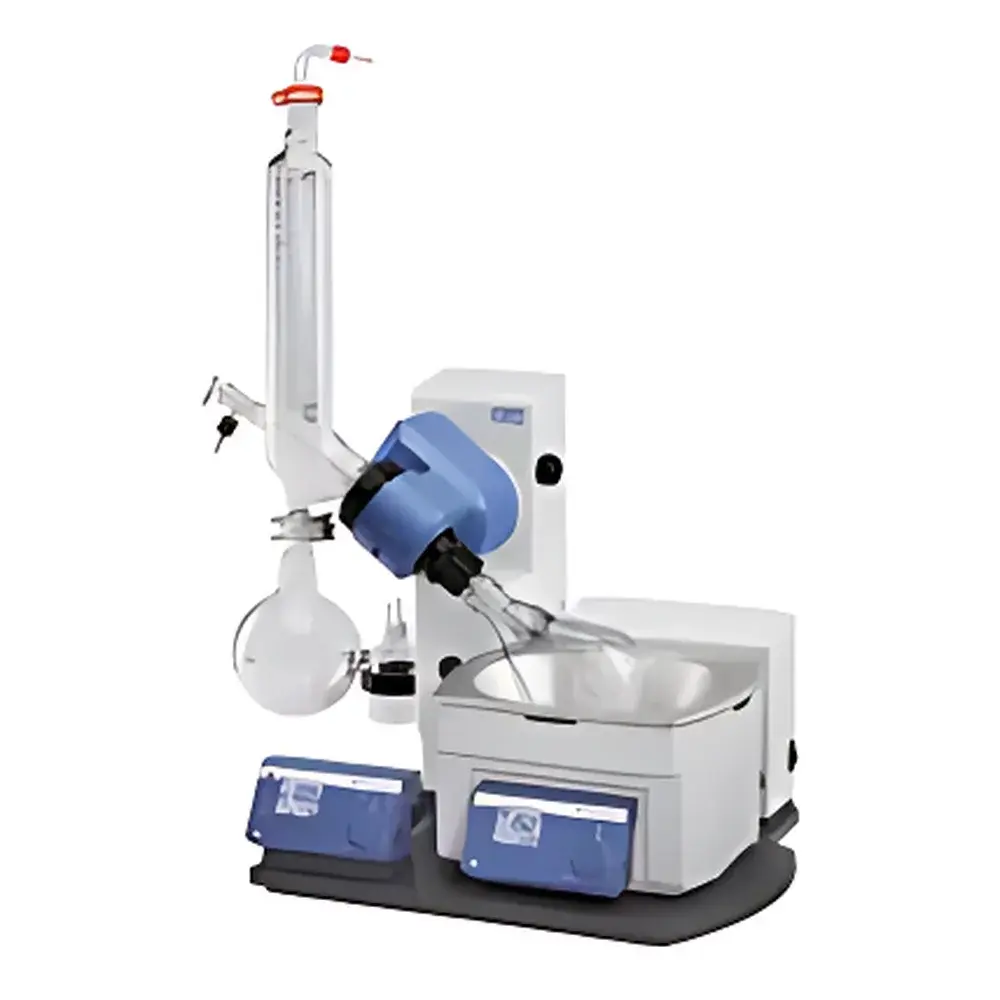
IKA RV 10 digital V-C Rotary Evaporator
| Brand | IKA |
|---|---|
| Origin | Germany |
| Model | RV 10 digital V-C |
| Capacity | 3 L |
| Rotation Speed | 20–280 rpm |
| Heating Temperature Range | Ambient to 180 °C |
| Temperature Control Accuracy | ±1 °C |
| Condenser Cooling Surface Area | 1500 cm² |
| Heating Bath Type | Dual-purpose (water/oil) |
| Interface | RS232 + IR remote control |
| Safety Features | Motorized lift with power-fail auto-retract, adjustable safety temperature cutoff, dry-run protection, programmable descent endpoint, bath lockout function |
| Optional | Explosion-proof coated glass assembly |
Overview
The IKA RV 10 digital V-C Rotary Evaporator is a precision-engineered laboratory system designed for efficient, reproducible solvent removal and concentration of heat-sensitive samples under reduced pressure. Based on the fundamental principle of rotary evaporation—where sample rotation increases surface area, simultaneous vacuum lowers boiling points, and controlled heating enables gentle thermal energy input—the RV 10 digital V-C delivers consistent distillation performance across diverse organic, pharmaceutical, and analytical workflows. Engineered in Staufen, Germany, this instrument integrates a vertically oriented condenser configuration with a dual-mode (water/oil) heating bath HB 10, enabling operation from ambient temperature up to 180 °C with ±1 °C thermal stability. Its 3 L evaporation flask capacity and 1500 cm² high-efficiency condenser surface ensure rapid vapor condensation and minimal bumping or carryover, even during extended batch processing.
Key Features
- Motorized vertical lift mechanism with automatic retraction upon power interruption—prevents overheating and ensures flask integrity
- Dual-mode heating bath (HB 10) compatible with water and oil media, featuring ergonomic safety handle and programmable temperature limit circuit
- Vertical condenser assembly with explosion-proof coated glass option (RV 10.10), optimized for gravitational reflux and minimal vapor path resistance
- Digital speed control (20–280 rpm) with soft-start functionality, bidirectional rotation (clockwise/counter-clockwise), and user-defined timer
- Integrated safety architecture: dry-run protection, adjustable descent endpoint, bath parameter lockout, and overtemperature cutoff
- Communication interfaces include RS232 for integration with IKA labworldsoft software and infrared port for wireless bath temperature control
- Ergonomically designed quick-release flask ejection knob and low-center-of-gravity mechanical structure enhance operational safety and long-term durability
Sample Compatibility & Compliance
The RV 10 digital V-C supports standard ISO/KIMAX-grade borosilicate glassware (including 3 L evaporation flasks and配套 vertical condensers), accommodating a broad range of solvents—including acetone, ethyl acetate, dichloromethane, methanol, and high-boiling-point media such as DMF and DMSO—under vacuum levels down to <10 mbar. Its design conforms to IEC 61010-1 for electrical safety in laboratory equipment and incorporates safeguards aligned with GLP-compliant environments: audit-trail-capable parameter logging (via labworldsoft), hardware-enforced temperature limits, and fail-safe lift positioning. While not intrinsically rated for Class I Division 1 hazardous locations, the optional explosion-proof coated glass kit (RV 10.10) meets DIN EN 14175-5 requirements for enhanced containment in volatile solvent applications.
Software & Data Management
RS232 connectivity enables full remote operation and real-time parameter monitoring via IKA labworldsoft—a validated laboratory management platform supporting method storage, execution logging, and CSV export. All heating bath setpoints, rotation speed profiles, timer status, and lift position data are timestamped and retainable for regulatory review. The software supports multi-user access control and complies with ALCOA+ data integrity principles. When paired with optional IKA vacuum controllers (e.g., VACUU·SELECT), the system achieves closed-loop pressure regulation synchronized with temperature and rotation parameters—facilitating USP , ASTM E2912, and ISO 17025-aligned validation protocols.
Applications
- Routine solvent recovery and sample concentration in synthetic organic chemistry labs
- Removal of low- and medium-boiling solvents from reaction mixtures prior to NMR or HPLC analysis
- Concentration of natural product extracts, essential oils, and botanical distillates under gentle thermal conditions
- Preparative-scale purification in QC/QA laboratories adhering to pharmacopeial monographs (e.g., USP , EP 2.2.27)
- Process development studies requiring precise thermal ramping and reproducible mass transfer kinetics
- Teaching laboratories where safety, intuitive interface, and robust construction support high-throughput student training
FAQ
What vacuum level is recommended for optimal performance with the RV 10 digital V-C?
For most common solvents (e.g., ethyl acetate, hexane), a stable vacuum between 10–50 mbar is recommended; lower pressures may be used for high-boiling solvents, but require careful coordination with bath temperature to avoid bumping.
Can the heating bath HB 10 be used with silicone oil at 180 °C continuously?
Yes—the HB 10 bath is rated for continuous operation up to 180 °C with appropriate high-temperature silicone oil (e.g., Dow Corning 200 Fluid, 50 cSt); thermal stability must be verified per oil manufacturer specifications.
Is the RS232 interface compatible with modern Windows/Linux systems without legacy drivers?
Yes—labworldsoft provides native 64-bit USB-to-RS232 adapter support and includes certified FTDI chipset drivers; no legacy DOS emulation is required.
Does the motorized lift support programmable height presets?
No—the lift is manually initiated but features automatic stop at user-defined descent endpoints and failsafe upward movement during power loss.
How often should the PTFE sealing components be inspected or replaced?
IKA recommends visual inspection before each use and replacement every 6–12 months under typical usage; frequency increases with exposure to aggressive solvents like chlorinated hydrocarbons or strong acids.



