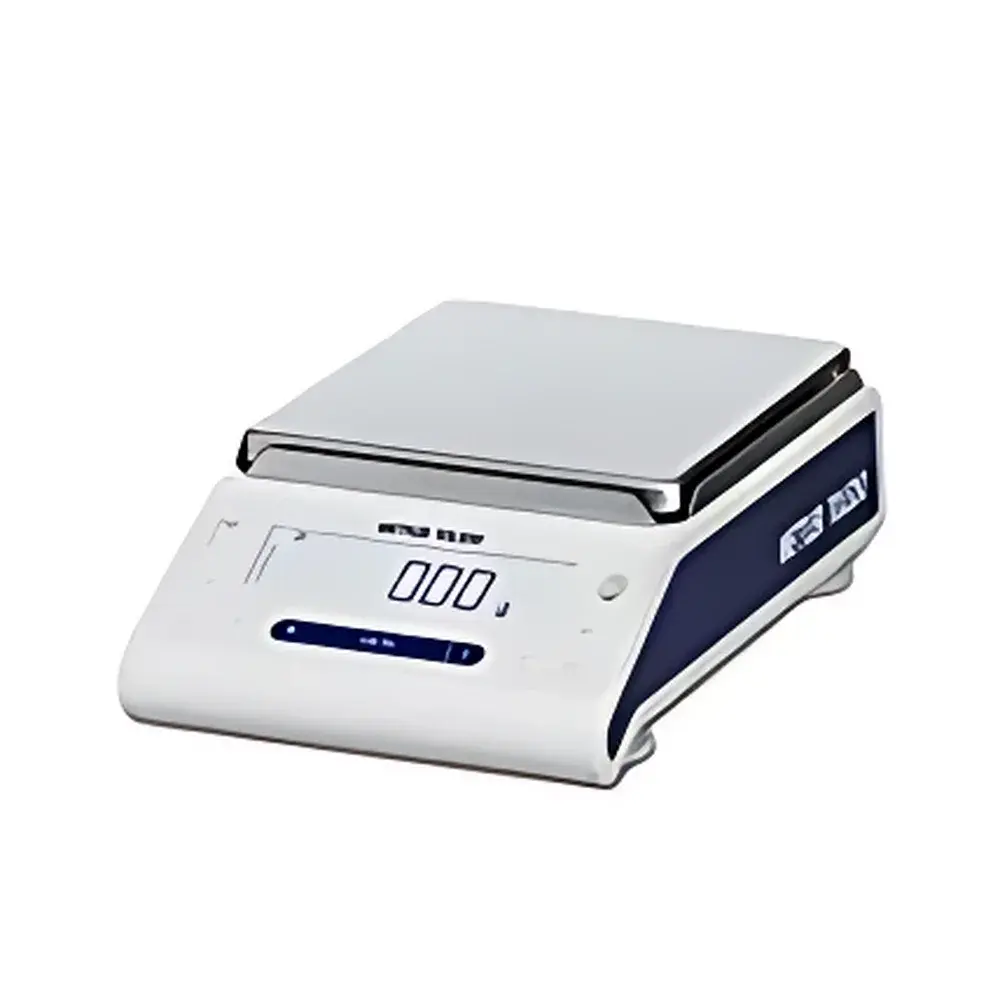
METTLER TOLEDO ML203T Precision Balance
| Brand | METTLER TOLEDO |
|---|---|
| Origin | Switzerland |
| Type | Precision Balance |
| Model | ML203T |
| Maximum Capacity | 220 g |
| Readability | 0.001 g |
| Repeatability | ≤ ±1 mg |
| Construction | Stainless steel base with chemical-resistant housing |
| Power Options | AC adapter or rechargeable battery |
| Compliance | ISO/IEC 17025, ASTM E898, USP <41>, GLP/GMP-ready |
Overview
The METTLER TOLEDO ML203T Precision Balance is an entry-level analytical-grade weighing instrument engineered for laboratories requiring high reproducibility, traceable calibration, and operational flexibility in constrained environments. Based on electromagnetic force compensation (EMFC) technology, the ML203T delivers stable, drift-free measurements by balancing the gravitational force on a sample against a precisely controlled electromagnetic field—ensuring long-term stability without mechanical wear. With a maximum capacity of 220 g and readability of 0.001 g (1 mg), it meets the performance criteria defined in USP for Class II balances and conforms to ISO/IEC 17025 requirements for uncertainty evaluation in accredited testing labs. Its compact footprint (210 × 320 × 90 mm) and dual-power architecture—supporting both AC mains and integrated rechargeable battery operation—enable seamless deployment across benchtop QC stations, field sampling carts, educational labs, and regulated manufacturing cleanrooms.
Key Features
- Single-module monolithic load cell with temperature-compensated EMFC transduction, minimizing thermal drift and ensuring consistent linearity across the full range.
- Internal automatic calibration system activated via front-panel key or scheduled intervals; includes built-in reference mass and real-time calibration status monitoring.
- Intuitive one-touch application menu with preconfigured modes: parts counting, percentage weighing, density determination, animal weighing, and checkweighing—each with configurable tolerances and pass/fail indicators.
- Rugged industrial design featuring a stainless-steel weighing pan and reinforced metal base coated with chemically inert polyurethane, resistant to common solvents including ethanol, acetone, and diluted acids.
- Integrated level indicator and adjustable feet for rapid mechanical leveling; auto-leveling alert triggers visual and audible warnings when tilt exceeds ±0.5°.
- RS232 and USB device ports compliant with METTLER TOLEDO’s Standard Interface Protocol (SIP), enabling direct data export to LIMS, ELN, or Excel without proprietary drivers.
Sample Compatibility & Compliance
The ML203T accommodates diverse sample forms—including powders, granules, liquids in tared containers, and small solid components—within its 130 mm diameter pan. Its draft shield compatibility (optional ML-SHIELD series) supports low-mass volatile samples under ambient airflow conditions. From a regulatory standpoint, the balance supports audit-trail-enabled operation when paired with METTLER TOLEDO LabX Lite software (sold separately), fulfilling ALCOA+ data integrity principles. It satisfies mandatory requirements for routine balance verification per ASTM E898 (Standard Practice for Verification of Analytical Balances) and aligns with FDA 21 CFR Part 11 expectations for electronic records when used with appropriate user access controls and electronic signatures.
Software & Data Management
While the ML203T operates autonomously via its embedded firmware, it interoperates seamlessly with METTLER TOLEDO’s LabX Lite software for centralized configuration, method deployment, and raw data archiving. LabX Lite provides automated report generation compliant with GLP and GMP documentation standards—including timestamps, operator ID, environmental metadata (temperature/humidity if external sensors are connected), and full calibration history. All exported data retain native units and significant figures, preserving metrological traceability. The balance also supports direct printing to certified thermal printers (e.g., Zebra GK420t) via ESC/POS command set, generating tamper-evident paper records suitable for batch release documentation.
Applications
- Pharmaceutical QC labs performing excipient assay, tablet weight variation testing (USP ), and standard solution preparation.
- Chemical R&D facilities conducting stoichiometric reagent dispensing, catalyst loading, and gravimetric titrant standardization.
- Food safety laboratories executing moisture content analysis (AOAC 950.46), ash determination, and nutritional labeling compliance checks.
- Academic teaching labs where robustness, intuitive interface, and battery portability support student-led experiments in analytical chemistry and materials science.
- Environmental testing sites weighing filter papers pre/post-exposure in PM2.5 and heavy metal particulate analysis workflows.
FAQ
What is the minimum sample weight for reliable measurement on the ML203T?
The minimum weight—defined as the smallest mass yielding a relative standard deviation ≤ 0.1% under repeatability testing—is 20 g, assuming optimal environmental conditions (draft-free, stable temperature, leveled surface).
Does the ML203T support external calibration with traceable weights?
Yes. While internal calibration is standard, the balance accepts manual external calibration using Class M2 or better certified weights per OIML R111, with full calibration certificate logging capability.
Can the ML203T be integrated into a networked lab infrastructure?
It supports TCP/IP connectivity via optional Ethernet module (ML-ETH), enabling remote configuration, firmware updates, and centralized diagnostics through LabX Enterprise.
Is the battery runtime sufficient for full-shift operation?
With typical intermittent use (10–15 weighings/hour), the integrated Li-ion battery provides ≥ 12 hours of continuous operation; full recharge takes ≤ 4 hours via included AC adapter.
How does the ML203T handle electrostatic interference during powder weighing?
The balance incorporates active electrostatic neutralization via integrated ionizer control logic—when used with optional ML-ION accessory—and automatically adjusts damping parameters to suppress oscillation artifacts caused by static charge accumulation.