
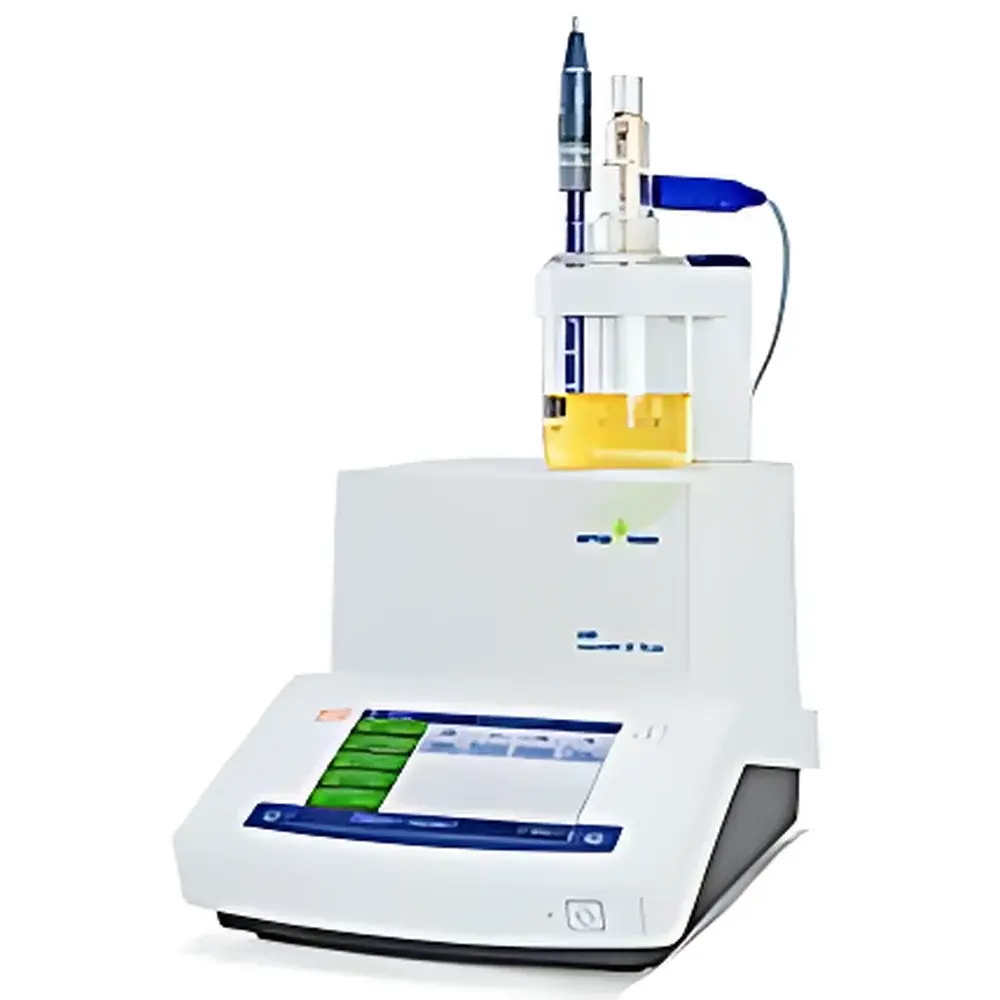
METTLER TOLEDO C20S Compact Coulometric Karl Fischer Moisture Analyzer
| Brand | METTLER TOLEDO |
|---|---|
| Origin | Switzerland |
| Instrument Type | Coulometric Karl Fischer Moisture Analyzer |
| Water Content Range | 10 µg – 200 µg |
| Measurement Accuracy | ±0.3 µg |
| Minimum Sample Injection Volume | 1 µL |
| Compliance | Fully compatible with GLP/GMP data integrity requirements (21 CFR Part 11 audit trail ready) |
| Electrode Options | Membrane-free and membrane-type electrolysis electrodes |
| Solvent Management | Integrated Solvent Manager with LevelSens level monitoring |
| Sample Introduction Modes | Direct injection, oven-based headspace extraction (up to 300 °C) |
Overview
The METTLER TOLEDO C20S Compact Coulometric Karl Fischer Moisture Analyzer is an engineered solution for trace-level water quantification in research laboratories, quality control environments, and regulated pharmaceutical manufacturing. Based on the electrochemical principle of coulometric Karl Fischer titration, the instrument generates iodine *in situ* via controlled electrolysis at a platinum electrode—eliminating the need for volumetric reagent standardization and ensuring inherent stoichiometric accuracy. This method delivers high reproducibility for samples containing water concentrations as low as 1 ppm (equivalent to 10 µg absolute water mass), making it especially suited for hygroscopic solids, solvents, polymers, active pharmaceutical ingredients (APIs), and excipients where residual moisture critically impacts stability, dissolution, or regulatory compliance.
Key Features
- Coulometric generation of iodine ensures direct proportionality between charge passed and water consumed—no reagent calibration drift or titrant degradation concerns.
- Compact glass titration cell with ultra-low drift design (<0.5 µg/min baseline stability) enables robust microgram-level determinations without environmental interference.
- Membrane-free electrolysis electrode option eliminates catholyte handling, reduces maintenance, and maintains precision down to sub-10 µg water measurements.
- One Click® interface with customizable graphical shortcuts allows user-specific workflows—12 programmable task buttons per profile streamline daily operation and minimize training time.
- Integrated Solvent Manager automates reagent dispensing, waste evacuation, and solvent replacement under full instrument control; LevelSens prevents overflow by real-time liquid-level monitoring.
- Oven coupling support (via optional KF Oven System) enables headspace analysis of non-soluble or thermally labile samples—programmable temperature ramping up to 300 °C with inert gas purge (N₂ or dry air).
Sample Compatibility & Compliance
The C20S accommodates liquid, solid, paste, and gaseous samples through multiple introduction pathways: syringe injection into the sealed cell, automated sample changer integration, or headspace transfer from heated ovens. It complies with ISO 8533:2017 (determination of water in petroleum products), ASTM D6304 (standard test method for water in petroleum products by coulometric Karl Fischer titration), and USP & EP general chapters and 2.5.12. Full 21 CFR Part 11 compliance is enabled via optional software modules supporting electronic signatures, audit trails, user access levels, and data encryption—meeting GMP/GLP documentation requirements for regulated industries.
Software & Data Management
Powered by METTLER TOLEDO’s dedicated tiamo™ software (v3.4+), the C20S supports method development, sequence programming, result validation, and report generation in accordance with ALCOA+ principles. All raw data—including current-time curves, endpoint detection logs, electrode status, and solvent consumption—are stored with immutable timestamps and operator IDs. Export formats include CSV, PDF, and XML for LIMS integration. Up to 100 user-defined methods can be saved locally, each with configurable parameters such as stirring speed, endpoint sensitivity, delay times, and over-titration limits.
Applications
- Pharmaceutical QC: Residual moisture in lyophilized powders, tablet coatings, and sterile APIs per ICH Q5C guidelines.
- Chemical manufacturing: Water content verification in catalysts, monomers, and specialty solvents prior to polymerization.
- Electronics: Moisture quantification in conformal coatings, encapsulants, and PCB substrates affecting dielectric performance.
- Food science: Low-level water activity assessment in dehydrated dairy powders, coffee extracts, and functional food additives.
- Materials R&D: Hydration state analysis of metal-organic frameworks (MOFs), zeolites, and battery electrolyte components.
FAQ
What is the difference between coulometric and volumetric Karl Fischer titration?
Coulometric KF generates iodine electrochemically within the titration cell, enabling precise measurement of water masses below 100 µg. Volumetric KF uses pre-standardized iodine-containing titrant delivered via burette—better suited for higher water contents (>100 µg) but subject to reagent stability limitations.
Can the C20S analyze samples that do not dissolve in methanol?
Yes—via headspace extraction using the optional KF Oven System, which volatilizes water from insoluble or thermally stable matrices and transports it to the titration cell under controlled gas flow.
Is method validation support available for regulated environments?
tiamo™ includes IQ/OQ templates and built-in system suitability tests (e.g., repeatability checks, blank correction, electrode response verification) aligned with USP and ASTM E2656.
How does the Solvent Manager enhance laboratory safety?
It fully automates handling of toxic, corrosive, and moisture-sensitive KF reagents—reducing operator exposure, minimizing spill risks, and ensuring consistent solvent volume delivery across analyses.
What electrode configuration is recommended for routine pharmaceutical testing?
The membrane-free electrode is preferred for most API and excipient applications due to simplified operation, reduced reagent consumption, and equivalent accuracy to membrane-type systems when maintained per manufacturer specifications.




