
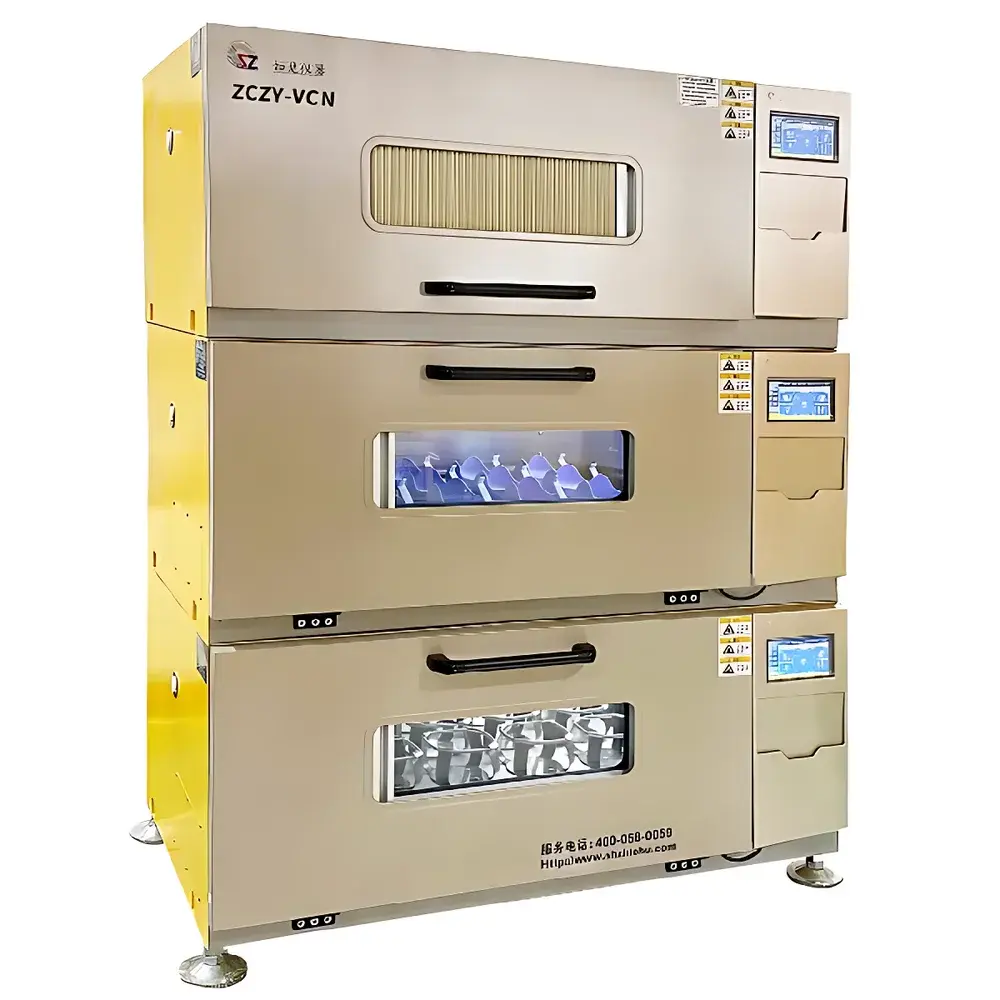
Zhichu ZCZY-VCN Triple-Layer Front-Access CO₂ Incubated Orbital Shaker
| Brand | Zhichu |
|---|---|
| Origin | Guangdong, China |
| Model | ZCZY-VCN |
| Instrument Type | CO₂-Controlled Temperature-Regulated Orbital Shaker |
| Timer Range | 0–999.9 h |
| Oscillation Frequency | 10–250 rpm (Ø50 mm) |
| Oscillation Amplitude | Ø50 mm (standard), Ø26 mm (optional) |
| Temperature Range | 4–60 °C (ambient: 23–25 °C) |
| Number of Shaking Platforms | 3 |
| Temperature Uniformity | ±0.3 °C at 37 °C |
| CO₂ Control Range | 0–20 % |
| CO₂ Control Accuracy | ±0.1 % |
| Display | LCD Touchscreen |
| Power Supply | AC 220 V ±10 %, 50–60 Hz |
| Noise Level | <55 dB(A) |
Overview
The Zhichu ZCZY-VCN is a triple-layer, front-access CO₂-incubated orbital shaker engineered for high-efficiency cell culture, microbial fermentation, and suspension-based bioprocess development under tightly controlled environmental conditions. Unlike conventional top-loading incubated shakers, its modular front-access architecture integrates three independently controllable shaking platforms within a single vertical footprint—maximizing lab space utilization without compromising operational flexibility or thermal/CO₂ stability. The system employs a precision-engineered three-dimensional eccentric cam drive mechanism to deliver smooth, low-vibration orbital motion across the full speed range, minimizing shear stress on sensitive biological samples while ensuring long-term mechanical reliability. Temperature regulation leverages a PID-controlled refrigeration circuit with variable-capacity inverter compressors and eco-friendly R134a refrigerant, enabling stable operation from 4 °C to 60 °C—even during extended low-temperature incubations. CO₂ concentration is actively maintained via a calibrated infrared (IR) sensor with real-time feedback control, supporting applications requiring strict physiological gas environments such as mammalian cell expansion, hybridoma culture, and anaerobic microbiology.
Key Features
- Triple-layer modular design with independent temperature, speed, and CO₂ control per platform—enabling simultaneous multi-condition experiments
- Front-access configuration with stainless-steel flush-mounted doors: lower two layers open downward; top layer opens upward—facilitating ergonomic loading/unloading of flasks and bioreactors without overhead clearance constraints
- Electropolished 304 stainless-steel interior with R-corner geometry and antimicrobial surface finish (≥99% bacterial inhibition per ISO 22196)
- UV-C germicidal lamp with programmable timer for routine chamber sterilization between runs
- Intelligent door-safety interlock: automatic motion stop upon door opening, with configurable restart delay
- Heated double-glazed observation window (tempered safety glass with integrated ITO heating film) prevents condensation and fogging during high-humidity or sub-ambient operation
- Adjustable door heating and optional light-blocking fabric curtain (reinforced polyurethane-coated polyester) for photophobic cultures
- High-torque servo motor with ±1 rpm speed accuracy and bidirectional rotation programming capability
- Integrated defrost cycle management: user-defined defrost duration (1–250 s) and interval (30–600 min) to prevent evaporator icing during prolonged cold operation
Sample Compatibility & Compliance
The ZCZY-VCN accommodates standard laboratory vessels—including Erlenmeyer flasks (250–2000 mL), baffled bottles, and culture bags—via interchangeable universal plastic clamps or stainless-steel fixtures. Its 540 × 540 mm platform supports up to 36 × 250 mL flasks (stainless-steel clamp) or 25 × 500 mL flasks (plastic clamp) per layer. All wetted surfaces comply with ISO 10993-5 cytotoxicity requirements and meet FDA-recommended material standards for bioprocessing equipment. The CO₂ delivery system achieves leak integrity per ASTM E2874 (gas containment test), maintaining 5% CO₂ setpoint for ≥30 minutes after supply interruption. Temperature uniformity (±0.3 °C at 37 °C) and CO₂ accuracy (±0.1 %) satisfy performance criteria outlined in USP for cell culture incubators and ISO 13408-2 for aseptic processing environments. Optional audit-trail-enabled firmware supports 21 CFR Part 11 compliance for regulated laboratories operating under GLP or GMP frameworks.
Software & Data Management
A 7-inch capacitive touchscreen interface provides unified visualization of real-time parameters—including actual and setpoint values for temperature, CO₂ concentration, RPM, elapsed time, and remaining runtime—without screen navigation. All operational data (temperature, speed, CO₂, alarms, door events) are logged internally with timestamping and retained for up to five years. Historical trends are rendered as overlayable XY plots directly on-screen. Data export is supported via USB 2.0 port in CSV format for downstream analysis in MATLAB, GraphPad Prism, or LIMS platforms. Optional remote monitoring via secure HTTPS-enabled mobile application allows authenticated access to live status, alarm notifications, and manual override functions—compatible with enterprise IT security policies including TLS 1.2 encryption and OAuth 2.0 authentication. Firmware includes configurable user roles (administrator, operator, viewer) with password-protected parameter locking to prevent unauthorized configuration changes.
Applications
- Mammalian cell line expansion (CHO, HEK293, hybridomas) under physiologically relevant CO₂ and temperature conditions
- Microbial growth kinetics studies requiring precise dissolved oxygen modulation through agitation-coupled aeration
- Suspension-based vaccine production workflows compliant with WHO TRS 999 Annex 2 guidance
- Stem cell differentiation assays where shear-sensitive progenitors demand consistent low-shear orbital motion
- Environmental microbiology studies involving psychrophilic or thermophilic strains across broad temperature ranges
- Biopharmaceutical process development—including media optimization, feeding strategy screening, and clone selection
FAQ
What is the maximum flask capacity per layer?
Each 540 × 540 mm platform supports up to 36 × 250 mL Erlenmeyer flasks using stainless-steel universal clamps, or 25 × 500 mL flasks using molded plastic clamps.
Can the ZCZY-VCN operate at 4 °C with CO₂ control active?
Yes—the refrigeration system and IR CO₂ sensor are fully functional across the entire 4–60 °C range, with validated CO₂ stability and temperature uniformity even at sub-ambient setpoints.
Is the internal UV sterilization cycle validated for mycoplasma reduction?
UV-C irradiation (254 nm, 30 mJ/cm² cumulative dose) meets ISO 15714:2019 requirements for >3-log reduction of common mycoplasma species when applied to clean, unobstructed surfaces.
Does the system support integration with building management systems (BMS)?
Optional Modbus RTU (RS-485) or Ethernet/IP interfaces are available for protocol-level integration into facility-wide environmental monitoring networks.
How is CO₂ calibration performed?
The factory-calibrated IR sensor requires no user recalibration; however, field verification using NIST-traceable gas standards (e.g., 5.00 ± 0.05 % CO₂ in N₂) is supported via service mode.




