
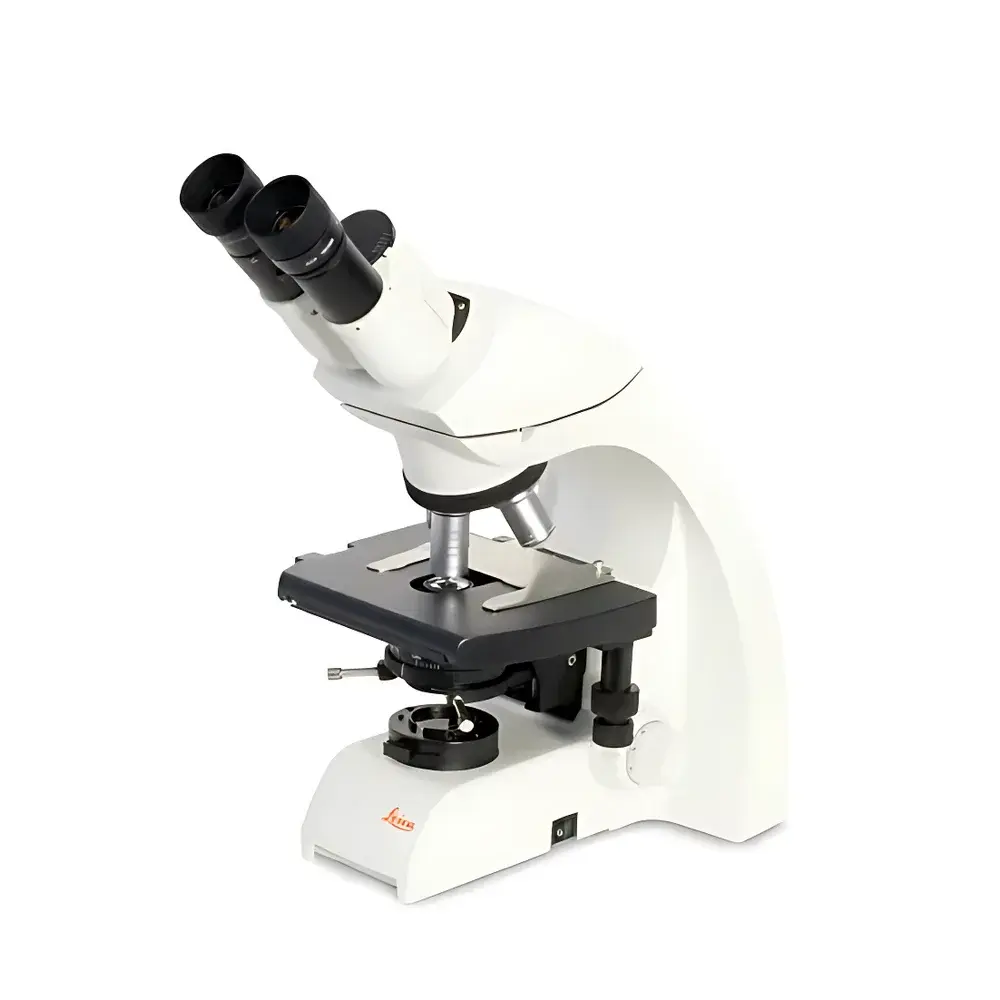
Leica DM750M Upright Metallurgical Microscope
| Brand | Leica |
|---|---|
| Origin | Beijing, China |
| Manufacturer Type | Authorized Distributor |
| Product Category | Domestic (China-manufactured) |
| Model | DM750M |
| Price Range | USD 1,400 – 7,000 |
| Configuration | Upright |
| Integrated Image Analysis System | Not Included |
Overview
The Leica DM750M is an upright metallurgical microscope engineered for precision material characterization in academic teaching laboratories, forensic science education, conservation science (e.g., artwork restoration), and introductory industrial quality control. It operates on reflected-light (epi-illumination) optical principles—optimized for opaque, non-transparent specimens such as metals, ceramics, composites, geological thin sections, and coated surfaces. Unlike transmitted-light biological microscopes, the DM750M integrates a modular Köhler-illuminated LED-based reflected-light turret with selectable contrast modes: brightfield, polarized light, and oblique illumination—enabling rapid, repeatable contrast optimization without mechanical realignment. Its optical path supports standard DIN 25 mm field-of-view eyepieces and accepts Leica’s full line of achromatic and semi-plan apochromatic objective lenses (5× to 100×), delivering nominal total magnifications from 50× to 1000× when paired with 10× wide-field eyepieces. The instrument adheres to ISO 8578 (microscopy — terminology and definitions) and complies with IEC 61000-6-3 (EMC emission standards) and IEC 61000-6-2 (immunity requirements) for laboratory instrumentation.
Key Features
- LED-reflected illumination system with integrated brightness control, delivering stable, flicker-free white light (CCT ≈ 5700 K) and >20,000-hour rated lifetime—eliminating filament replacement and thermal drift during extended observation sessions.
- Multi-mode illumination turret supporting brightfield, linear polarized light (with rotatable analyzer), and four-segment oblique illumination—enabling rapid contrast enhancement for surface topography, grain boundary delineation, and anisotropic phase identification.
- Robust mechanical stage with 76 × 52 mm travel range, calibrated vernier scales (0.1 mm resolution), and interchangeable specimen holders accommodating samples up to Ø30 mm (standard) or custom fixtures for irregular geometries.
- Dual-path compatibility: Stage and condenser are mechanically optimized for both reflected-light metallurgical work and optional transmitted-light applications (e.g., transparent inclusions or dual-mode polymer analysis) using accessory condensers and filters.
- Ergonomic modular viewing head options: Siedentopf binocular, inclined trinocular (for camera port), ergonomic tilting, and high-eyepoint configurations—each compatible with Leica 10×/20 mm FOV wide-field eyepieces and diopter-adjustable oculars.
- Reinforced cast-aluminum main frame with anti-vibration damping base; all optical components mounted on kinematic supports to minimize thermal and mechanical drift during multi-hour imaging sessions.
Sample Compatibility & Compliance
The DM750M accommodates standard metallurgical specimens (polished/mounted metallographic sections, sintered powders, fracture surfaces), geological thin sections (up to 30 mm diameter), forensic trace evidence (paint chips, tool marks, fiber fragments), and conservation samples (pigment layers, varnish cross-sections). Specimen mounting is facilitated via spring-loaded clamps, magnetic chucks (optional), or vacuum holders (accessory). The system meets structural safety requirements per EN 61000-1-2 (electromagnetic compatibility) and conforms to ISO/IEC 17025 guidelines for calibration traceability when used with NIST-traceable stage micrometers and reference standards. While not certified for GMP/GLP production environments, its design supports audit-ready documentation workflows when paired with compliant digital imaging hardware.
Software & Data Management
The DM750M is designed for seamless integration with third-party digital imaging platforms. It features a standardized C-mount (1×) video port and optional trinocular tube for coupling to Leica DMC-series or industry-standard USB3/UVC-compliant cameras (e.g., IDS UI-3880CP, Basler acA2000-50gm). No proprietary image analysis software is bundled; however, the microscope is fully compatible with open-architecture platforms including ImageJ/Fiji (with Leica-compatible metadata plugins), Olympus cellSens (via TWAIN driver), and HALCON-based custom QA pipelines. All captured images retain EXIF metadata (magnification, illumination mode, objective ID, exposure time), supporting traceable documentation under FDA 21 CFR Part 11–aligned systems when deployed with validated acquisition software and electronic signature modules.
Applications
- Materials Science Education: Grain size analysis (ASTM E112), inclusion rating (ASTM E45), phase identification in alloys and heat-treated steels.
- Forensic Laboratories: Comparative toolmark analysis, bullet striation evaluation, paint layer sequencing, and fiber birefringence assessment.
- Cultural Heritage Conservation: Stratigraphic examination of painted surfaces, gilding integrity mapping, corrosion product morphology in archaeological metals.
- Geoscience Instruction: Mineral identification in polished rock sections, porosity quantification in reservoir rocks, deformation feature analysis in tectonically sheared zones.
- Quality Assurance: Coating thickness estimation (cross-sectional view), solder joint inspection, weld microstructure verification per AWS D1.1 or ISO 5817.
FAQ
Is the DM750M suitable for quantitative image analysis?
No built-in analysis software is included. Quantitative measurements require external camera hardware and third-party software (e.g., ImageJ with calibrated stage micrometer input).
Can the microscope be upgraded to support fluorescence imaging?
No—fluorescence capability requires a dedicated excitation filter cube turret and mercury/xenon lamp source, which the DM750M optical path does not accommodate.
What objective lens series is compatible with the DM750M?
All Leica standard-thread (RMS) metallurgical objectives (e.g., EC Plan, N PLAN, and PROFLUO series), as well as third-party DIN 25 mm objectives meeting ISO 8578 mechanical tube length specifications.
Does the LED illumination support colorimetric consistency across users?
Yes—the fixed-color-temperature LED ensures reproducible white balance across operators and time, eliminating variability inherent in halogen lamp aging or voltage fluctuations.
Is service and calibration support available outside China?
Global technical support is provided through Leica Microsystems’ authorized distributor network; calibration services follow ISO/IEC 17025 protocols where local accredited labs are engaged.



