
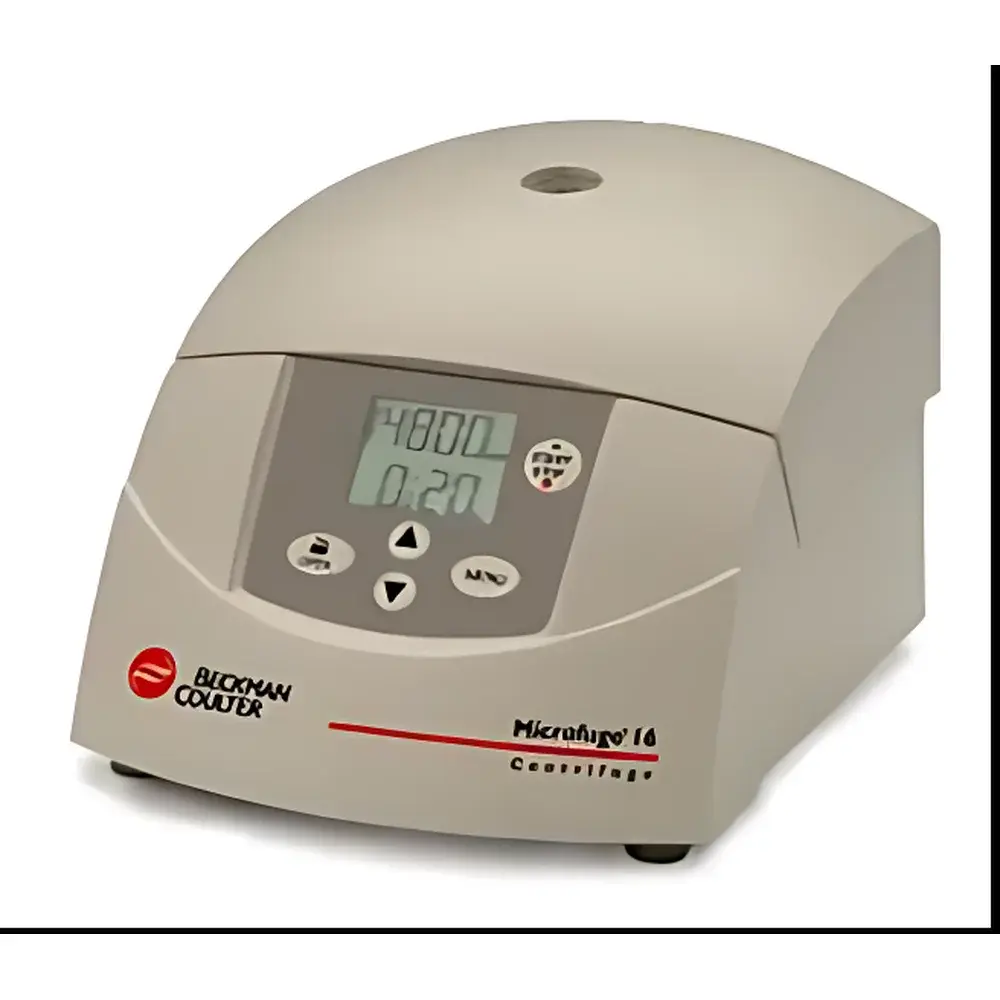
Beckman Coulter Microfuge 16 Benchtop Microcentrifuge
| Brand | Beckman Coulter |
|---|---|
| Origin | USA |
| Model | Microfuge 16 |
| Centrifuge Type | Benchtop Centrifuge |
| Speed Range | 0–14,800 rpm |
| Max RCF | 16,163 × g |
| Max Capacity | 24 × 2.2 mL |
| Dimensions (W×D×H) | 266 × 266 × 176 mm |
| Rotor Configuration | Fixed-angle rotor with dual-row asymmetric bore geometry |
| Tube Compatibility | 0.2–2.2 mL microtubes |
| Acceleration Time | 13 s (0–14,800 rpm) |
| Deceleration Time | 11 s (14,800 rpm → 0) |
| Motor Type | Brushless induction motor |
| Rotor Sterilization | Autoclavable (121 °C, 20 min) |
Overview
The Beckman Coulter Microfuge 16 is a compact, high-performance benchtop microcentrifuge engineered for precision separation of biological macromolecules and cellular components in resource-constrained laboratory environments. Utilizing fixed-angle rotor centrifugation based on sedimentation principles under controlled gravitational force (RCF), the instrument delivers reproducible pelleting of nucleic acids, proteins, viruses, and bacterial cells at up to 16,163 × g. Its mechanical architecture centers on a brushless induction motor—eliminating carbon brush wear, reducing electromagnetic interference, and ensuring long-term operational stability without routine motor maintenance. The unit operates within ISO 13485-aligned manufacturing standards and complies with IEC 61010-1 for electrical safety in laboratory equipment.
Key Features
- Ultra-compact footprint (266 × 266 × 176 mm) optimized for biosafety cabinets, laminar flow hoods, and shared benchtop workspaces.
- Dual-row fixed-angle rotor with asymmetric bore alignment—each row oriented at a distinct angular offset relative to the drive shaft—to ensure uniform radial acceleration across all 24 positions at identical rotational speeds.
- Brushless induction motor delivering quiet operation (<55 dB(A) at maximum speed) and thermal stability over extended run cycles.
- Rapid acceleration (0–14,800 rpm in 13 seconds) and deceleration (14,800–0 rpm in 11 seconds) minimize total processing time per run without compromising sample integrity.
- Autoclavable aluminum rotor (121 °C, 20 minutes, standard gravity cycle) supports GLP/GMP-compliant workflows requiring validated decontamination between batches.
- Integrated lid lock mechanism with automatic rotor recognition prevents operation unless the correct rotor is fully seated and secured.
Sample Compatibility & Compliance
The Microfuge 16 accommodates standard conical-bottom microcentrifuge tubes ranging from 0.2 mL PCR strips to 2.2 mL polypropylene tubes, with optional adapters enabling use of 0.5 mL and 1.5 mL formats. All rotors are certified for compatibility with common laboratory reagents including ethanol, isopropanol, chloroform, and low-concentration sodium hypochlorite solutions. The system meets IEC 61010-1:2010 for protection against electric shock and mechanical hazards, and its design facilitates compliance with FDA 21 CFR Part 11 requirements when integrated with validated LIMS or ELN platforms supporting electronic signatures and audit trails. Routine performance verification follows ASTM E2500-13 guidelines for equipment qualification in regulated environments.
Software & Data Management
As a standalone benchtop instrument, the Microfuge 16 features an intuitive rotary encoder interface with LED display for direct parameter entry (speed, time, RCF). It does not incorporate onboard data logging or network connectivity; however, its consistent mechanical repeatability (±50 rpm speed accuracy, ±5 s timer tolerance) enables integration into paper-based or electronic batch records compliant with ISO/IEC 17025 and CLIA standards. For laboratories implementing digital workflow management, third-party time-stamped run logs can be generated via external timers synchronized to SOP-defined protocols.
Applications
- Routine pelleting of plasmid DNA, genomic DNA, and RNA during extraction workflows (e.g., silica-membrane column purification).
- Concentration and recovery of recombinant proteins from clarified lysates prior to SDS-PAGE or HPLC analysis.
- Harvesting viral particles from cell culture supernatants in vaccine development and virology research.
- Separation of bacterial pellets for downstream genomic DNA isolation or antibiotic susceptibility testing.
- Micro-volume phase separation in organic-aqueous extractions (e.g., phenol-chloroform protocols).
- Preparative centrifugation steps in CRISPR-Cas9 ribonucleoprotein complex assembly workflows.
FAQ
Is the Microfuge 16 suitable for clinical diagnostic use under CLIA or CAP requirements?
Yes—when operated within documented SOPs and subjected to periodic preventive maintenance and speed calibration per manufacturer specifications, it supports CLIA-waived and moderate-complexity testing environments.
Can the rotor be sterilized using ethylene oxide (EtO) gas?
No—only autoclaving (121 °C, 20 min) is validated by Beckman Coulter for rotor decontamination. EtO exposure may compromise aluminum rotor integrity and void warranty coverage.
Does the instrument support programmable ramp profiles (e.g., gradual acceleration/deceleration)?
No—the Microfuge 16 employs fixed-rate acceleration and deceleration profiles optimized for microtube integrity and reproducible pelleting efficiency.
What is the recommended interval for rotor lifetime monitoring?
Beckman Coulter specifies a rotor service life of 10 years or 10,000 runs (whichever occurs first); users must record cumulative run counts and inspect for visible corrosion or deformation before each use.
Are replacement rotors and adapters available through authorized global distributors?
Yes—all original-equipment rotors (e.g., 302514, 302515), tube adapters, and lid assemblies are distributed through Beckman Coulter’s certified channel partners with full traceability documentation.



