
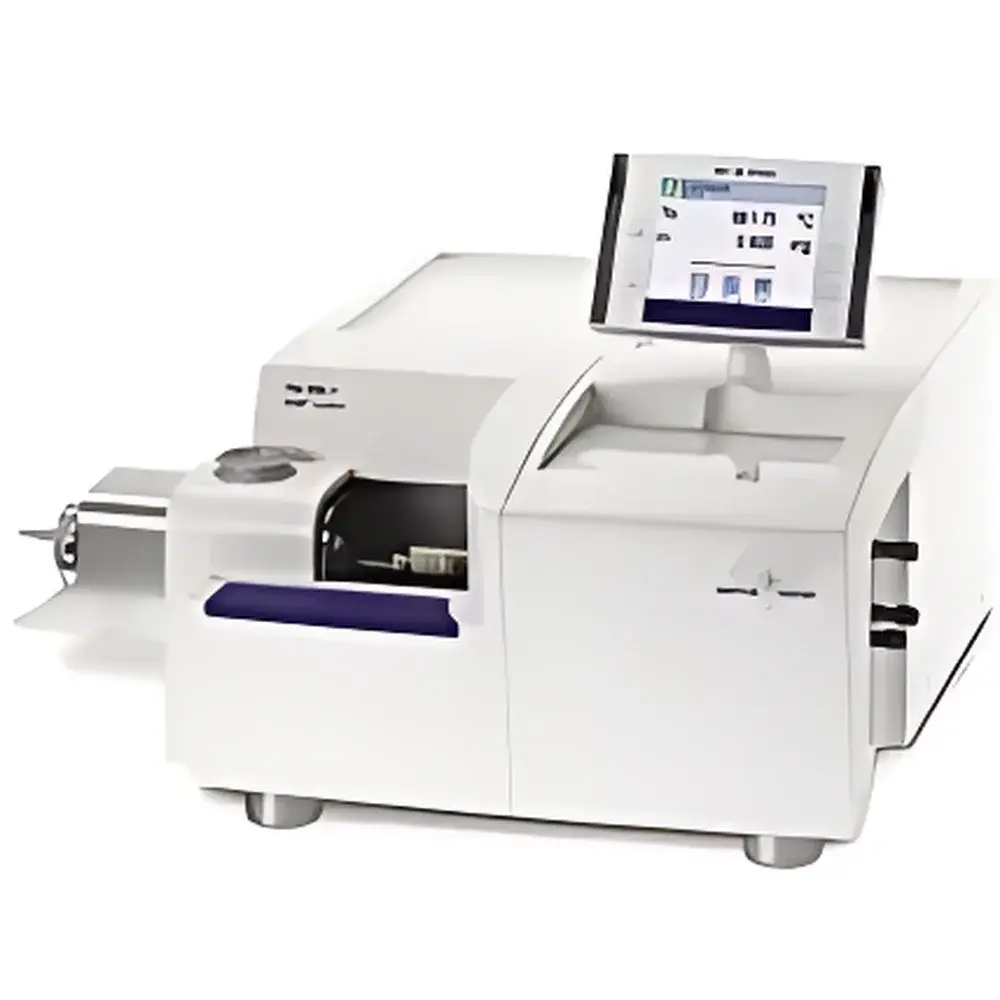
METTLER TOLEDO TGA/DSC 1 Simultaneous Thermal Analyzer
| Brand | METTLER TOLEDO |
|---|---|
| Origin | Switzerland |
| Model | TGA/DSC 1 |
| Temperature Range | RT to 1600 °C |
| Mass Resolution | Sub-microgram |
| Automation | Integrated Robotic Sample Changer |
| 炉 Atmosphere Control | Hermetic Furnace Design |
| Coupling Compatibility | MS and FTIR for Evolved Gas Analysis |
| Modular Architecture | Field-upgradable Hardware Modules |
Overview
The METTLER TOLEDO TGA/DSC 1 is a high-precision simultaneous thermal analyzer engineered for concurrent thermogravimetric analysis (TGA) and differential scanning calorimetry (DSC) measurements. It operates on the fundamental principle of measuring mass change (TGA) and heat flow (DSC) as a function of temperature or time under precisely controlled atmospheric conditions. The instrument employs METTLER TOLEDO’s proprietary ultra-microbalance—widely recognized as the industry benchmark for stability, linearity, and long-term repeatability—ensuring sub-microgram mass resolution across the full dynamic range. Its hermetically sealed furnace enables rigorous control of purge gas composition, flow rate, and pressure, critical for reproducible decomposition kinetics, oxidation studies, and volatile content quantification. Designed for research laboratories and industrial QC environments, the TGA/DSC 1 delivers traceable, GLP-compliant data essential for material certification, regulatory submissions, and process development in regulated sectors.
Key Features
- Ultra-stable microbalance with <1 µg mass resolution and <0.1 µg baseline drift over 24 h, calibrated in situ using integrated reference weights
- Continuous temperature operation from ambient to 1600 °C with ±0.1 °C thermal accuracy and <0.01 °C/min heating rate control
- Hermetic furnace architecture supporting inert, oxidative, reducing, and reactive atmospheres with dual-gas mixing and flow regulation (0–200 mL/min)
- Integrated robotic autosampler accommodating up to 48 standard crucibles (alumina, platinum, gold, or ceramic), enabling unattended multi-day testing sequences
- Modular hardware platform: optional DSC sensor upgrade paths, vacuum-compatible furnace variants, and direct coupling interfaces for quadrupole mass spectrometry (QMS) or Fourier-transform infrared (FTIR) spectrometers
- Real-time synchronization of TGA mass loss curves with DSC endo/exothermic peaks, enabling direct correlation of weight change events with thermal transitions (e.g., dehydration, decomposition, crystallization)
Sample Compatibility & Compliance
The TGA/DSC 1 accommodates solid powders, granules, thin films, fibers, and small metallic specimens (max. 1 g nominal sample mass). Crucible options include high-purity alumina (for general use), platinum-rhodium (for high-temperature oxidations), and sealed gold (for vapor-tight containment). The system complies with ASTM E1131, ISO 11358, and USP for thermal analysis methodology validation. Data acquisition and reporting meet FDA 21 CFR Part 11 requirements when deployed with METTLER TOLEDO’s STARe software in audit-trail-enabled mode—including electronic signatures, user access controls, and immutable raw-data archiving. Full traceability is maintained per ISO/IEC 17025 calibration protocols, with factory-certified verification reports supplied for balance sensitivity, temperature uniformity, and furnace geometry.
Software & Data Management
STARe (Simultaneous Thermal Analysis Research) software provides unified control, real-time visualization, and advanced kinetic modeling. It supports multi-step temperature programs, automatic peak detection with customizable baselines, and isoconversional analysis (e.g., Friedman, Ozawa-Flynn-Wall). Raw data files are stored in vendor-neutral .tdms format; export options include CSV, Excel, and XML for LIMS integration. Version-controlled method templates ensure inter-laboratory consistency, while electronic lab notebook (ELN) compatibility enables direct annotation and metadata tagging. All software modules undergo annual cybersecurity patching and are validated for GxP environments per METTLER TOLEDO’s IQ/OQ/PQ documentation package.
Applications
- Quantitative determination of moisture, solvent residues, filler content, and polymer degradation onset in pharmaceutical excipients and APIs
- Thermal stability profiling of battery cathode/anode materials (e.g., LiCoO₂, NMC, silicon composites) under argon and air
- Decomposition kinetics and activation energy calculation for catalysts, zeolites, and metal-organic frameworks (MOFs)
- Char yield assessment and ash composition analysis in coal, biomass, and municipal waste feedstocks
- Phase transition mapping in shape-memory alloys, high-entropy ceramics, and thermoset curing profiles (e.g., epoxy, phenolic resins)
- Gas evolution fingerprinting via hyphenated TGA-FTIR for identifying VOCs, H₂O, CO₂, SOₓ, and NOₓ released during pyrolysis
FAQ
What is the maximum sample mass capacity for quantitative TGA analysis?
Standard operation recommends ≤500 mg for optimal signal-to-noise ratio and thermal homogeneity; however, the furnace accommodates up to 1 g with appropriate crucible selection and calibration adjustment.
Can the TGA/DSC 1 be operated under vacuum or controlled partial pressures?
Yes—the hermetic furnace supports static vacuum down to 10⁻² mbar and dynamic pressure regulation between 0.1–5 bar absolute, compatible with specialized pressure-rated crucibles.
Is STARe software validated for use in FDA-regulated pharmaceutical manufacturing?
Yes—when configured with 21 CFR Part 11 compliance settings and installed per METTLER TOLEDO’s documented validation protocol, STARe satisfies data integrity requirements for batch release and stability studies.
How often does the microbalance require recalibration during routine use?
The built-in reference weight enables daily automated verification; full external calibration is recommended every 6 months or after mechanical shock, per ISO 9001 maintenance schedules.
Does the system support ASTM E2550 for decomposition onset temperature determination?
Yes—STARe includes preconfigured ASTM E2550 workflows with tangent-intersection algorithms and baseline correction routines compliant with the standard’s procedural definitions.



