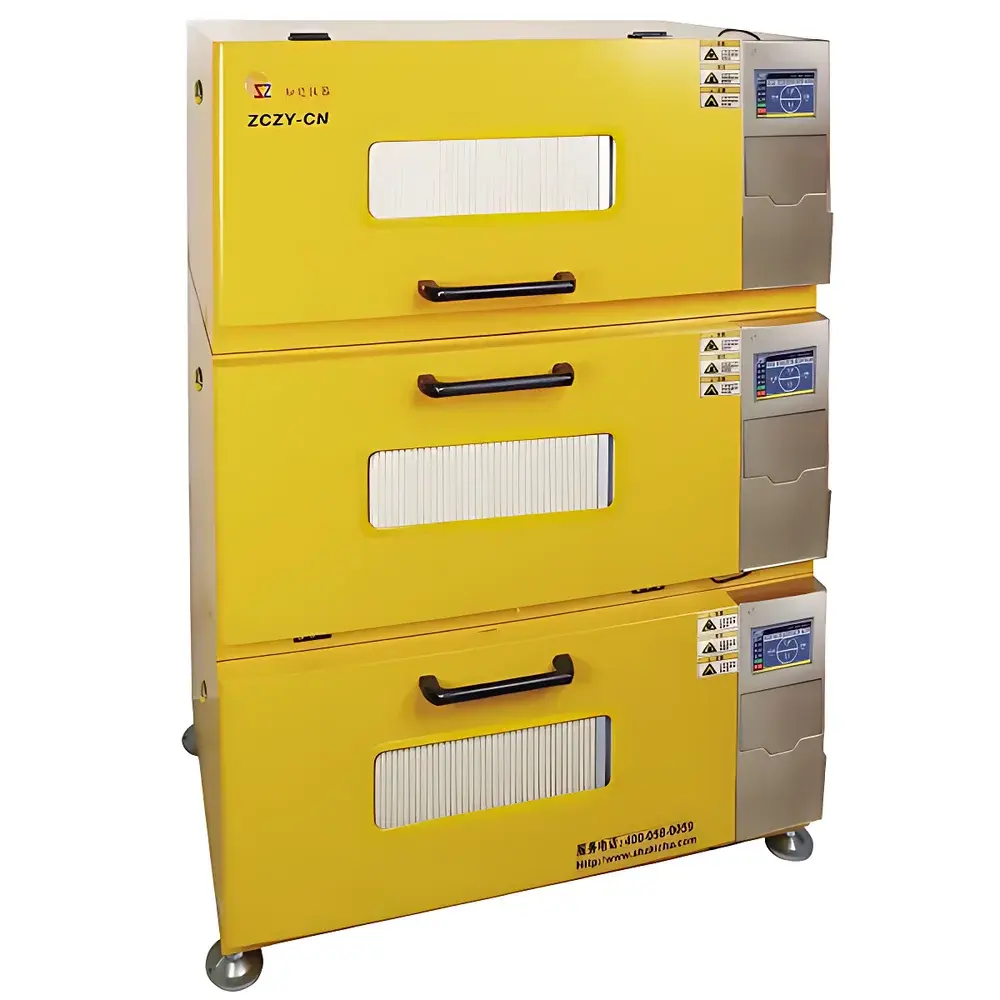
Zhichu ZCZY-CN Triple-Layer Compact CO₂ Orbital Shaking Incubator
| Brand | Zhichu |
|---|---|
| Origin | Guangdong, China |
| Manufacturer Type | Authorized Distributor |
| Product Category | Domestic |
| Model | ZCZY-CN |
| Instrument Type | CO₂-Regulated Temperature-Controlled Orbital Shaker |
| Timer Range | 0–999.9 h |
| Oscillation Frequency | 10–250 rpm (Φ50 mm platform) |
| Oscillation Amplitude | Φ50 mm (standard), Φ26 mm (optional) |
| Temperature Range | 4–60 °C (ambient: 23–25 °C) |
| Number of Shaking Decks | 3 |
Overview
The Zhichu ZCZY-CN is a triple-layer compact CO₂ orbital shaking incubator engineered for high-density, multi-condition cell culture, microbial fermentation, and suspension-based bioprocess development in constrained laboratory spaces. It integrates precise CO₂ concentration control (0–20% v/v), microprocessor-driven PID temperature regulation (±0.1 °C setpoint accuracy), and independently programmable orbital shaking across three vertically stacked decks. Each deck employs a robust three-dimensional eccentric cam drive mechanism—designed to minimize mechanical resonance and ensure long-term stability at high rotational speeds—while maintaining uniform heat distribution (±0.5 °C at 37 °C) and consistent gas-phase homogeneity. The system utilizes an imported non-dispersive infrared (NDIR) CO₂ sensor with 0.1% resolution and <30-minute decay time from 5% to 4.5% CO₂ under sealed conditions, ensuring reliable maintenance of physiological gas environments during extended runs. Its refrigeration subsystem features adjustable cooling capacity, adaptive defrost scheduling (1–250 s duration, 30–600 min intervals), and eco-friendly R134a refrigerant, enabling stable sub-ambient operation down to 4 °C without evaporator icing.
Key Features
- Modular triple-deck architecture (990 × 845 × 1740 mm) maximizes volumetric throughput per floor area—each deck operates independently with user-defined temperature, speed, CO₂, and timer settings
- Three-point eccentric cam drive system delivers smooth, low-vibration orbital motion (Φ50 mm standard amplitude; Φ26 mm optional) with ±1 rpm speed repeatability
- Double-glazed, heated tempered glass door with integrated anti-fog heating elements enables real-time visual monitoring without thermal or humidity disruption
- Medical-grade 304 stainless steel interior with R-corner design and seamless welds supports ISO 14644-compliant cleaning protocols and achieves >99% surface bacteriostatic performance
- UV-C germicidal lamp (254 nm) mounted inside the chamber provides automated sterilization cycles between experiments
- LCD touchscreen interface displays real-time values for temperature, RPM, CO₂ %, remaining time, and historical trend curves—all on a single screen with password-protected parameter locking
- Integrated data logging stores up to five years of timestamped environmental and operational data (temperature, speed, CO₂), exportable via USB to CSV or PDF for GLP/GMP audit trails
Sample Compatibility & Compliance
The ZCZY-CN accommodates standard Erlenmeyer flasks (250–2000 mL), roller bottles, and deep-well plates using either universal plastic clamps (one-hand loading/unloading) or stainless steel fixtures. Each deck supports maximum loads of 250 mL × 36, 500 mL × 25, 1000 mL × 16, or 2000 mL × 9 per layer. Humidity control (optional) maintains ≥90% RH at 37 °C via dual-stage evaporation trays, while door-heating functionality prevents condensation during low-temperature/high-humidity operation. The unit complies with IEC 61000-6-3 (EMC emissions), IEC 61000-6-2 (immunity), and meets mechanical safety requirements per ISO 13857. Its CO₂ control architecture aligns with USP guidance for cell culture environment qualification, and data integrity functions—including electronic signatures and audit trail generation—support FDA 21 CFR Part 11 readiness when paired with validated software configurations.
Software & Data Management
Embedded firmware supports continuous recording of all critical parameters at user-selectable intervals (1 s to 60 min). Trend visualization includes overlayable dual-axis plots (e.g., temperature vs. CO₂) with zoom, annotation, and threshold alarm markers. USB export generates time-stamped datasets compatible with JMP, MATLAB, and LIMS platforms. Optional cloud-connected mobile application (via Wi-Fi module) enables remote monitoring, push notifications for out-of-spec events (e.g., CO₂ deviation >±0.3%, temperature drift >±0.5 °C), and secure firmware updates. All logged data are stored in non-volatile memory with battery-backed clock, preserving continuity during power interruption—complemented by auto-resume functionality that restores pre-failure operating states.
Applications
- Mammalian cell line expansion under controlled pH (via CO₂/bicarbonate buffering) and shear-sensitive agitation
- High-yield recombinant protein expression in E. coli and Pichia pastoris cultures requiring precise dissolved oxygen modulation through orbital speed tuning
- Stem cell differentiation assays where multi-tiered environmental gradients (e.g., hypoxic upper deck + normoxic lower deck) accelerate protocol optimization
- Antibiotic susceptibility testing (AST) with simultaneous exposure of identical isolates to varying drug concentrations across decks
- Microbial consortia studies involving syntrophic co-cultures maintained under differential gas and thermal regimes within a single instrument footprint
FAQ
What is the CO₂ sensor technology used, and how often does it require calibration?
The system employs a factory-calibrated NDIR sensor with built-in automatic baseline correction. Full recalibration is recommended annually or after 2000 hours of cumulative operation, using certified 5% CO₂ in air reference gas.
Can individual decks operate at different temperatures simultaneously?
Yes—each of the three decks has independent heating/cooling circuits and PID controllers, allowing concurrent operation from 4 °C to 60 °C with ±0.1 °C setpoint resolution.
Is the unit suitable for GMP-regulated environments?
When configured with enabled audit trail, electronic signature, and data export validation packages, the ZCZY-CN satisfies key elements of Annex 11 and FDA 21 CFR Part 11 for computerized system validation in pharmaceutical QC labs.
How is humidity maintained during long-term incubation?
The dual-stage humidification tray system—combined with chamber wall heating and door-seal optimization—sustains ≥90% RH at 37 °C for >72 hours without manual refilling; RH is not actively controlled below 30 °C.
What safety protections are implemented against thermal or mechanical failure?
Redundant safeguards include overtemperature cutoff (hardware-independent), CO₂ overpressure venting, motor stall detection, door-open immediate stop logic, and uninterruptible power recovery with state rollback.