
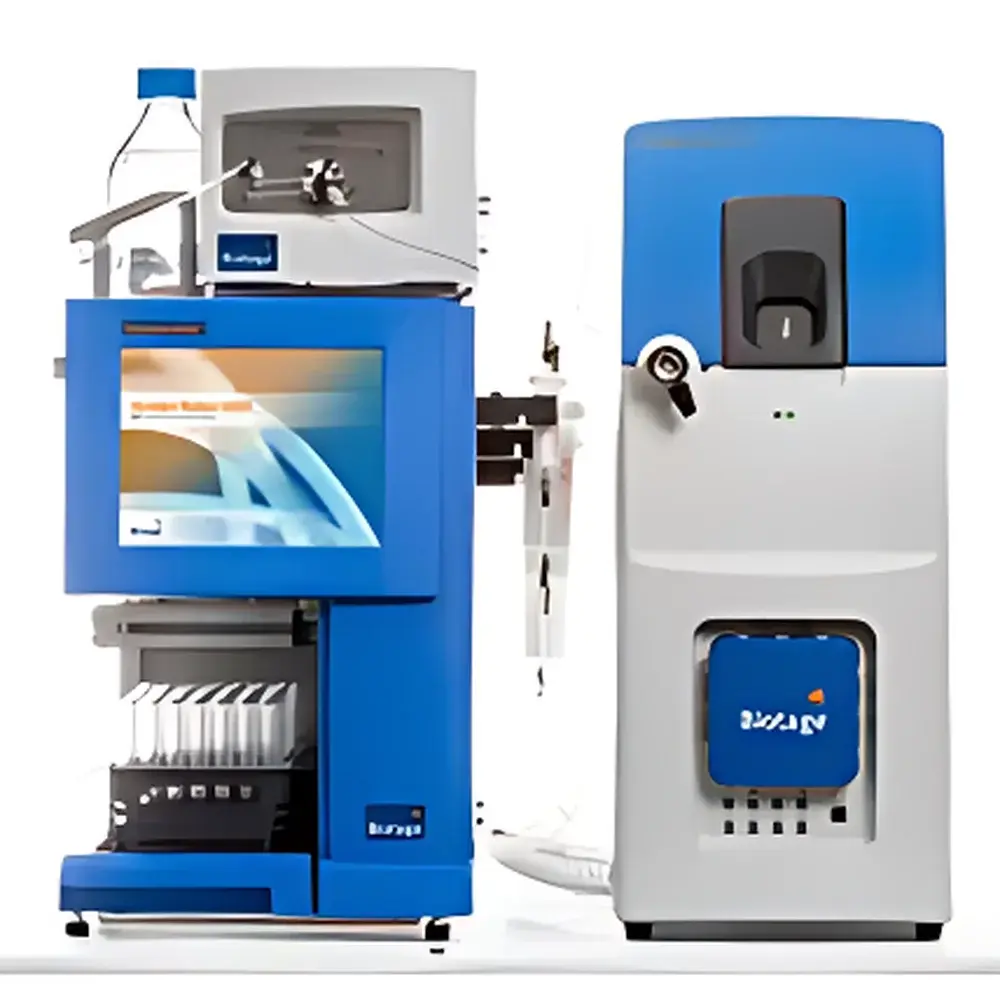
Biotage Dalton 2000 Rapid Purification–Mass Spectrometry System
| Brand | Biotage |
|---|---|
| Origin | Sweden |
| Model | Dalton 2000 |
| Ionization Sources | APCI (ESI optional) |
| Mass Range | 10–2000 m/z |
| Resolution | <0.7 FWHM at m/z |
| Mass Accuracy | ±0.1 m/z |
| Flow Rate Compatibility | 10–100 mL/min |
| Dimensions | 28 × 56 × 66 cm |
| Weight | 54 kg |
| Nitrogen Supply Pressure | 4.1–6.9 bar |
Overview
The Biotage Dalton 2000 is a purpose-built, compact single-quadrupole mass spectrometer engineered for real-time, on-line mass detection during flash chromatography purification. Designed as an integrated component of the Isolera™ platform, it operates in tandem with the Isolera Spektra preparative system and connects via the Isolera Dalton Nanolink interface to enable synchronized fraction collection and structural verification. Its core measurement principle relies on atmospheric pressure chemical ionization (APCI), with electrospray ionization (ESI) available as an optional source—providing robust ionization across a broad range of compound polarities and molecular weights (m/z 10–2000). Unlike standalone benchtop MS systems, the Dalton 2000 is optimized for high-flow LC-compatible operation (10–100 mL/min), eliminating the need for flow splitting or post-column dilution. This architecture supports direct coupling to normal-phase and reversed-phase flash systems without compromising sensitivity or duty cycle, making it suitable for routine compound identification in synthetic chemistry, natural product isolation, and medicinal chemistry workflows.
Key Features
- Real-time, on-line MS detection synchronized with flash chromatography fraction collection via Nanolink interface
- Dual-polarity operation: simultaneous positive- and negative-ion mode acquisition
- Full-scan MS acquisition with user-defined mass window selection for targeted fraction triggering
- Selective ion monitoring (SIM) for enhanced signal-to-noise ratio in complex matrices
- Auto-stop functionality triggered when target m/z signal crosses baseline threshold—minimizing solvent waste and operator intervention
- Modular design with front-access service panels and tool-free ion source exchange for rapid maintenance
- Integrated nitrogen supply regulation (4.1–6.9 bar) compatible with standard lab-grade nitrogen generators
Sample Compatibility & Compliance
The Dalton 2000 accommodates diverse sample types—including small-molecule organics, pharmaceutical intermediates, heterocycles, and moderately polar natural products—without requiring derivatization. Its APCI source delivers stable ionization for thermally stable, semi-volatile compounds; ESI option extends compatibility to polar, thermally labile, or high-molecular-weight species (e.g., peptides, glycosides). The system complies with ISO/IEC 17025 requirements for method validation in accredited laboratories and supports audit-ready data handling per FDA 21 CFR Part 11 when deployed with compliant LIMS or Biotage’s proprietary software suite. All firmware and calibration protocols are traceable to NIST-traceable standards, and mass accuracy (±0.1 m/z) meets ASTM E2933-13 criteria for qualitative mass spectral identification.
Software & Data Management
Control and data acquisition are managed through Biotage’s Isolera Software v5.x, which provides unified instrument orchestration across purification and MS modules. The software enables method-driven workflows: users define retention time windows, target m/z values, intensity thresholds, and collection logic prior to run initiation. Raw MS data are stored in open-format .RAW files (compatible with third-party processing tools including Compound Discoverer and MassHunter). Audit trails record all parameter changes, calibration events, and user actions with timestamps and operator IDs. Data integrity safeguards include electronic signatures, role-based access control, and encrypted local storage—supporting GLP/GMP environments where full traceability and reproducibility are mandated.
Applications
- Rapid identification of reaction products and by-products directly from crude flash eluates
- High-throughput purification of parallel synthesis libraries with immediate structural confirmation
- Isolation and characterization of natural product fractions without offline re-injection
- Method development for chiral or reverse-phase purification where MS-guided fraction cutting improves yield and purity
- Quality control of synthetic intermediates in API manufacturing under ICH Q5A/Q5D guidelines
FAQ
Can the Dalton 2000 be used with existing Isolera systems?
Yes—the Dalton 2000 is fully backward-compatible with Isolera Spektra, Isolera One, and Isolera LS platforms via the Nanolink interface.
Is ESI ionization required for polar compounds?
ESI is optional but recommended for highly polar, non-volatile, or thermally sensitive analytes; APCI remains effective for most medium-polarity organic molecules.
Does the system support quantitative analysis?
While primarily designed for qualitative detection and fraction triggering, SIM-mode data can be exported for semi-quantitative assessment using external calibration curves.
What maintenance intervals are recommended for the APCI source?
Source cleaning is advised every 200–300 hours of operation; full calibration is recommended quarterly or after major hardware servicing.
Is remote monitoring supported?
Yes—via secure HTTPS-enabled web interface; real-time status, run progress, and alert notifications are accessible through enterprise network infrastructure.





