
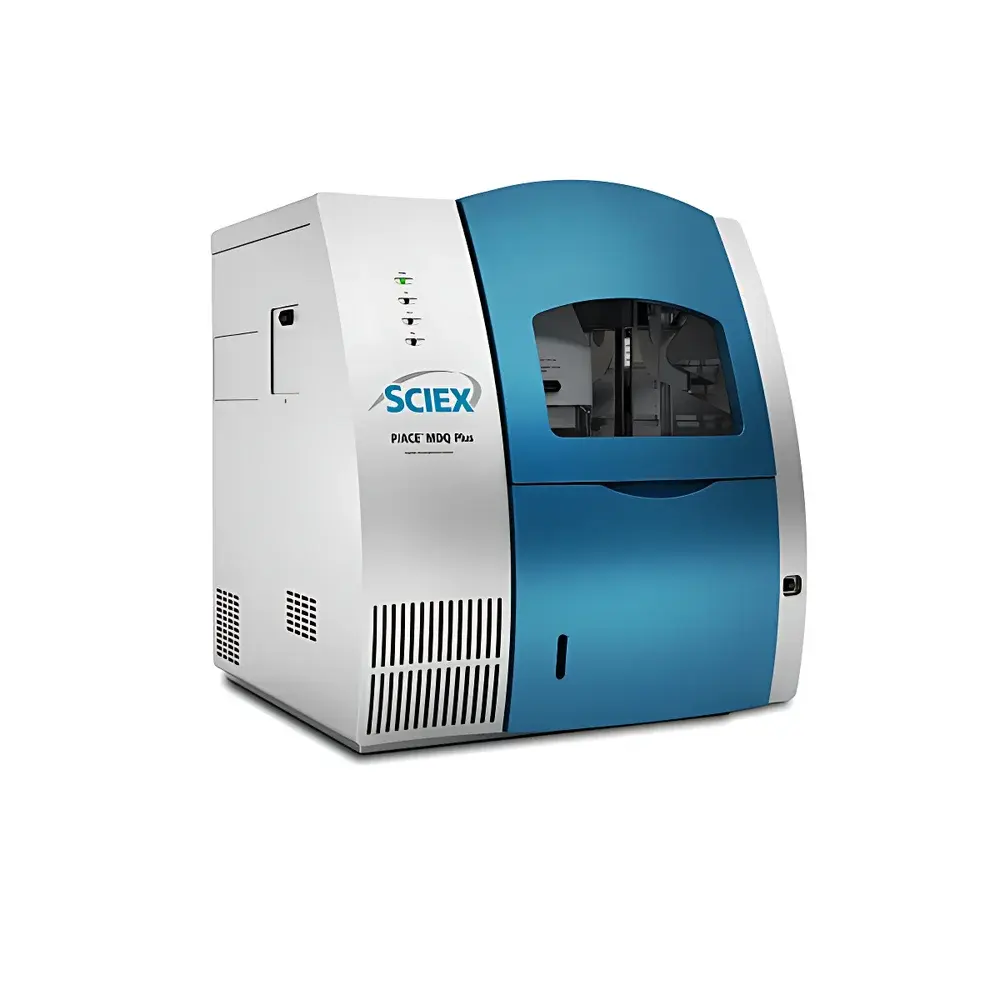
SCIEX P/ACE™ MDQ Plus Capillary Electrophoresis System
| Brand | SCIEX |
|---|---|
| Origin | Germany |
| Model | P/ACE™ MDQ Plus |
| Instrument Type | Capillary Electrophoresis (CE) |
| Sample Analysis | Organic Analysis |
| Cooling Method | Liquid Cooling |
| Detectors | UV, Laser-Induced Fluorescence (LIF), Diode Array Detector (DAD) |
| Injection Mode | Electrokinetic |
| Pressure Range | 5–100 psi |
| Temperature Control System | Liquid-Cooled Capillary Thermostat |
| Vendor Type | Authorized Distributor |
| Import Status | Imported |
Overview
The SCIEX P/ACE™ MDQ Plus Capillary Electrophoresis System is a fully automated, programmable platform engineered for high-resolution separation and quantitative analysis of charged and polar analytes in complex matrices. Based on the fundamental principles of capillary electrophoresis—where analytes migrate under the influence of a high-voltage electric field through a fused-silica capillary filled with electrolyte buffer—the system delivers exceptional efficiency, selectivity, and reproducibility. Its design emphasizes robustness for routine laboratory use while supporting method development flexibility across pharmaceutical, biopharmaceutical, clinical, and environmental applications. The P/ACE™ MDQ Plus integrates core CE functions—including high-voltage power supply, precision electrokinetic and pressure-assisted injection, real-time current monitoring, and temperature-stabilized capillary cartridge handling—into a single compact instrument architecture.
Key Features
- Modular, user-replaceable capillary cartridge system enabling rapid method switching and minimized downtime during maintenance or column changeover
- Patented liquid-cooled capillary thermostat providing precise temperature control (±0.1 °C) across the full operating range, critical for reproducible migration times and resolution stability
- Dual-mode injection capability: electrokinetic (voltage-driven) and pressure-assisted (pneumatic), with programmable voltage, duration, and pressure parameters (5–100 psi)
- Integrated high-voltage power supply (up to ±30 kV) with real-time current feedback and automatic current limiting for safe operation with high-conductivity buffers
- Onboard pneumatic system delivering stable, pulse-free pressure and vacuum for consistent sample introduction and buffer replacement
- Flexible sample introduction options: standard vials, micro-volume inserts, and direct 96-well plate compatibility via optional autosampler module
- Detector interchangeability: UV-Vis absorbance (190–600 nm), laser-induced fluorescence (LIF), and diode array detection (DAD) modules mount directly into the detector bay without tools
- Thermoelectrically controlled sample tray (4–40 °C) minimizing analyte degradation during extended runs
Sample Compatibility & Compliance
The P/ACE™ MDQ Plus accommodates a broad range of organic and bioorganic analytes—including small molecules, peptides, oligonucleotides, carbohydrates, and chiral compounds—particularly where traditional HPLC methods face limitations in speed or resolution. Its ability to operate with high-ionic-strength buffers and large-bore capillaries (up to 100 µm ID) enhances loading capacity and signal-to-noise for trace-level analysis. The system complies with essential regulatory requirements for analytical instrumentation: it supports audit-trail-enabled software (via SCIEX OS or legacy 32KARAT), meets FDA 21 CFR Part 11 criteria when configured with appropriate user access controls and electronic signature workflows, and aligns with ISO/IEC 17025 documentation practices for accredited testing laboratories. All hardware components are certified to IEC 61010-1 for electrical safety and electromagnetic compatibility (EMC).
Software & Data Management
Controlled via SCIEX OS or the legacy 32KARAT software suite, the P/ACE™ MDQ Plus enables complete method programming—including voltage ramping, temperature profiles, injection sequences, and detector acquisition parameters—in a single intuitive interface. Raw data are stored in vendor-neutral formats (e.g., .cdf) compatible with third-party processing tools. Software features include real-time electropherogram display, peak integration with customizable baseline algorithms, calibration curve generation, and report templates compliant with GLP/GMP documentation standards. Audit trails record all method modifications, run executions, and user logins with timestamps and operator IDs. Data backups, export to LIMS, and secure network deployment are supported in enterprise configurations.
Applications
- Pharmaceutical impurity profiling and stability-indicating assays per ICH Q5A/Q5B guidelines
- Charge variant analysis of monoclonal antibodies and other therapeutic proteins
- Genotyping and fragment analysis using capillary gel electrophoresis (CGE)
- Chiral separations of enantiomeric drug substances using cyclodextrin-modified buffers
- Metabolite identification in biological fluids (plasma, urine) following LC-CE hyphenation workflows
- Quality control of synthetic oligonucleotides and mRNA intermediates in biomanufacturing
- Environmental analysis of ionic pesticides and herbicides in aqueous extracts
FAQ
What capillary dimensions and coatings are supported?
Standard capillaries range from 25 to 100 µm inner diameter and 30–100 cm total length; bare fused silica, polyacrylamide-coated, and neutral capillaries are all compatible.
Can the system be integrated with an external autosampler or LIMS?
Yes—via RS-232, Ethernet, or OPC UA protocols; SCIEX OS supports direct LIMS connectivity through configurable API endpoints and HL7 messaging.
Is method transfer from older P/ACE systems straightforward?
Method parameters (voltage, temperature, injection settings) are backward-compatible; detector modules may require firmware updates for full feature parity.
What maintenance intervals are recommended for the liquid cooling system?
Coolant level and pump function should be verified quarterly; full coolant replacement is advised every 24 months under continuous operation.
Does the system support gradient elution or dynamic coating regeneration?
No—capillary electrophoresis does not employ mobile-phase gradients; however, dynamic coating renewal is achievable via programmed buffer flushes between runs.





