
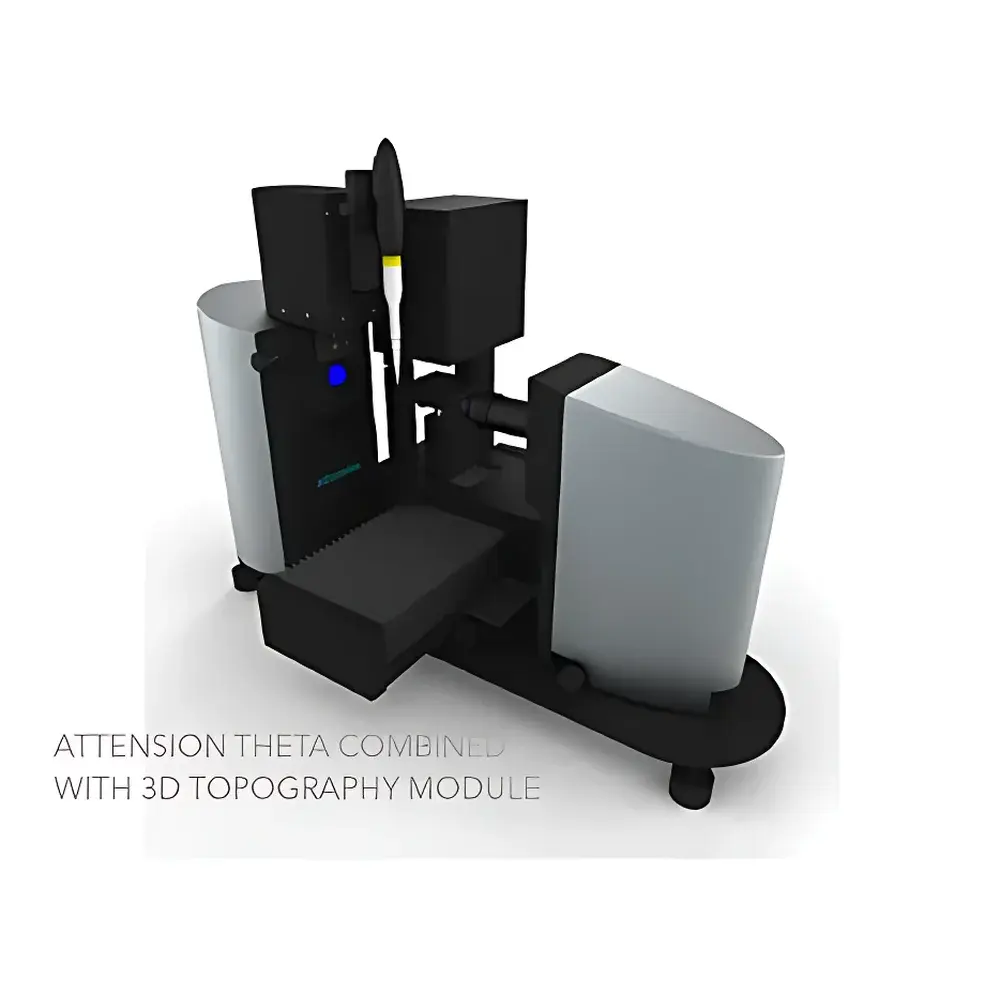
Theta-3D 3D Topography Module for Optical Contact Angle Analysis
| Origin | Sweden |
|---|---|
| Manufacturer Type | Authorized Distributor |
| Origin Category | Imported Instrument |
| Model | Theta-3D |
| Instrument Class | Dynamic Contact Angle Analyzer |
| Form Factor | Benchtop Laboratory System |
| Contact Angle Measurement Range | 0–180° |
| Angular Resolution | 0.1° |
| Sample Stage Dimensions (L × W × H) | Unlimited × 180 mm × 22 mm |
| Image Resolution | 1280 × 960 pixels |
| Surface & Interfacial Tension Range | 0–1000 mN/m |
Overview
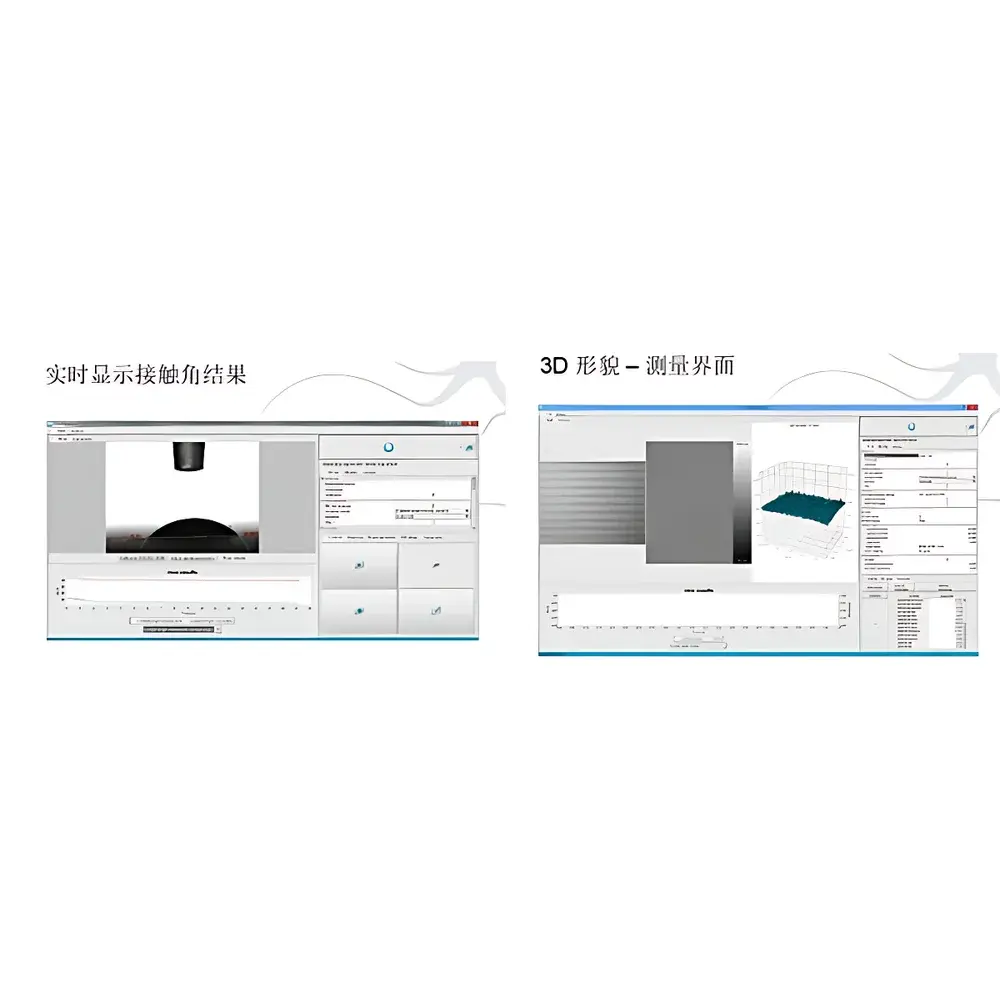
The Theta-3D 3D Topography Module is a precision optical add-on designed exclusively for integration with the Theta series of high-resolution optical contact angle analyzers. It represents the first commercially available solution enabling simultaneous, co-registered acquisition of dynamic contact angle data and quantitative 3D surface topography—within a single measurement cycle and without sample repositioning. The module operates on the principle of focus variation microscopy, utilizing a motorized high-NA objective and precise Z-axis scanning to reconstruct sub-micrometer-scale surface height profiles across defined XY fields. By correlating local topographic features (e.g., Sa, Sdr, Sq) directly with spatially resolved contact angle values (θapp), the system enables rigorous application of Wenzel’s model to compute the roughness-corrected (intrinsic) contact angle θc. This dual-parameter output provides foundational input for thermodynamic surface free energy calculations under ISO 14713-2 and ASTM D7490 frameworks—critical for materials where surface chemistry and topography co-determine interfacial behavior.
Key Features
- Co-registered 3D topography and dynamic contact angle acquisition in one instrument platform
- Automated Wenzel-based correction yielding intrinsic contact angle θc and surface free energy components (Lifshitz-van der Waals, acid-base)
- Focus-variation imaging with 1.41 mm × 1.06 mm lateral field (expandable to 4.2 mm × 4.2 mm via image stitching)
- Working distance of 18 mm—enabling compatibility with tall or irregularly shaped samples
- ISO-compliant roughness analysis per ISO 4287 (2D) and ISO 25178-2 (3D), including Sa, Sq, Sdr, Ra, Rq, Rp, Rv, Rz, R10z
- Gaussian high-pass filtering (per ISO 11562) for separation of roughness, waviness, and form
- XYZ motorized stage with unlimited longitudinal travel, supporting large-format substrates up to 180 mm wide × 22 mm high
Sample Compatibility & Compliance
The Theta-3D module requires optically diffuse-reflecting surfaces for reliable focus-variation profiling; highly specular or transparent substrates may require matte coating or alternative calibration protocols. All measurements adhere to internationally recognized standards for surface metrology and interfacial characterization: ISO 4287/4288 for 2D profile parameters, ISO 25178-2 for 3D areal parameters, and ASTM D7490 for contact angle methodology. Data audit trails, user access controls, and electronic signature support align with FDA 21 CFR Part 11 requirements when deployed in regulated GMP/GLP environments. Traceable calibration is maintained via NIST-traceable reference standards for both angular resolution (0.1° certified) and vertical height accuracy (±50 nm).
Software & Data Management
The Theta software suite (v6.0+) integrates native 3D topography processing with advanced contact angle analytics. It supports batch-mode analysis of multi-point arrays, automated region-of-interest (ROI) selection based on height thresholds, and export of fully annotated datasets in HDF5, CSV, and standardized .sur formats. All raw images, height maps, and derived parameters are time-stamped and linked to instrument configuration logs. For quality assurance workflows, the software generates PDF reports compliant with ISO/IEC 17025 documentation requirements—including uncertainty budgets for θc propagation based on combined roughness and angular measurement variances.
Applications
- Biomedical Implant Development: Quantifying independent contributions of mechanical grit-blasting (roughness) versus plasma polymerization (chemistry) to hydrophilicity and protein adsorption kinetics on Ti-6Al-4V or PEEK surfaces.
- Paper & Packaging Coating Optimization: Correlating micro-roughness (Ra < 0.5 µm) and wax dispersion uniformity with barrier performance against moisture vapor transmission (MVTR) and ink adhesion strength.
- Construction Material Durability Assessment: Evaluating how sandblasting-induced topography (Sdr > 15%) modulates water ingress resistance in cementitious coatings under cyclic humidity exposure.
- Wood–Plastic Composite (WPC) Interface Engineering: Mapping localized interfacial energy gradients at wood fiber/polyolefin boundaries to predict delamination onset under thermal stress.
- Microfluidic Device Fabrication: Validating lithographic fidelity by comparing designed vs. measured feature aspect ratios and their impact on capillary-driven flow initiation angles.
FAQ
Can the Theta-3D module be retrofitted to existing Theta optical goniometers?
Yes—the module mounts directly onto the Theta base unit via standardized kinematic interfaces and requires no hardware modification; firmware update and calibration validation are performed during installation.
What is the minimum resolvable surface feature height?
Vertical resolution is 50 nm (1σ) over the full 18 mm working distance, validated per ISO 25178-6 using calibrated step-height standards.
Does the system support advancing/receding contact angle hysteresis mapping?
Yes—automated liquid dosing and video capture enable pixel-wise hysteresis calculation across the entire topographic map, with spatial correlation to local slope and curvature.
Is ISO 25178-2 compliance verified by an accredited body?
Yes—type examination certification is held by SP Technical Research Institute of Sweden (accredited to ISO/IEC 17065), covering all 3D areal parameter algorithms.
How is sample tilt compensated during topography acquisition?
The software applies real-time planar fitting and Z-offset correction using fiducial markers or edge detection, ensuring accurate Sa/Sq computation even on non-level substrates.



