
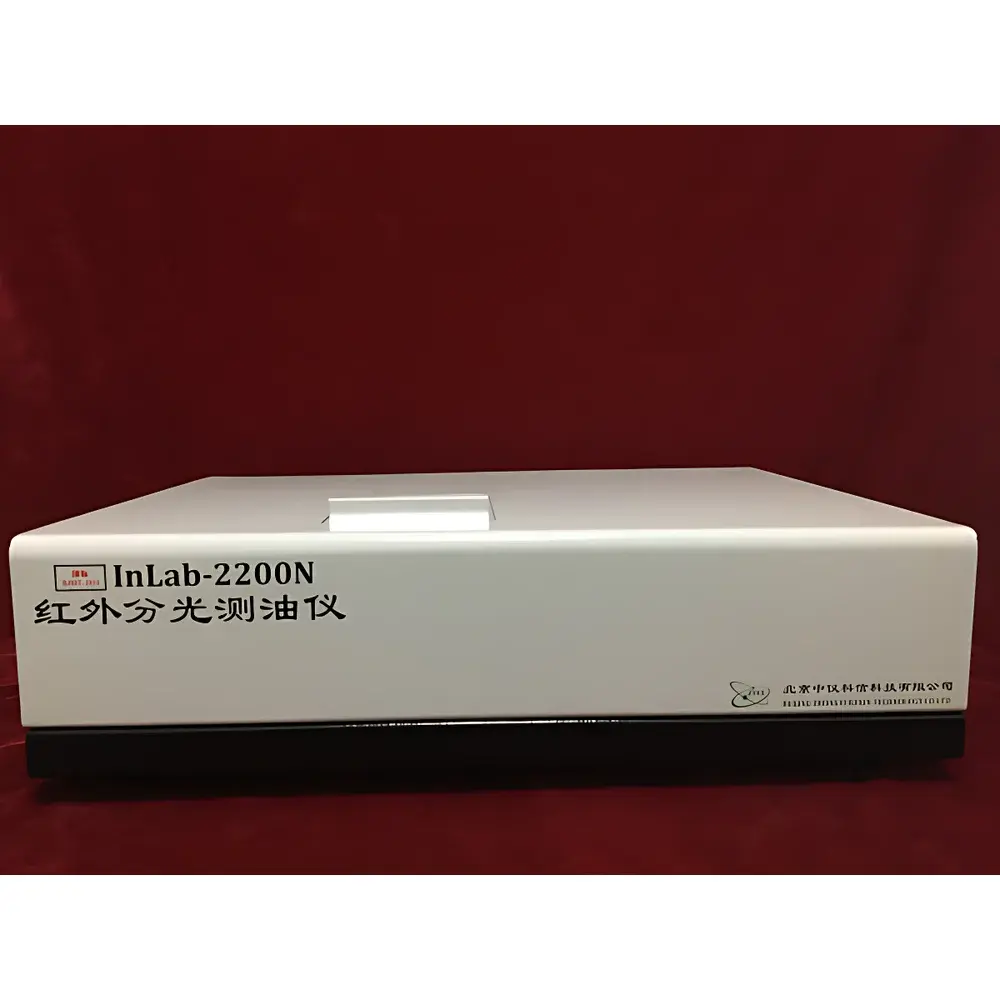
InLab-2200N Infrared Spectrophotometric Oil Content Analyzer
| Brand | ZYKX |
|---|---|
| Origin | Beijing, China |
| Model | InLab-2200N |
| Principle | Infrared Spectrophotometry |
| Measurement Range | 0–800 mg/L (extract) / 0.0012–64,000 mg/L (water sample, 100:1 extraction ratio) |
| Detection Limit | <0.05 mg/L (water sample, typical) |
| Accuracy | ±0.4 mg/L (C < 10 mg/L), ±3% (10 ≤ C ≤ 80 mg/L) |
| Resolution | 0.001 mg/L |
| Wavenumber Range | 4000–2400 cm⁻¹ |
| Spectral Resolution | 1 cm⁻¹ |
| Absorbance Range | 0.0000–3.000 AU |
| Baseline Drift | <0.001 AU/60 min |
| Measurement Frequency | 10 samples/min (discrete mode) |
| Cell Pathlength Compatibility | 0.5–5 cm |
| Interface | RS-232 or USB |
| Dimensions | 550 × 380 × 150 mm |
| Weight | ~14 kg |
| Power | 220 ± 22 V, 50 ± 1 Hz, 40 VA |
Overview
The InLab-2200N Infrared Spectrophotometric Oil Content Analyzer is a laboratory-grade instrument engineered for precise quantification of petroleum hydrocarbons, animal and vegetable oils, and total oil content in aqueous and solid-phase environmental matrices. It operates on the principle of infrared absorption spectroscopy—specifically targeting the asymmetric and symmetric C–H stretching vibrations near 2960 cm⁻¹, 2930 cm⁻¹, and 2870 cm⁻¹—enabling selective detection of hydrocarbon-based contaminants in compliance with internationally harmonized methodologies. The instrument fully supports both HJ 637–2012 and HJ 637–2018, China’s national standards aligned with ISO 9377-2 (petroleum hydrocarbons in water) and equivalent regulatory frameworks governing wastewater discharge, drinking water safety, and soil contamination assessment. Its dual-mode capability—simultaneous infrared spectrophotometric scanning and non-dispersive infrared (NDIR) measurement—ensures method flexibility without cross-interference, making it suitable for routine QC laboratories, environmental monitoring stations, and third-party testing facilities requiring trace-level sensitivity and spectral verification.
Key Features
- Modular optical architecture: Detachable, pre-aligned IR optics with post-dispersion absorption path—optimized for stability, low thermal drift, and high signal-to-noise ratio (SNR).
- Electrically modulated IR source: Eliminates mechanical chopper components, reducing maintenance, vibration artifacts, and heat load on the optical bench.
- Lock-in amplifier signal processing: Enhances detection sensitivity and extends the practical lower limit of quantitation (LLOQ) to sub-0.05 mg/L in water samples.
- Spectral validation capability: Real-time absorbance curve display (4000–2400 cm⁻¹) enables interference identification—e.g., alcohols, ketones, or chlorinated solvents—that may co-extract with target hydrocarbons.
- Universal cell compatibility: Accommodates standard quartz or CaF₂ cells with pathlengths from 0.5 cm to 5.0 cm; 4 cm cell supplied as standard for optimal sensitivity in low-concentration applications.
- Multi-solvent support: Fully compatible with tetrachloroethylene (per ASTM D7066–22 and HJ 637–2018), as well as legacy CCl₄-based protocols—without recalibration or hardware modification.
- Integrated software-controlled auto-zero and baseline correction: Compensates for solvent blank variability and long-term photodetector drift, ensuring adherence to Lambert–Beer law linearity (R > 0.9995).
- Two independent analytical modes: Full-spectrum IR scan (~90 s) for method validation and spectral deconvolution; rapid NDIR mode (2 s/sample) for high-throughput screening.
Sample Compatibility & Compliance
The InLab-2200N is validated for use across diverse environmental sample types—including surface water, groundwater, seawater, municipal wastewater, industrial effluents, soil leachates, and cooking fume condensates—following standardized liquid–liquid extraction (e.g., using tetrachloroethylene per HJ 637). It meets performance criteria specified in HJ 637–2018 for precision (repeatability ≤1% at 20 and 40 mg/L), accuracy (±0.4 mg/L below 10 mg/L), and spectral fidelity (wavenumber repeatability ±1 cm⁻¹). While not certified to ISO/IEC 17025 out-of-the-box, its data integrity features—including timestamped audit trails, user-access logging, and exportable raw spectra—support GLP-compliant operation and internal QA/QC documentation. Optional pH module integration allows concurrent acidity monitoring during oil extraction, supporting studies on pH-dependent emulsification or hydrolysis effects.
Software & Data Management
The proprietary acquisition and analysis software provides full control over instrument parameters, spectral acquisition, calibration management, and quantitative reporting. All measurements are stored with metadata (operator ID, date/time, cell pathlength, solvent batch, calibration curve ID), enabling traceability required under ISO 17025 Clause 7.7 and FDA 21 CFR Part 11 (when deployed with electronic signature and role-based access controls). Users can generate regression curves (linear or polynomial), overlay reference spectra, perform peak integration at defined wavenumbers (e.g., CH₂, CH₃, aromatic C–H), and export ASCII or CSV files for LIMS integration. Spectral libraries for common interferents (e.g., silicone oils, fatty acids) are configurable. Data backups, report templates (PDF/Excel), and spectral printing are supported natively.
Applications
- Regulatory compliance testing for petroleum hydrocarbons in wastewater discharges (EPA Method 1664 equivalents, GB/T 16488–1996, HJ 637).
- Drinking water source protection monitoring—detection of diesel, gasoline, or lubricant leakage into aquifers.
- Soil contamination assessment following ASTM D7678 (oil-in-soil by IR).
- Cooking oil mist analysis in food service exhaust systems per national emission standards.
- QC of organic solvents—verification of hydrocarbon impurity profiles prior to use in extraction protocols.
- Research applications involving C–H bond quantification in complex mixtures (e.g., bio-oils, microplastic leachates, or biodegradation intermediates).
FAQ
Does the InLab-2200N comply with international standards beyond Chinese national methods?
Yes—it implements core spectroscopic principles consistent with ISO 9377-2 (petroleum hydrocarbons in water), ASTM D7066–22 (tetrachloroethylene-based IR analysis), and EN ISO 9377-2:2000, facilitating cross-border data acceptance when paired with appropriate validation documentation.
Can the instrument distinguish between mineral oil and vegetable oil?
It does not speciate individual compound classes automatically, but spectral deconvolution of absorbance bands—particularly the CH₃/CH₂ ratio and presence of ester C=O peaks near 1740 cm⁻¹—enables semi-quantitative differentiation when reference spectra are available.
Is method validation support provided?
The system includes built-in tools for LOD/LOQ determination, linearity assessment (R² calculation), spike recovery tests, and duplicate analysis tracking—all documented in the software audit log.
What maintenance is required for long-term optical stability?
Annual verification of wavenumber accuracy (using polystyrene film standard) and detector dark-current calibration are recommended; no lamp replacement is needed for ≥5,000 hours due to solid-state IR source design.
Can raw spectral data be exported for third-party chemometric analysis?
Yes—absorbance vs. wavenumber (.csv) files are exportable with 1 cm⁻¹ resolution, preserving full spectral fidelity for PCA, PLS regression, or library matching in external platforms like MATLAB or Unscrambler.







