
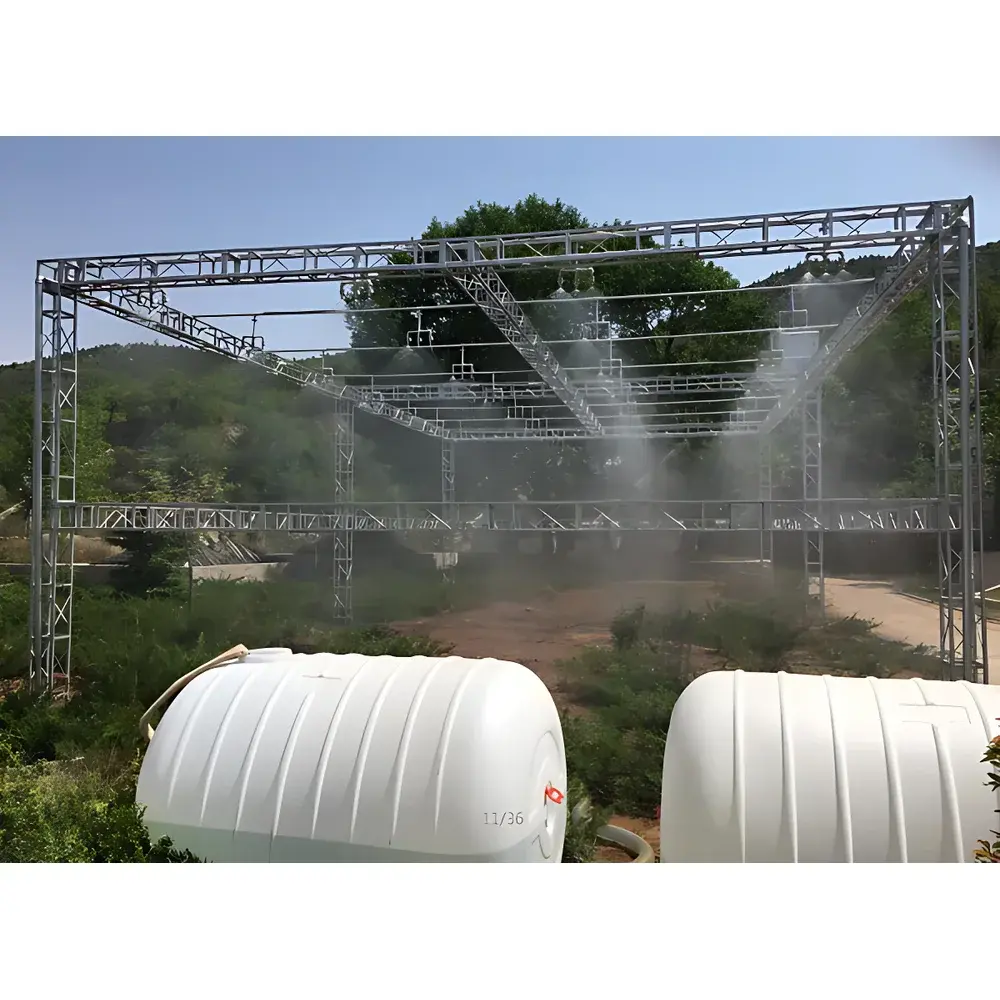
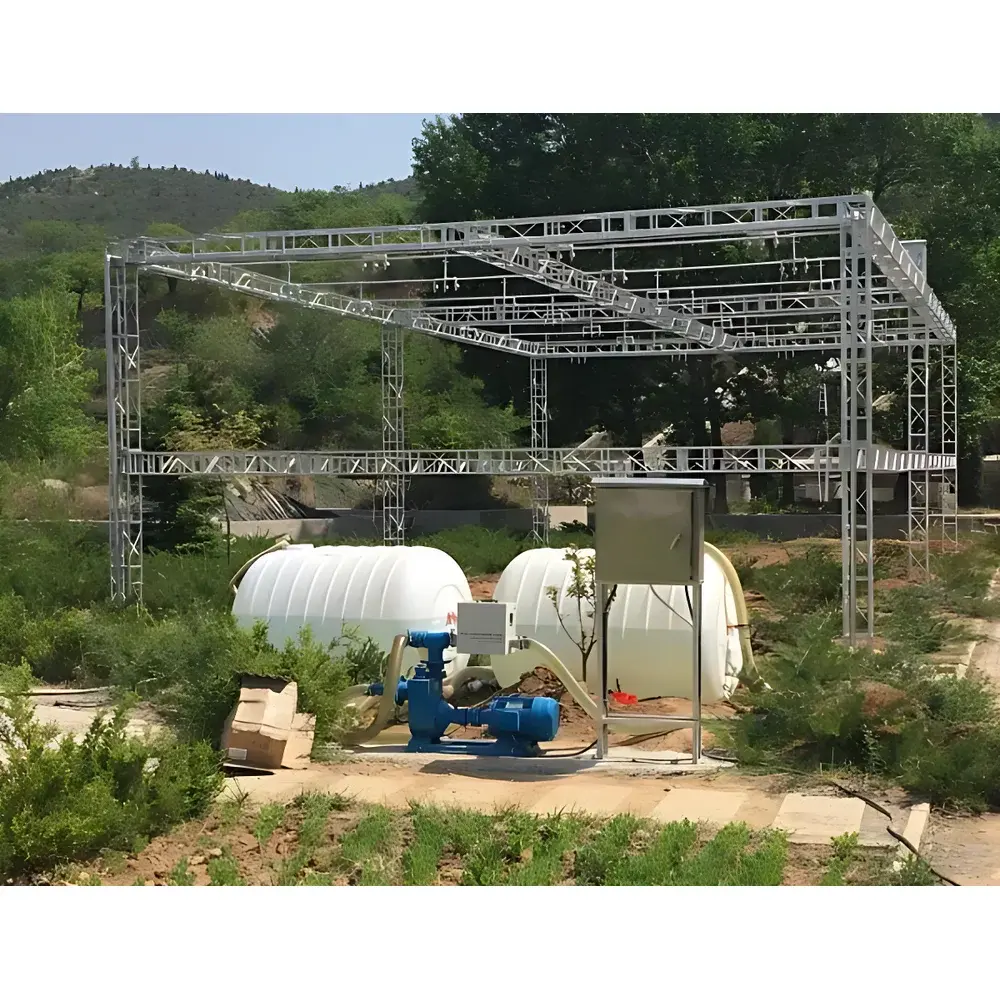
ZYJY-DZ10 Portable Artificial Rainfall Simulator
| Brand | ZYKX |
|---|---|
| Origin | Beijing, China |
| Manufacturer Type | Authorized Distributor |
| Country of Origin | China |
| Model | ZYJY-DZ10 |
| Instrument Type | Soil Moisture & Infiltration Simulation System |
| Rainfall Area | 2–100 m² (customizable) |
| Rainfall Height | 3–4 m (customizable) |
| Rainfall Intensity Range | 20–200 mm/h |
| Rainfall Uniformity Coefficient | >85% |
| Intensity Resolution | ±6 mm/h |
| Rainfall Duration | Programmable (unlimited) |
| Control Mode | PC-based real-time monitoring with pressure, valve status, and intensity feedback |
| Power Supply | 220 V AC |
| Structural Design | Tool-free quick-connect modular assembly |
| Service Life | ≥15 years |
| Data Storage Capacity | 1000 hours of rainfall intensity logs |
Overview
The ZYKX ZYJY-DZ10 Portable Artificial Rainfall Simulator is an engineered field-deployable system designed for controlled, reproducible simulation of natural precipitation under outdoor or semi-field conditions. It operates on a pressurized vertical-drop principle—mimicking the kinetic energy and spatial distribution characteristics of atmospheric rainfall—enabling quantitative investigation of surface hydrological processes including infiltration, runoff generation, soil erosion, sediment transport, and crust formation. Unlike gravity-fed or low-energy sprinkler-based simulators, the ZYJY-DZ10 delivers consistent droplet impact energy across its designated test area (2–100 m²), making it suitable for soil physics, ecohydrology, land degradation, and civil engineering applications where rainfall energy and spatial uniformity are critical experimental variables. Its modular architecture and self-contained hydraulic control eliminate dependency on external water infrastructure, supporting rapid deployment in remote or topographically variable terrain.
Key Features
- Pressurized vertical-drop nozzle array ensures high kinetic energy delivery and enhanced wind resistance—critical for maintaining rainfall uniformity (>85% coefficient) under ambient field winds up to 5 m/s.
- Modular tool-free assembly using standardized quick-connect couplings enables full system setup or reconfiguration in under 20 minutes by two personnel.
- Real-time closed-loop intensity control via motorized ball valves, with continuous feedback of pipeline pressure, flow rate, and actuator position transmitted to the host PC interface.
- Programmable rainfall profiles support discrete or ramped intensity sequences—including sustained drizzle (20 mm/h), moderate rain (60 mm/h), heavy rain (120 mm/h), and storm-level events (200 mm/h)—with adjustable duration per phase.
- Integrated data logging captures timestamped rainfall intensity at 1-second resolution, storing up to 1000 hours of measurement history locally on embedded non-volatile memory.
- Corrosion-resistant stainless-steel and UV-stabilized polymer components ensure long-term structural integrity in humid, acidic, or saline environments; rated for ≥15 years of field service under routine maintenance.
Sample Compatibility & Compliance
The ZYJY-DZ10 accommodates heterogeneous soil surfaces—including bare loam, gravel-mixed substrates, vegetated plots, biochar-amended layers, and engineered geotextile-reinforced slopes—without requiring substrate modification. Its adjustable height (3–4 m) and scalable coverage allow direct alignment with ASTM D3910 (Standard Test Method for Determining Erosion Resistance of Soils) and ISO 11274 (Soil Quality – Determination of Field-Saturated Hydraulic Conductivity). While not certified for GLP or FDA-regulated studies, its deterministic control architecture supports traceable, auditable experimental protocols compliant with ISO/IEC 17025 documentation requirements for environmental testing laboratories. All electrical components meet IEC 60529 IP54 ingress protection standards.
Software & Data Management
The system interfaces with Windows-based control software featuring a graphical SCADA-style dashboard. Users define rainfall schedules using a drag-and-drop timeline editor, set upper/lower bounds for intensity tolerance, and enable automatic validation checks prior to execution. Logged data export formats include CSV (for MATLAB, R, or Python post-processing) and XML (compatible with LIMS integration). Audit trails record operator login, parameter changes, emergency stops, and calibration events—supporting basic 21 CFR Part 11 readiness when deployed in academic or government research settings governed by data integrity mandates.
Applications
- Quantification of infiltration dynamics and Hortonian/Phillips-type runoff thresholds across soil texture gradients.
- Validation of erosion prediction models (e.g., RUSLE, WEPP) under controlled, repeatable rainfall energy inputs.
- In situ assessment of mulch efficacy, cover crop performance, and soil amendment impacts on splash detachment and seal formation.
- Calibration and verification of distributed hydrological models requiring spatially explicit rainfall–runoff response functions.
- Testing of erosion control geosynthetics, biodegradable mats, and slope stabilization systems under simulated design-storm conditions.
- Interdisciplinary field experiments bridging pedology, agronomy, and civil infrastructure resilience planning.
FAQ
What power source is required for field operation?
A standard 220 V AC single-phase supply is required; optional portable diesel or solar-battery hybrid power kits can be integrated upon request for off-grid deployments.
Can the system operate autonomously without a connected PC?
Yes—the onboard microcontroller executes preloaded rainfall programs independently; the PC is only required for configuration, real-time visualization, and data retrieval.
Is rainfall uniformity validated per international standards?
Uniformity is verified using the Christiansen Coefficient method (ASTM D5242) during factory acceptance testing; users may perform field recalibration using standardized catch-can arrays.
How is system portability achieved without compromising structural rigidity?
All primary load-bearing components utilize triangulated aluminum extrusion frames with captive fasteners; no bolts or tools are needed for assembly/disassembly, and total packed weight remains below 120 kg for air transport compliance.
Does the system support integration with third-party sensors (e.g., tensiometers, TDR probes)?
Yes—via RS-485 Modbus RTU or analog 4–20 mA inputs, enabling synchronized acquisition of soil moisture, matric potential, and temperature alongside rainfall metrics.
Related Products







