
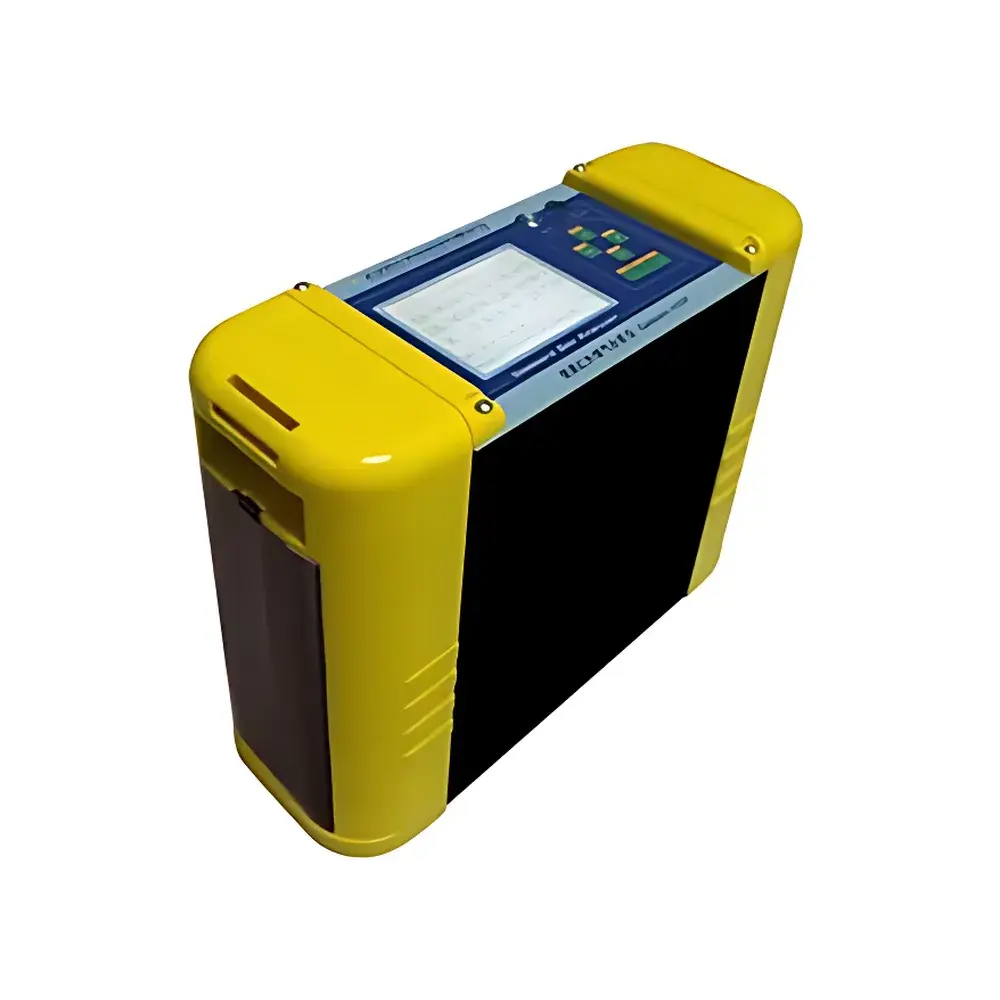
GB-3100P Portable NDIR/TCD Multi-Gas Analyzer for Coal Gas and Biogas
| Origin | Beijing, China |
|---|---|
| Manufacturer Type | Authorized Distributor |
| Country of Origin | China |
| Model | GB-3100P |
| Instrument Type | Portable |
| Analyte Range | CO, CO₂, CH₄, H₂, O₂, CnHm (selectable 1–6 components) |
| Minimum Detection Range | 0–50 ppm (for trace-level configurations) |
| Repeatability | ≤1% FS |
| Resolution | 0.1 ppm (ppm-range mode) / 0.01% (percent-range mode) |
| Response Time (T90) | ≤10 s (NDIR), ≤60 s (full multi-gas cycle) |
| Zero Drift | ≤±5% FS / 24 h |
| Span Drift | ≤±1% FS / 24 h |
| Linearity Error | ≤±2% FS |
| Sample Flow Rate | 0.7–1.2 L/min |
| Inlet Pressure | 2–50 kPa |
| Power Supply | Rechargeable Li-ion battery (internal), 12.6 V DC external charger |
| Output Interfaces | RS-232 digital, 4–20 mA analog |
| Compliance | Designed to support ASTM D1945, ISO 6974-1, and EN 15403 workflows for calorific value determination in fuel gases |
Overview
The GB-3100P Portable NDIR/TCD Multi-Gas Analyzer is an engineered solution for field-deployable, real-time compositional analysis and higher heating value (HHV) calculation of industrial fuel gases—including coke oven gas, blast furnace gas, converter gas, producer gas, and biogas. It integrates dual-sensor physics: non-dispersive infrared (NDIR) spectroscopy for CO, CO₂, CH₄, and hydrocarbon (CnHm) detection; thermal conductivity detection (TCD) for H₂ quantification; and electrochemical detection (ECD) for O₂. This hybrid architecture eliminates cross-sensitivity between key interferents—such as CnHm on CH₄ or CO/CO₂ on H₂—enabling robust, interference-free measurement across complex, variable matrices typical of coal gasification and biomass upgrading processes. The analyzer calculates gross calorific value (GCV) in both kcal/m³ and MJ/m³ units per ISO 6974-1 Annex B and ASTM D1945 empirical correlations, with automated stoichiometric compensation for moisture and diluent effects.
Key Features
- Dual-technology gas sensing: NDIR channels for CO, CO₂, CH₄, and CnHm; MEMS-based TCD for H₂; ECD for O₂—each calibrated independently and validated against certified reference gases (CRGs)
- Interference-resilient design: CnHm measurement does not bias CH₄ output; CO, CO₂, and CH₄ exhibit no measurable effect on H₂ signal stability under dynamic flow conditions (0.7–1.2 L/min)
- Thermal drift compensation: Onboard temperature and pressure sensors feed real-time corrections to all gas concentration algorithms, maintaining accuracy across ambient ranges of −10 °C to +50 °C
- Intelligent power management: Soft-start circuitry prevents low-voltage operation; battery state-of-charge monitoring triggers audible and visual alerts prior to shutdown
- Field-ready ergonomics: Integrated sampling pump, IP54-rated enclosure, and <2.8 kg total mass enable continuous operation during pipeline surveys, stack testing, or mobile lab deployment
- Zero-consumables operation: No carrier gases, columns, or chemical reagents required—unlike GC or Orsat methods—reducing lifecycle cost and operator dependency
- Bilingual UI: Switchable English/Chinese interface with context-aware prompts, configurable display contrast, and backlight dimming for low-light environments
Sample Compatibility & Compliance
The GB-3100P accepts dry, particle-free, oil-free sample streams within 2–50 kPa inlet pressure range. Condensate traps and particulate filters are recommended upstream when analyzing raw syngas or wet biogas. It meets mechanical and electrical safety requirements per IEC 61010-1 for portable measurement equipment. While not certified to ATEX or IECEx for hazardous area use, its design supports operation in Zone 2 environments when installed with appropriate barrier protection. Data integrity protocols align with GLP principles: each stored record includes timestamp, sensor ID, calibration epoch, ambient T/P, and operator tag. Audit trails comply with FDA 21 CFR Part 11 metadata requirements when exported via RS-232 to validated laboratory information systems (LIS).
Software & Data Management
Data acquisition and reporting are managed through embedded firmware supporting automatic storage of up to 10,000 test records. Each entry contains full component concentrations, calculated GCV, flow rate, and environmental metadata. Records can be reviewed, filtered by date or gas composition range, deleted individually or in bulk, and exported in CSV format via USB or RS-232. Optional PC software (Windows/macOS compatible) enables batch report generation compliant with ISO 5167 and EN 15403 annexes—including uncertainty propagation per GUM (JCGM 100:2008). Firmware updates are delivered via secure signed binaries; version history and checksum verification ensure traceability.
Applications
- Energy efficiency auditing in integrated steel plants: real-time monitoring of blast furnace gas (BFG) and coke oven gas (COG) blending ratios and HHV for combustion optimization
- Biogas quality assurance at anaerobic digestion facilities: simultaneous CH₄/H₂S surrogate (via CnHm proxy), CO₂, and O₂ tracking to assess desulfurization and upgrading efficacy
- Gasifier performance validation: quantifying H₂/CH₄ shift during biomass gasification and correlating with tar content estimates using CnHm signals
- Regulatory compliance testing: supporting EPA Method 3A, EN 14792, and GB/T 13612-2022 for town gas and synthetic natural gas (SNG) certification
- R&D laboratories: rapid screening of catalyst performance in Fischer–Tropsch or methanation reactors via second-by-second H₂/CO ratio trending
FAQ
What gas standards are required for calibration?
Certified binary or ternary reference gases traceable to NIST or NIM (China National Institute of Metrology), with uncertainties ≤1% relative, are recommended for initial setup and quarterly verification.
Can the instrument measure H₂S or NH₃?
No—H₂S and NH₃ are not supported by the current sensor configuration. Optional add-on modules for electrochemical H₂S detection may be available upon request.
Is field recalibration possible without a service technician?
Yes—zero calibration is performed automatically on startup; span adjustment requires user-accessible menu navigation and certified span gas, with full audit log generation.
How is moisture handled in the sample stream?
The analyzer requires dew-point-controlled input (<−10 °C). External thermoelectric chillers or permeation dryers are advised for high-humidity biogas applications.
Does the device meet explosion-proof requirements for refinery use?
It is not intrinsically safe or explosion-proof rated. Use in classified areas requires installation inside an approved purge enclosure or remote sampling with inert transport line.







