
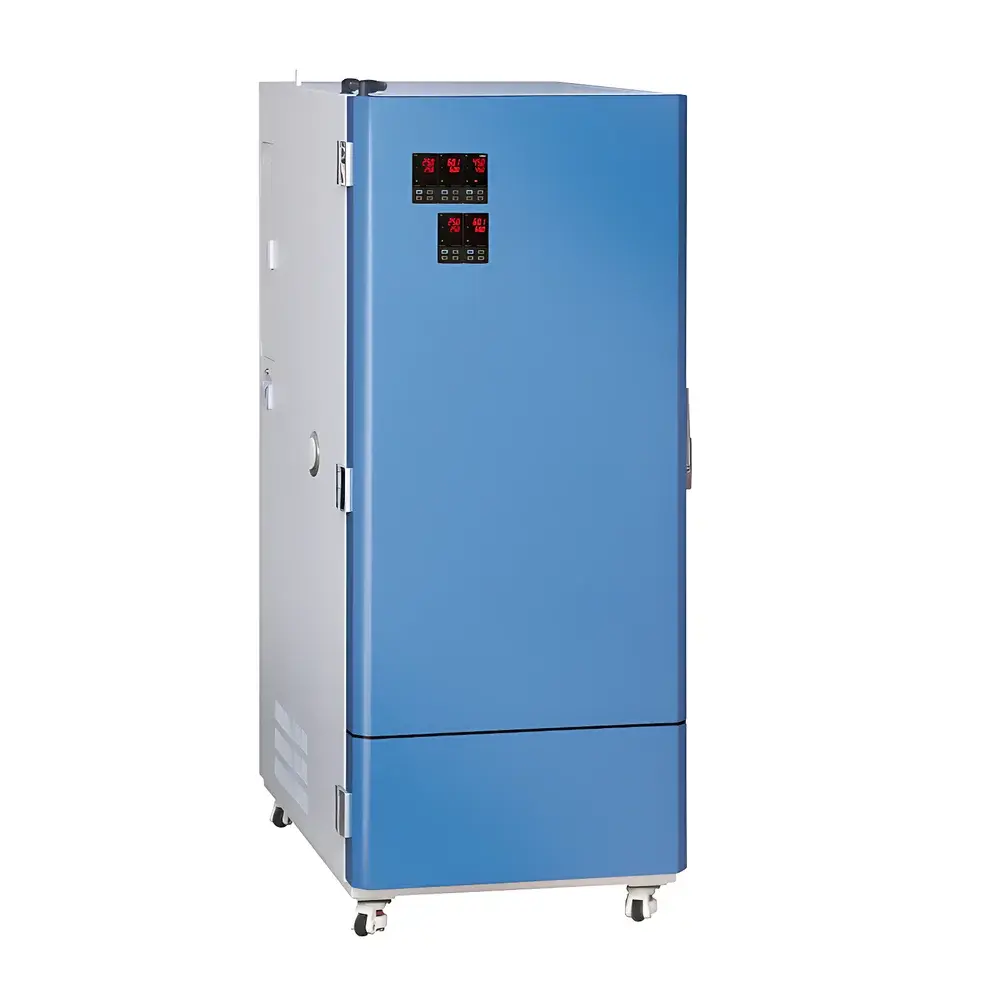
YSEI SHH-300GD-2F Drug Photostability Testing Chamber
| Brand | YSEI |
|---|---|
| Origin | Chongqing, China |
| Manufacturer Type | Direct Manufacturer |
| Product Category | Domestic |
| Model | SHH-300GD-2F |
| Pricing | Upon Request |
| Dimensions (D×W×H) | Not Specified in Input |
| Operating Power | Measured at 25°C Constant |
| Ambient Operating Conditions | 5–35°C, ≤85% RH |
| Compliance | ICH Q1B, USP <1191>, Chinese Pharmacopoeia 2015 Edition, FDA Guidance on Photosensitivity Testing |
| Data Logging | Dual-mode (RS485 + built-in thermal printer) |
| Remote Monitoring | TCP/IP-enabled, up to 30 units per host PC |
| Safety Protections | Independent chamber overtemperature cutoff, compressor overload protection |
| Warranty | 12 months post-commissioning, lifetime technical support |
| Qualification Support | IQ/OQ documentation and execution services available |
Overview
The YSEI SHH-300GD-2F Drug Photostability Testing Chamber is an engineered environmental simulation system designed explicitly for photostability assessment of pharmaceutical substances and products under controlled irradiance conditions. It operates in accordance with the internationally recognized ICH Q1B guideline “Photostability Testing of New Drug Substances and Products”, as well as the U.S. FDA’s recommendations for photosensitivity evaluation and the Chinese Pharmacopoeia (2015 Edition) requirements for forced light exposure testing. The chamber delivers calibrated, uniform visible and near-ultraviolet radiation across the test chamber volume, enabling reproducible quantification of photochemical degradation pathways—critical for establishing shelf-life, packaging selection, and labeling statements. Its architecture integrates a high-stability xenon arc lamp system with precision optical filtering, temperature-controlled air circulation, and real-time radiometric monitoring to ensure compliance with the ICH-specified cumulative exposure thresholds: ≥1.2 × 10⁶ lux·hr total visible illumination and ≥200 W·hr/m² near-UV (320–400 nm) irradiance.
Key Features
- Calibrated dual-spectrum irradiation source: Xenon arc lamp with integrated daylight and UV-A filters, traceable to NIST-traceable reference sensors
- Stable chamber temperature control: Maintains setpoint ±0.5°C across operational range (typically 25°C ±2°C during photostability protocols)
- Dual independent data recording: Real-time digital logging via RS485 interface to external SCADA or LIMS systems, plus optional thermal printer for GLP-compliant hard-copy audit trail
- Networked remote operation: Supports TCP/IP communication; single host PC can monitor and configure up to 30 SHH-GD series units simultaneously
- Hardware-level safety interlocks: Independent overtemperature cutoff circuitry for test chamber, dedicated compressor overload relay, and door-open interruption logic
- Modular internal configuration: Accommodates standardized sample trays and optional light-intensity mapping fixtures for spatial uniformity validation per ICH Q1B Annex
Sample Compatibility & Compliance
The SHH-300GD-2F accommodates standard pharmaceutical packaging formats—including blister cards, amber vials, HDPE bottles, and aluminum foil pouches—within its uniformly illuminated workspace. Sample placement follows ICH Q1B guidance for geometric distribution and orientation relative to incident irradiance. All operational parameters are documented to support regulatory submissions under FDA 21 CFR Part 11 (with optional electronic signature and audit trail modules), EU Annex 11, and WHO TRS 992 Annex 6. The system is pre-qualified to meet ISO/IEC 17025 calibration traceability requirements for photometric and thermal sensors. Validation packages—including Installation Qualification (IQ), Operational Qualification (OQ), and protocol-ready test scripts—are provided to facilitate GMP-aligned commissioning and periodic requalification.
Software & Data Management
Data acquisition is managed through a Windows-based local control application supporting configurable logging intervals (1–60 min), alarm thresholds, and export to CSV or XML formats compatible with statistical process control (SPC) platforms. The embedded RS485 Modbus RTU interface enables integration into enterprise laboratory information management systems (LIMS) or MES environments. Thermal printer output includes timestamped irradiance values, chamber temperature, runtime, and operator ID—configurable for batch-specific header fields. All electronic records retain immutable timestamps and support version-controlled backup strategies compliant with ALCOA+ principles (Attributable, Legible, Contemporaneous, Original, Accurate, Complete, Consistent, Enduring, Available).
Applications
- ICH Q1B photostability stress testing of drug substances and products
- Comparative light-exposure studies for primary and secondary packaging qualification
- Forced degradation method development per ICH Q5C and Q1A(R2)
- Supporting stability protocol design for ANDA, NDA, and MAA regulatory filings
- Internal quality assurance investigations of color change, potency loss, or impurity formation under light exposure
- Environmental stress screening during formulation development and excipient compatibility assessment
FAQ
Does the SHH-300GD-2F comply with ICH Q1B Annex requirements for irradiance uniformity mapping?
Yes—the chamber geometry and lamp positioning are validated to achieve ≥90% spatial uniformity across the defined test zone, and optional mapping kits with calibrated photodiode arrays are available for user-performed verification.
Can the system generate 21 CFR Part 11-compliant electronic records without third-party software?
The base configuration supports audit-trail-enabling firmware; full Part 11 compliance requires deployment of YSEI’s optional SecureLog module with role-based access control and electronic signature capability.
What is the recommended recalibration interval for the integrated irradiance sensors?
Annual recalibration against NIST-traceable standards is advised; field verification using portable spectroradiometers is supported via the RS485 diagnostic port.
Is ozone generation mitigated within the chamber during extended UV exposure cycles?
Yes—an integrated catalytic ozone destruction unit is standard, ensuring ozone concentrations remain below 0.05 ppm during continuous operation.
How is temperature stability maintained while delivering high-intensity irradiance?
A closed-loop refrigeration system with PID-controlled evaporator airflow and heat-shielded lamp housing ensures thermal equilibrium despite radiant heat load—verified per ASTM E2912-13 for photostability chamber performance.




