
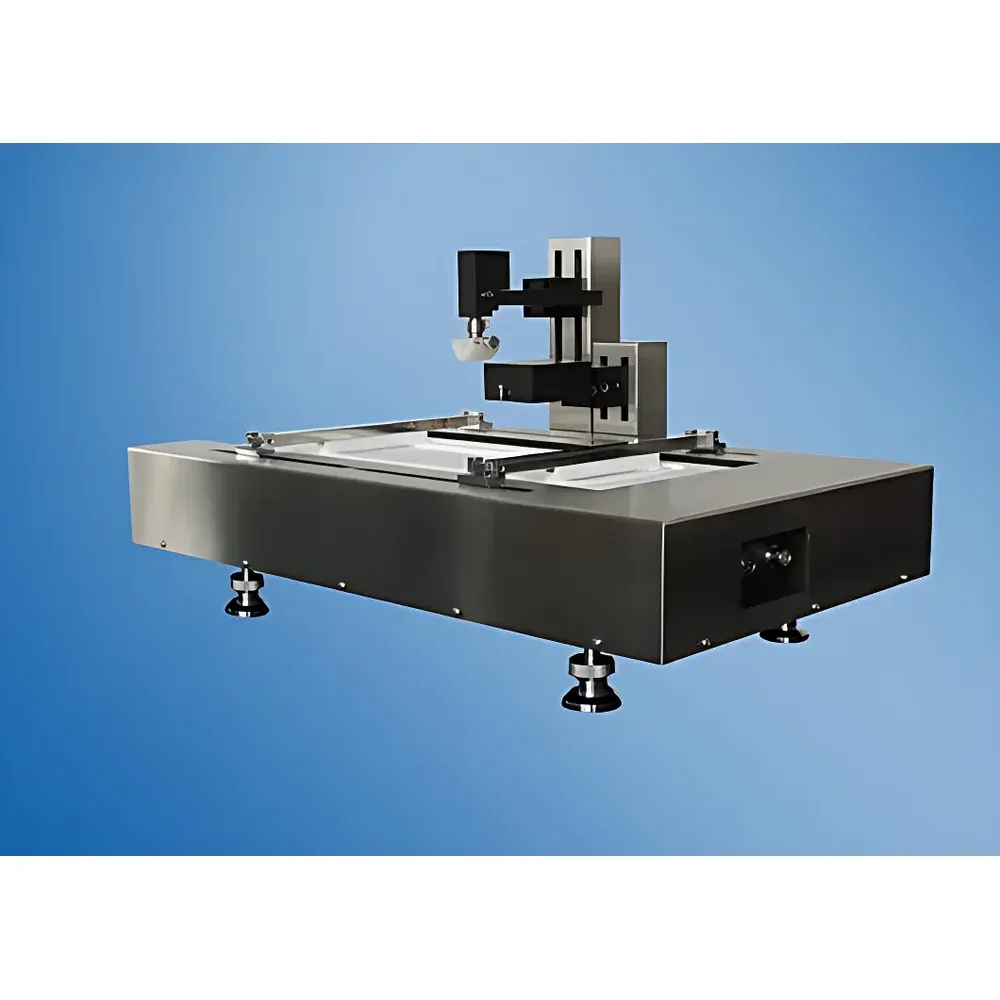
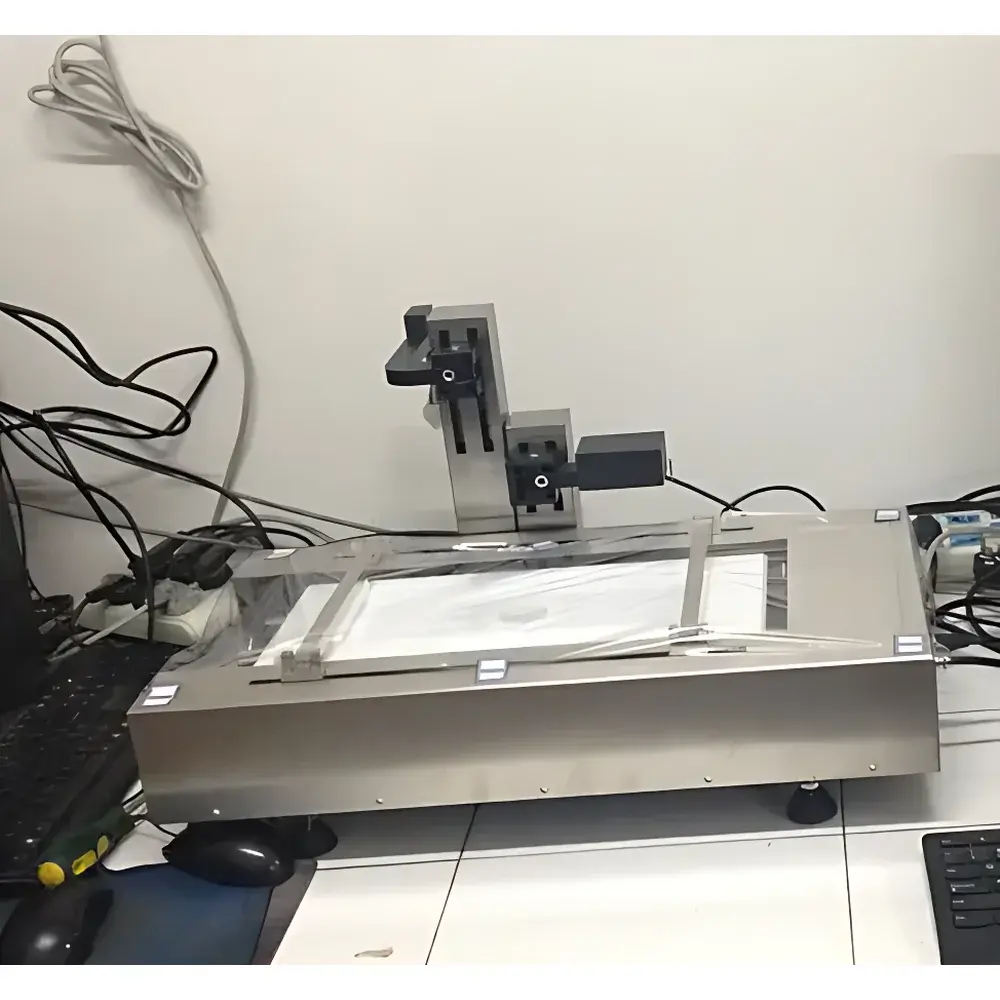
JML04C3M Langmuir-Blodgett Trough System with Wilhelmy Plate Surface Tensiometry
| Origin | Beijing, China |
|---|---|
| Manufacturer Type | Authorized Distributor |
| Origin Category | Domestic (China) |
| Model | JML04C3M |
| Price Range | USD 7,000 – 14,000 |
| Surface Tension Range | 0–150 mN/m |
| Resolution | 0.05 mN/m |
| Measurement Method | Wilhelmy Plate (Wilhelmy Type) |
| Trough Material | PTFE (Fully Fluorinated) |
| Trough Dimensions | 300 mm × 200 mm |
| Compression Ratio | Up to 90% |
| Barrier Speed | 0.48–97 mm/min |
| Vertical Deposition Speed | 0.22–45 mm/min |
| Deposition Modes | Upstroke & Downstroke |
| Power Supply | AC 220 V ±10%, 50 Hz |
| Max Power Consumption | 150 W |
| Operating Temperature | Ambient (with optional external thermostatic bath interface) |
| Relative Humidity | 30–85% RH |
| Leak-Proof Barrier Option | Standard |
| Dual/Multi-Trough Configurability | Available on request |
Overview
The JML04C3M Langmuir-Blodgett (LB) Trough System is a precision surface science instrument engineered for quantitative characterization of monolayers formed by amphiphilic molecules at the air–liquid interface. Based on the classical Langmuir trough architecture and integrated Wilhelmy plate tensiometry, it enables real-time measurement of surface pressure (π), surface tension (γ), molecular area (A), and compressibility modulus (Cs⁻¹) during dynamic compression and vertical deposition. The system operates on the fundamental principle of force balance: the vertical force exerted on a platinum or filter paper Wilhelmy plate immersed at the interface is directly proportional to the surface tension of the subphase. This method—standardized in ASTM D971 and ISO 6295—is traceable, highly reproducible, and widely accepted in academic and industrial surface laboratories for studying lipid monolayers, protein–lipid interactions, polymer surfactants, and synthetic pulmonary surfactants.
Key Features
- Fully automated operation via embedded microcontroller and Windows-based host software, minimizing operator-induced variability and enabling protocol-driven experiments.
- High-precision Wilhelmy plate sensor with 0.05 mN/m resolution and full-scale range of 0–150 mN/m, calibrated against certified reference standards.
- PTFE-coated Langmuir trough (300 × 200 mm) offering chemical inertness, ultra-low leakage (<0.1 mm²/min), and thermal stability—compatible with organic solvents, aqueous buffers, and acidic/basic subphases.
- Motorized, leak-proof barrier with programmable speed (0.48–97 mm/min) and position feedback, supporting precise area control and repeatable π–A isotherm acquisition.
- Vertical deposition module with dual-direction (up/down) motion, adjustable speed (0.22–45 mm/min), and closed-loop tension maintenance mode for consistent LB film transfer.
- Integrated surface tension auto-measurement function independent of monolayer formation—suitable for pure subphase characterization or cleaning validation.
- Modular design supports customization: dual-trough configurations, temperature-controlled jacket integration (via external chiller), and optional environmental enclosure for humidity-sensitive studies.
Sample Compatibility & Compliance
The JML04C3M accommodates a broad spectrum of amphiphilic systems including phospholipids (e.g., DPPC, POPG), lung surfactant extracts (e.g., Survanta®, Curosurf®), block copolymers, dendrimers, peptides, and functionalized nanoparticles. Its PTFE construction ensures compatibility with chloroform, chloroform/methanol mixtures, hexane, and aqueous Tris/HEPES buffers. Data acquisition complies with GLP-aligned documentation practices; raw force/time and area/pressure datasets are timestamped and exportable in CSV and ASCII formats for audit-ready analysis. While not FDA 21 CFR Part 11–certified out-of-box, the software architecture supports metadata tagging, user access logs, and electronic signature add-ons upon qualification.
Software & Data Management
The native Windows application provides intuitive graphical control of barrier movement, deposition cycles, and tensiometric calibration. Real-time plotting of γ–A and π–A isotherms includes automatic inflection point detection, phase transition annotation, and compressibility modulus derivation. All curves are vector-rendered for publication-grade output; data can be exported without loss of resolution for secondary processing in MATLAB, Origin, or Python (Pandas/SciPy). Batch experiment templates, parameter locking for SOP enforcement, and multi-user profile management enhance lab-wide reproducibility. Software updates and firmware patches are delivered via secure vendor portal—no internet connectivity required during operation.
Applications
This system serves critical roles across multiple domains: biophysics research into alveolar surfactant dysfunction in NRDS and ARDS pathophysiology; formulation development of synthetic surfactants and liposomal drug carriers; interfacial rheology of microemulsions in enhanced oil recovery; fabrication of ultrathin functional films for organic electronics and biosensors; and fundamental studies of 2D crystallization, domain morphology, and phase coexistence in mixed monolayers. It is routinely cited in peer-reviewed literature indexed in Web of Science under subject categories including Colloid and Interface Science, Biophysical Chemistry, and Biomaterials.
FAQ
What subphase temperature control options are available?
The base system operates at ambient temperature but features standardized ports for connection to external recirculating chillers or heating circulators (e.g., Julabo, Huber), enabling isothermal studies from 5 °C to 45 °C.
Can the trough accommodate custom barrier geometries or hydrophilic/hydrophobic modifications?
Yes—barrier surfaces can be coated with PDMS, octadecyltrichlorosilane (OTS), or plasma-treated for tailored wettability; custom barrier widths and shapes are supported under engineering consultation.
Is the Wilhelmy plate compatible with aggressive solvents such as chloroform or THF?
Platinum-coated plates are standard; for prolonged exposure to halogenated solvents, optional glassy carbon or PTFE-wrapped plates are available to prevent corrosion and hysteresis.
How is system calibration verified between experiments?
Built-in calibration routines use standard liquids (e.g., ultrapure water at 25 °C: γ = 72.0 mN/m; diethyl ether: γ = 17.0 mN/m) and mechanical zero-force verification before each session.
Does the system support synchronized fluorescence microscopy or Brewster angle microscopy (BAM)?
The trough deck includes standardized optical access ports (Ø25 mm) and kinematic mounting holes for third-party BAM, epifluorescence, or AFM integration—mechanical vibration isolation is recommended for high-resolution imaging.



