
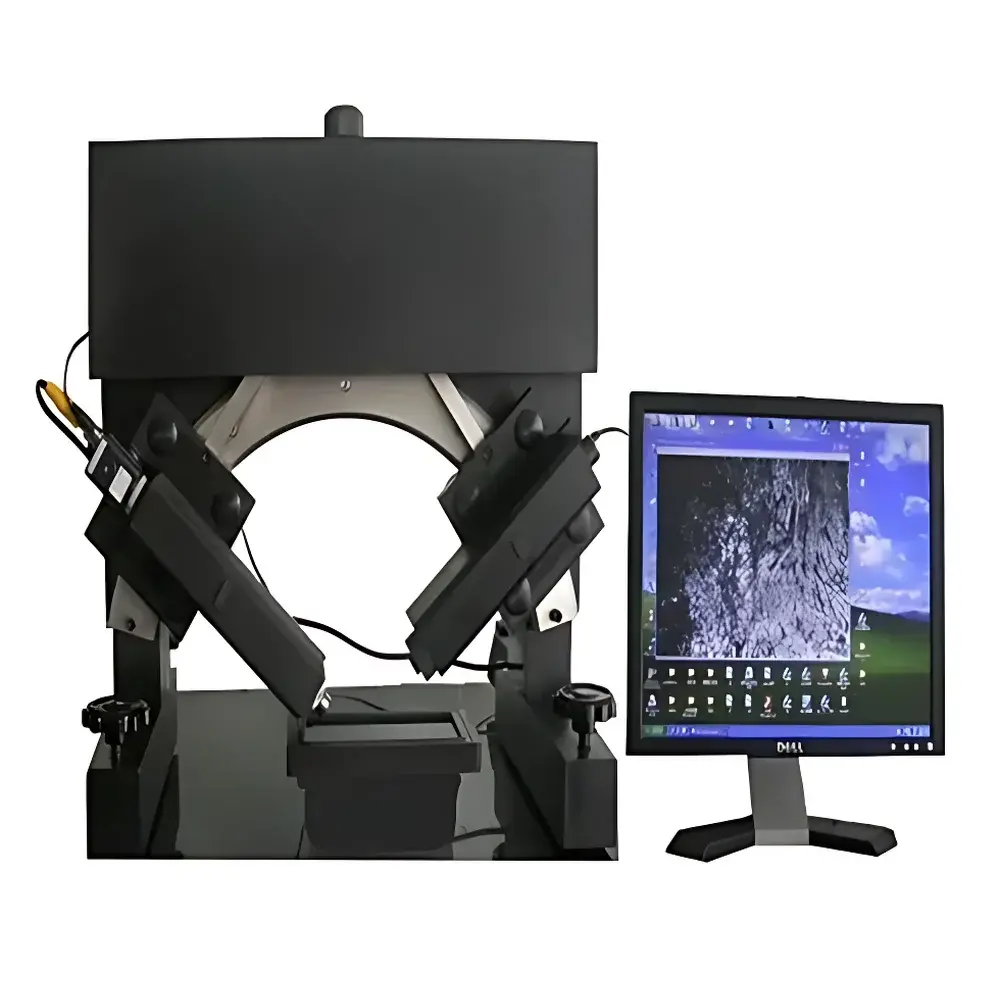
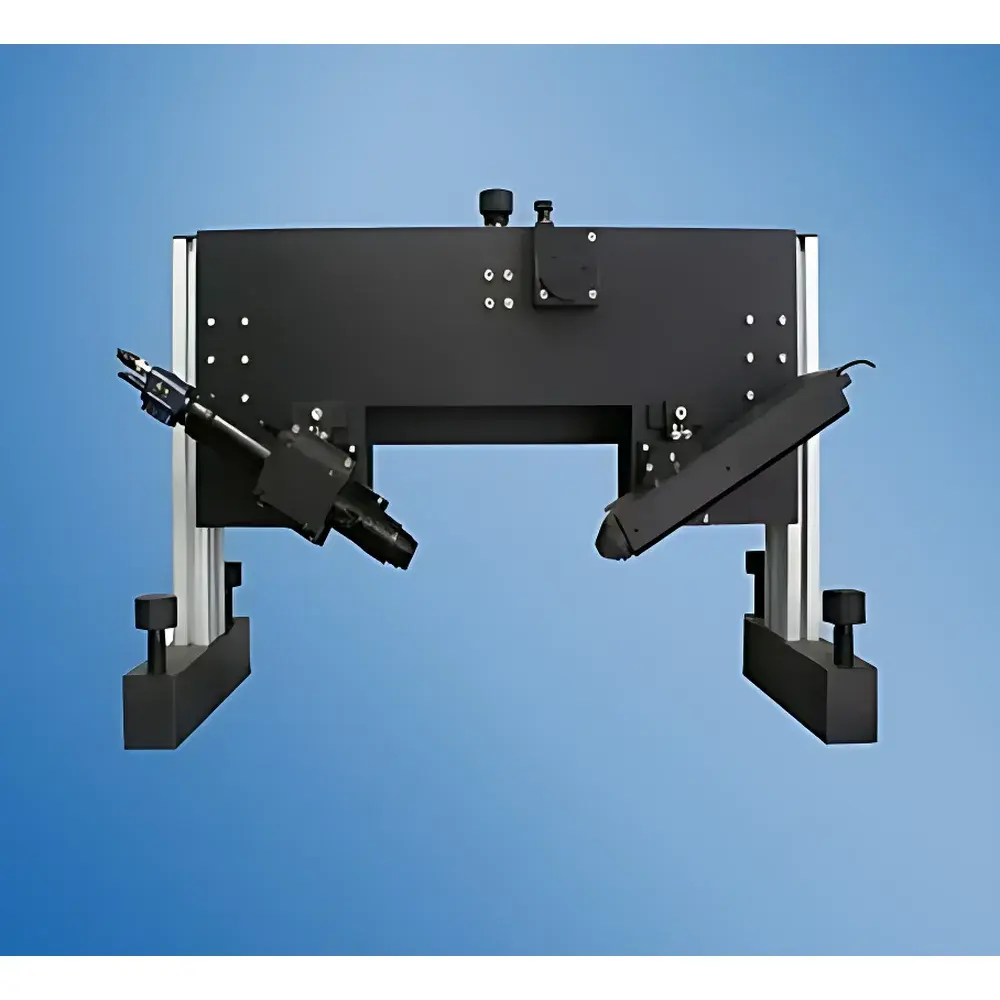
JML04M Series Langmuir-Blodgett Trough with Integrated Brewster Angle Microscope
| Origin | Beijing, China |
|---|---|
| Manufacturer Type | Authorized Distributor |
| Regional Origin | Domestic (China) |
| Model | JML04M Series |
| Pricing | Upon Request |
Overview
The JML04M Series Langmuir-Blodgett (LB) Trough with Integrated Brewster Angle Microscope (BAM) is a precision surface science instrument engineered for in situ, real-time visualization and quantitative characterization of monolayers at the air–water interface. It operates on the fundamental optical principle of Brewster angle reflection: when p-polarized light strikes a dielectric interface—such as a clean water surface—at the Brewster angle (typically ~53° for air/water at 532 nm), reflectance drops to near zero. The formation of an organic monolayer alters the interfacial refractive index and effective optical thickness, thereby shifting the Brewster angle and restoring measurable p-polarized reflectance. This intensity-modulated signal is captured via high-resolution microscopy, enabling direct, label-free observation of domain morphology, phase coexistence, nucleation dynamics, and monolayer collapse behavior without perturbing the film.
Key Features
- Integrated Brewster Angle Microscopy (BAM) with motorized angular adjustment (45°–60° range) and fine-tuned polarization control using high-transmission Glan-Taylor calcite prisms
- High-stability Langmuir trough with dual symmetric barrier system, precise area control (±0.1 cm² resolution), and temperature-regulated subphase bath (optional Peltier module)
- 532 nm solid-state green laser source (20 mW or 50 mW output), continuously adjustable intensity (1–100%) via analog modulation
- Dedicated BAM optical path featuring Nikon MS-01 continuous zoom objective (90 mm working distance), delivering 700–1100 pixels/mm magnification with ≤2 µm lateral resolution
- Scientific-grade monochrome CCD camera with electronic shutter, coupled to a CG400 frame grabber for synchronized image acquisition and real-time contrast optimization
- Windows-based control software with intuitive GUI, supporting automated compression isotherm recording, time-lapse BAM imaging, and synchronized parameter logging (surface pressure, area, temperature, reflectance intensity)
Sample Compatibility & Compliance
The JML04M system accommodates a broad spectrum of amphiphilic materials—including fatty acids, phospholipids, block copolymers, π-conjugated molecules, and nanoparticle–surfactant hybrids—for monolayer formation on ultrapure water (resistivity ≥18.2 MΩ·cm) or buffered subphases. All mechanical and optical components comply with ISO 9001-certified manufacturing protocols. Data acquisition workflows support GLP-compliant documentation: timestamped metadata, user authentication logs, and audit-trail-enabled parameter tracking align with FDA 21 CFR Part 11 requirements when deployed with validated software configuration. The system meets ASTM D1388 (Standard Test Method for Surface Tension of Solutions by the Langmuir Trough Method) and ISO 9073-10 (Nonwovens — Test Methods — Part 10: Determination of Monolayer Characteristics Using Langmuir Troughs) for interfacial property quantification.
Software & Data Management
The proprietary Windows-native software provides full instrument orchestration: barrier positioning, pressure feedback control (Wilhelmy plate or electrobalance), laser alignment presets, and BAM image capture triggered by surface pressure thresholds or time intervals. Image processing includes background subtraction, contrast normalization, dynamic range enhancement, and binary segmentation for domain area quantification. Export formats include TIFF (16-bit), CSV (isotherm + metadata), and AVI (time-series movies). Raw data files are structured with embedded EXIF-like headers containing calibration constants, environmental conditions (room temperature, humidity), and operator ID—ensuring traceability across multi-user laboratory environments.
Applications
- Quantitative assessment of monolayer homogeneity, phase transition pressures, and compressibility moduli (Cs⁻¹ = −A(dπ/dA))
- In situ monitoring of domain nucleation, growth kinetics, and collapse mechanisms during compression cycles
- Characterization of mixed lipid monolayers to model biomembrane rafts and protein–lipid interactions
- Screening of surfactant efficiency and interfacial rheology for formulation development (e.g., pulmonary surfactants, agrochemical adjuvants)
- Deposition process optimization for LB-film transfer onto solid substrates (Si wafers, ITO glass, mica) with controlled layer stoichiometry
- Environmental monitoring of surface-active contaminants (e.g., microplastic leachates, oil dispersants) at trace concentrations
FAQ
What subphase purity requirements apply for reliable BAM imaging?
Ultrapure water (18.2 MΩ·cm resistivity, TOC < 5 ppb) is mandatory; dissolved ions or organics induce spurious reflectance gradients that obscure monolayer contrast.
Can the system operate under controlled atmosphere or gas environment?
Yes—optional glovebox integration or nitrogen-purged chamber accessories enable experiments under inert or low-humidity conditions to prevent oxidation or hydration artifacts.
Is the software compatible with third-party analysis tools such as ImageJ or MATLAB?
All exported TIFF and CSV files conform to open scientific data standards and are fully interoperable with ImageJ/Fiji plugins (e.g., Particle Analyzer, Fractal Dimension) and MATLAB’s Image Processing Toolbox.
What maintenance is required for long-term optical stability?
Annual recalibration of the Wilhelmy plate sensor and BAM angular encoder is recommended; laser power output should be verified quarterly using a calibrated photodiode sensor.
Does the system support multi-layer deposition verification in real time?
While BAM visualizes only the topmost interface, synchronized pressure-area isotherms and hysteresis analysis provide indirect validation of transfer fidelity across successive layers.



