
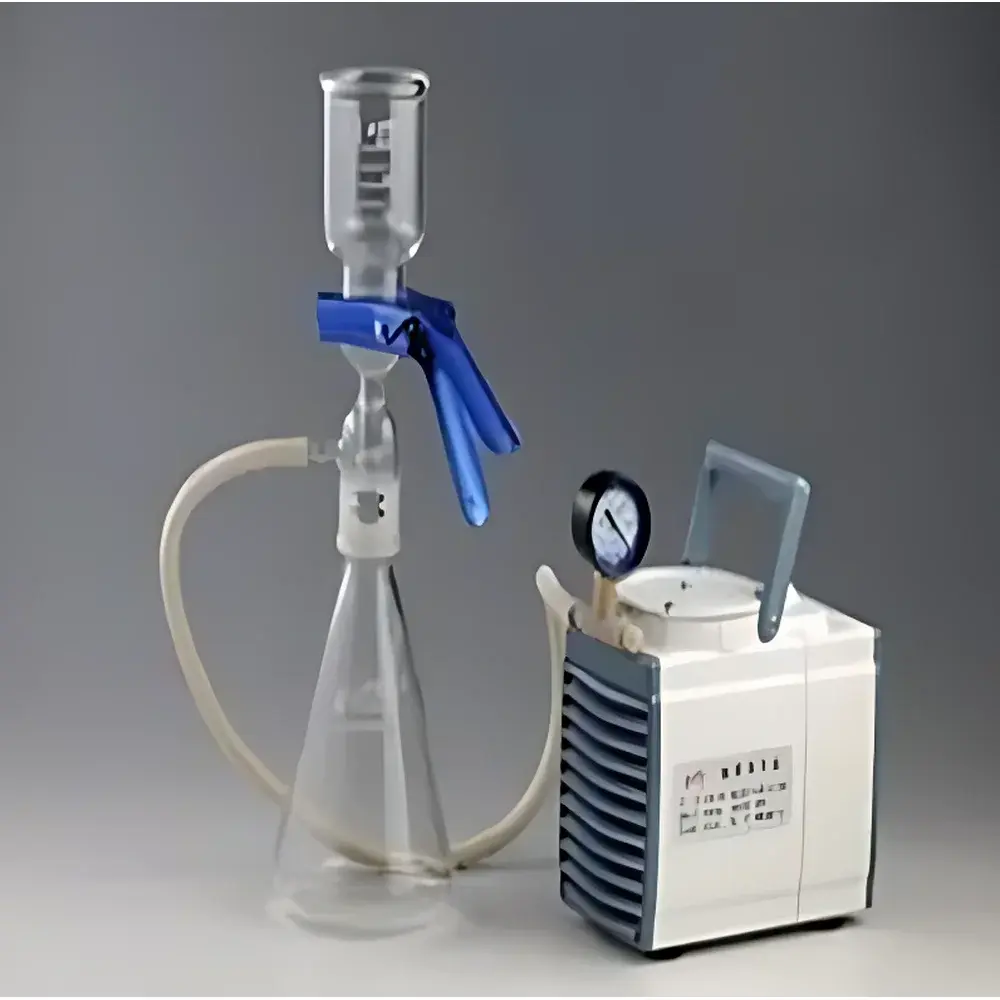
Weight Method Solvent Filtration System for Suspended Solids (SS) Analysis
| Origin | Beijing |
|---|---|
| Manufacturer Type | Distributor |
| Origin Category | Domestic |
| Model | SS |
| Quotation | Upon Request |
| Instrument Type | Laboratory |
Overview
The Weight Method Solvent Filtration System for Suspended Solids (SS) Analysis is a precision laboratory-grade filtration assembly engineered for gravimetric determination of total suspended solids in aqueous and organic liquid matrices. It operates on the fundamental principle of membrane filtration followed by controlled drying and mass difference quantification—fully compliant with standardized methods including EPA Method 160.2, ISO 11923:1997, and ASTM D5907. The system comprises two core components: a borosilicate glass solvent filtration manifold with calibrated funnel geometry and standardized flange dimensions (DIN/ISO-compliant), and a corrosion-resistant diaphragm vacuum pump designed for continuous, oil-free operation under regulated negative pressure. Unlike pressure-driven or centrifugal alternatives, this system maintains laminar flow integrity across the filter surface, minimizing particle redistribution and ensuring high reproducibility in mass-based SS quantitation—critical for regulatory reporting in environmental compliance, wastewater treatment monitoring, and drinking water quality assurance.
Key Features
- Borosilicate glass filtration manifold: Manufactured from high-purity, low-thermal-expansion glass with uniform wall thickness, zero bubble inclusion, and optical clarity—validated for autoclaving at 121 °C for 20 min (EN 285-compliant sterilization cycles).
- Integrated micro-porous membrane support: Accommodates standard 47 mm diameter filters (e.g., GF/C, PTFE, nylon, or mixed cellulose ester) with precise O-ring sealing to prevent bypass leakage and ensure complete sample retention.
- Oil-free diaphragm vacuum pump: Rated for uninterrupted 24-hour operation at ≤50 dB(A) acoustic noise; maximum vacuum ≥0.08 MPa (200 mbar absolute); thermal management maintains pump head temperature <55 °C during extended duty cycles.
- Chemical compatibility: Glass manifold and fluoropolymer pump valves resist aggressive solvents (e.g., acetone, chloroform, methanol, 10% HCl), enabling dual-phase (aqueous/organic) filtration without material degradation.
- Ergonomic laboratory integration: Compact footprint (215 × 120 × 235 mm), integrated vibration-dampening feet, and standardized 6 mm barbed inlet/outlet ports for seamless connection to filtration funnels and exhaust traps.
Sample Compatibility & Compliance
The system supports filtration of diverse liquid matrices—including raw sewage, treated effluent, surface water, leachate, pharmaceutical process streams, pesticide formulations, and HPLC mobile phases—without compromising filter integrity or analyte recovery. Its design conforms to GLP and ISO/IEC 17025 documentation requirements for traceable weight measurements. When used with pre-weighed, ash-free filters and validated drying protocols (e.g., 103–105 °C for 1 h, desiccator cooling), it meets US EPA and EU Water Framework Directive (2000/60/EC) SS reporting thresholds. All wetted components are non-leaching and certified extractable-free per USP , supporting applications in biopharmaceutical sterile filtration validation and environmental reference material analysis.
Software & Data Management
While the core filtration process is manual and gravimetric, the system is fully compatible with digital laboratory workflows. Filter weights are recorded via analytical balances interfaced with LIMS or ELN platforms (e.g., LabVantage, Benchling) supporting 21 CFR Part 11 audit trails. Optional barcode-labeled filter cassettes enable automated sample tracking. Pump operational logs (runtime, vacuum stability) can be captured using external data loggers for preventive maintenance scheduling and ISO 17025 method validation records.
Applications
- Regulatory SS testing per EPA 160.2, ISO 11923, and APHA Standard Methods 2540 D.
- HPLC mobile phase degassing and particulate removal prior to column injection.
- Sterile filtration of heat-labile APIs and biological buffers using 0.22 µm PVDF membranes.
- Pre-concentration of trace metals or microplastics for subsequent ICP-MS or microscopy analysis.
- Validation of membrane integrity in environmental sampling kits (e.g., EPA Method 1615 for virus detection).
FAQ
What filter membrane types are recommended for SS analysis?
Standard 47 mm glass fiber (GF/C) or quartz fiber filters are preferred for gravimetric SS due to low blank mass and high thermal stability. For organic-solvent applications, hydrophobic PTFE membranes (0.45 µm or 0.22 µm) are recommended.
Can this system be used for turbidity correlation studies?
No—it performs direct mass quantification, not optical measurement. However, paired SS data can be statistically correlated with turbidity readings for site-specific calibration models.
Is the vacuum pump suitable for corrosive acid digestates?
Yes—the pump’s fluoropolymer diaphragm and valve materials resist HNO₃, HCl, and HF up to 10% concentration when operated within the 7–40 °C ambient range.
Does the system include filter drying and weighing accessories?
No—drying ovens, desiccators, and analytical balances (0.01 mg resolution) are required separately per standard methodology.
What maintenance intervals are recommended for the diaphragm pump?
Diaphragm inspection every 6 months under continuous use; full service (valve replacement, lubrication-free recalibration) annually per manufacturer’s technical bulletin TB-SS-2023.







