
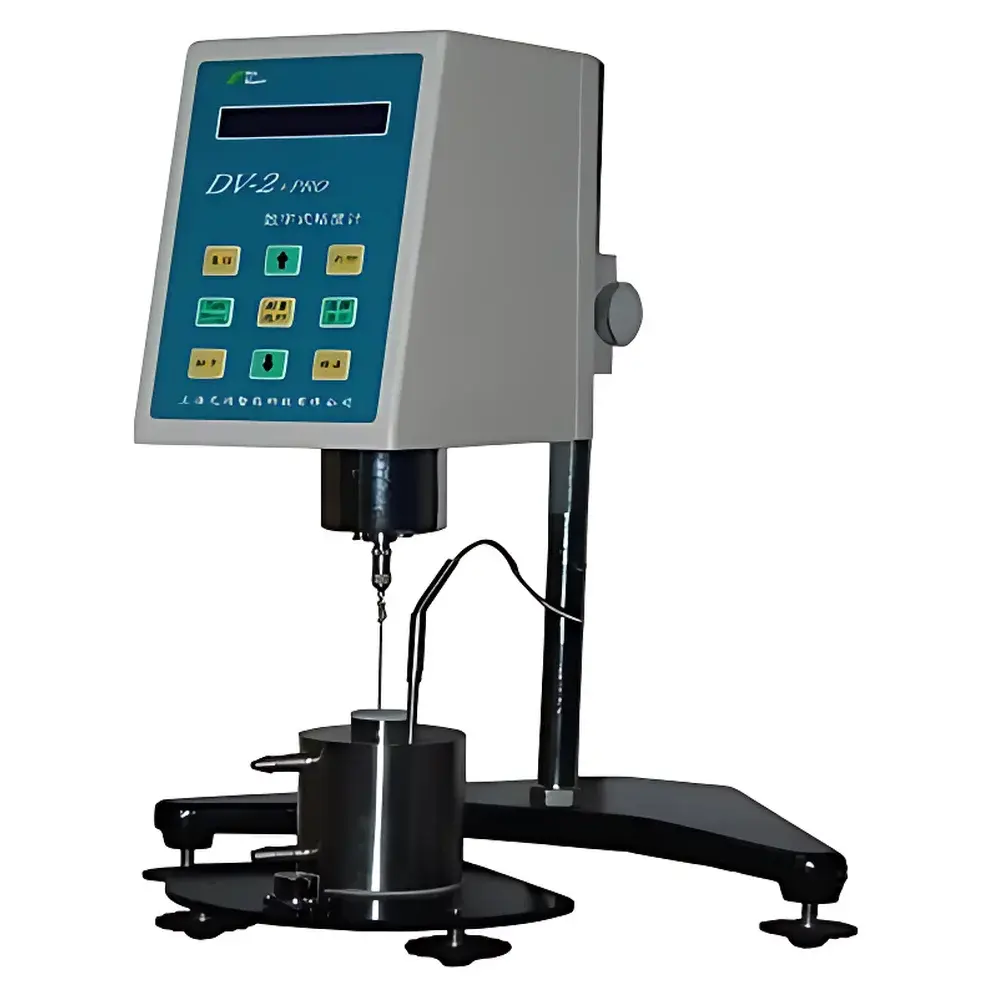
Brookfield DV-n+PRO Digital Rotational Viscometer
| Origin | Beijing, China |
|---|---|
| Manufacturer Type | Authorized Distributor |
| Origin Category | Domestic (China) |
| Model | DV-n+PRO |
| Instrument Type | Rotational Viscometer (Not Oscillatory) |
| Speed Range | 0.1–250 rpm |
| Viscosity Range | 1–32,000,000 cP (depending on spindle & model variant) |
| Accuracy | ±1% of full scale |
| Repeatability | ±0.5% |
| Temperature Control | Integrated RTD probe (0–200 °C, ±0.1 °C) |
| Spindle Options | Standard #1–#7 |
| Data Interface | RS-232/USB |
| Compliance | Calibratable to NIST-traceable standard oils |
Overview
The Brookfield DV-n+PRO Digital Rotational Viscometer is an advanced, microprocessor-controlled instrument engineered for precision measurement of dynamic viscosity in Newtonian and non-Newtonian fluids under controlled shear conditions. Based on the Couette principle—where torque exerted on a rotating spindle immersed in a fluid is directly proportional to its shear stress—the DV-n+PRO delivers high reproducibility across a broad operational range. Unlike oscillatory or capillary-based systems, this rotational viscometer applies steady-state shear at user-defined rates, making it especially suitable for quality control (QC), formulation development, and rheological profiling in industrial laboratories. Its design conforms to internationally recognized test methodologies including ASTM D2196, ISO 2555, and USP , supporting regulatory-compliant viscosity assessment in pharmaceuticals, coatings, adhesives, food emulsions, and polymer solutions.
Key Features
- 16-bit microcontroller architecture with high-subdivision stepper motor drive ensures stable, jitter-free rotation across 0.1–250 rpm—immune to AC line frequency fluctuations.
- Real-time simultaneous display of viscosity (cP/mPa·s), shear stress (Pa), shear rate (s⁻¹), spindle speed (rpm), elapsed time, sample temperature (°C), and maximum measurable viscosity for the selected spindle/speed combination.
- Over 1,000 programmable shear rate steps enable granular flow curve construction and thixotropy evaluation using timed-scan protocols.
- Integrated platinum RTD temperature sensor (Class A, ±0.1 °C accuracy) provides continuous thermal monitoring from 0 °C to 200 °C—critical for temperature-dependent viscosity studies.
- Full-scale linearity calibration performed digitally via PC interface, traceable to Brookfield-certified reference oils and optionally to NIST-traceable standards.
- Modular spindle system: standard #1–#7 spindles; optional #0 for ultra-low-viscosity fluids (<1 cP); specialized geometries (#21, #27–#29) with Small Sample Adapter (reducing required volume by 6×).
- RS-232 and USB connectivity support standalone operation, printer output (optional thermal unit), and full integration with DV Data Acquisition & Rheological Analysis Software.
Sample Compatibility & Compliance
The DV-n+PRO accommodates diverse sample types—from low-viscosity solvents and inks to highly structured gels and pastes—when paired with appropriate spindles and accessories. The Small Sample Adapter enables testing of volumes as low as 0.5 mL, minimizing material consumption during R&D screening. For thermally sensitive materials, the optional dedicated viscosity恒温 water bath (not included) maintains isothermal conditions per ASTM D445 requirements. All measurements adhere to Good Laboratory Practice (GLP) and Good Manufacturing Practice (GMP) frameworks when used with software-enabled audit trail logging, electronic signatures, and 21 CFR Part 11–compliant data handling modules. Calibration certificates issued against ISO/IEC 17025-accredited reference materials are available upon request.
Software & Data Management
The optional DV Data Acquisition & Rheological Analysis Software transforms the instrument into a comprehensive rheological workstation. It supports automated multi-speed ramp tests, time-sweep thixotropy analysis, yield stress estimation (via vane or controlled-stress extrapolation), and Bingham/Power Law model fitting. Raw data exports to CSV, Excel, and XML formats; graphical outputs include log-log viscosity vs. shear rate plots, hysteresis loops, and temperature-compensated curves. Software-generated reports include operator ID, timestamp, environmental metadata, and calibration status—ensuring full traceability for internal audits or regulatory submissions.
Applications
- Pharmaceutical: Suspension stability assessment, ointment consistency verification, syringeability testing of injectables.
- Paints & Coatings: Shear-thinning behavior quantification, sag resistance prediction, spray atomization modeling.
- Foods: Texture profiling of sauces, dairy products, and plant-based alternatives; shelf-life correlation with structural breakdown.
- Polymers: Melt index approximation, solvent-borne resin characterization, crosslinking kinetics monitoring.
- Electronics: Solder paste rheology, conductive ink deposition consistency, underfill encapsulant flow modeling.
- Personal Care: Gel network strength evaluation, shampoo viscosity drift over time, emulsion coalescence onset detection.
FAQ
Is the DV-n+PRO compliant with FDA 21 CFR Part 11?
Yes—when operated with the validated DV Data Acquisition & Rheological Analysis Software configured for electronic signatures, audit trails, and role-based access control.
Can I measure yield stress with this instrument?
Direct yield stress determination requires controlled-stress capability (not available on standard DV-n+PRO). However, approximate yield values may be inferred via extrapolation from low-shear-rate flow curves or using optional vane spindles.
What is the minimum sample volume required?
With standard spindles: ~20 mL. With Small Sample Adapter and #21–#29 spindles: as low as 0.5 mL.
Does the instrument support temperature ramping?
No—the built-in RTD only monitors temperature. Active temperature control requires external thermostatted baths or Peltier-based accessories (sold separately).
How often should calibration be performed?
Per ISO/IEC 17025 guidelines: before each critical test series, after maintenance, and at least daily in regulated environments. Use of certified standard oils (e.g., Cannon-Manning series) is recommended for routine verification.



