
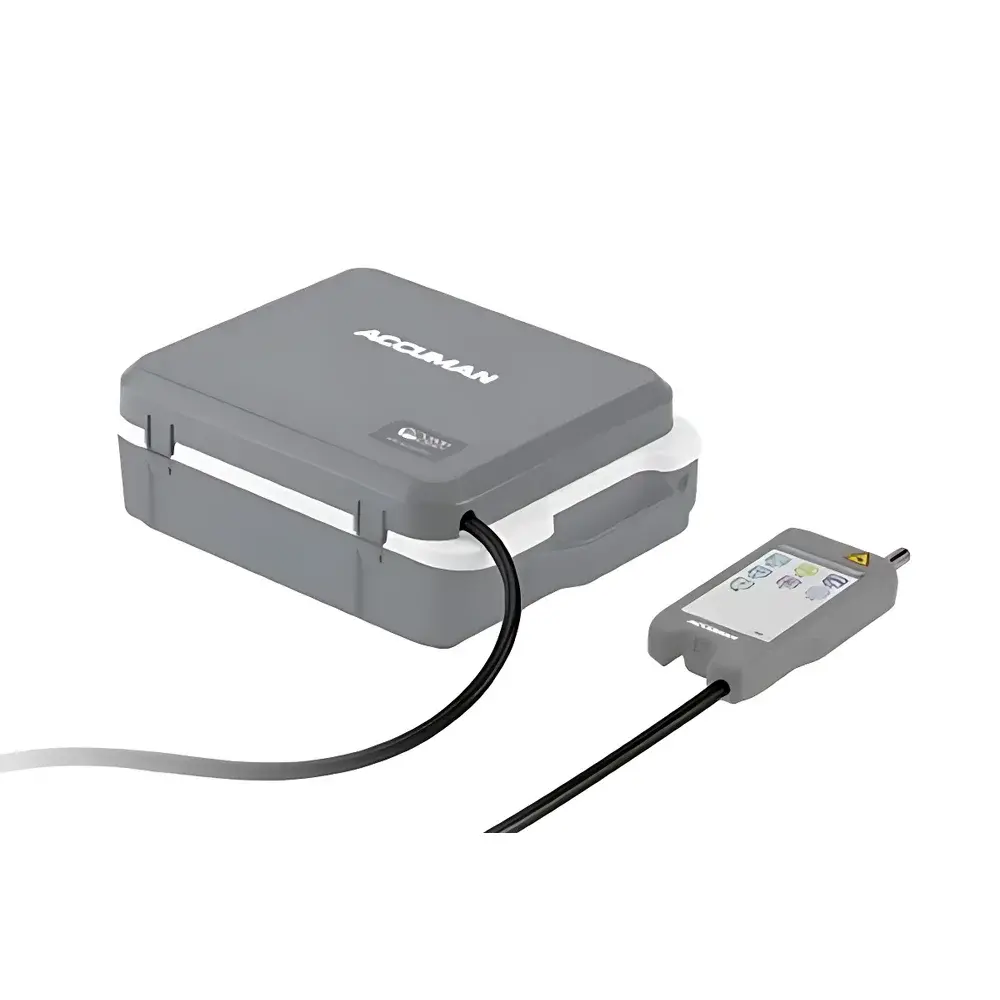
Ocean Optics ACCUMAN SR-510 Pro Portable Research-Grade Raman Spectrometer
| Brand | Ocean Optics |
|---|---|
| Origin | USA |
| Model | ACCUMAN SR-510 Pro |
| Instrument Type | Portable/Handheld Raman Spectrometer |
| Spectral Range | 170–3900 cm⁻¹ |
| Spectral Resolution | 4 cm⁻¹ |
| Detector | Deep-Cooled Back-Illuminated CCD |
| Excitation Wavelength | 785 nm (standard), optional 532 nm or 1064 nm configurations |
| Laser Stability | <±0.02 nm over 8 hours |
| Spectral Reproducibility | <±0.5 cm⁻¹ (RMS, 24 h) |
| Data Interface | USB 3.0 and Wi-Fi 5 (802.11ac) |
| Operating Temperature | 10–40 °C |
| Weight | 1.4 kg (with battery) |
Overview
The Ocean Optics ACCUMAN SR-510 Pro is a portable, research-grade Raman spectrometer engineered for field-deployable and laboratory-integrated molecular fingerprinting. Based on dispersive Raman spectroscopy with laser excitation and high-throughput Czerny-Turner optical architecture, the system delivers laboratory-quality spectral data in a handheld form factor. It operates on the principle of inelastic scattering of monochromatic light—typically from a stabilized 785 nm diode laser—where vibrational modes of chemical bonds produce characteristic Stokes and anti-Stokes shifts. The instrument’s deep-cooled, back-illuminated CCD detector ensures high quantum efficiency (>90% at 785 nm) and low dark current (<0.001 e⁻/pixel/s at –15 °C), enabling reliable detection of weak Raman signals even in ambient-light environments. Designed for quantitative and qualitative analysis across diverse sample matrices, the SR-510 Pro meets the technical rigor required by academic researchers, quality control laboratories, and regulatory-compliant field analysts.
Key Features
- Research-grade optical design: Optimized f/2.0 Czerny-Turner spectrometer with holographic ruled grating and thermally stable mechanical housing.
- High-sensitivity detection: Deep-cooled (–15 °C) back-illuminated CCD with 2048 × 64 pixel array and >90% peak QE at 785 nm.
- Precision laser source: Temperature-stabilized 785 nm diode laser (≤0.02 nm wavelength drift over 8 h), with optional 532 nm or 1064 nm modules for fluorescence suppression or resonance enhancement.
- Robust spectral performance: Full spectral coverage from 170 to 3900 cm⁻¹ with ≤4 cm⁻¹ resolution (FWHM, measured at 1003 cm⁻¹ of acetone), validated per ASTM E1840-22 guidelines for Raman instrument characterization.
- Integrated battery and ruggedized enclosure: IP54-rated magnesium alloy chassis; operational autonomy up to 4.5 h on single charge; MIL-STD-810G compliant for shock, vibration, and thermal cycling.
- Real-time spectral processing: Onboard FPGA-accelerated fluorescence background subtraction (asymmetric least squares algorithm), cosine-interpolation spectral alignment, and peak-fitting routines compliant with ISO 17025 traceability requirements.
Sample Compatibility & Compliance
The ACCUMAN SR-510 Pro accommodates solid, liquid, gel, and powder samples via interchangeable fiber-coupled probes (e.g., contact, non-contact, immersion, and standoff configurations). Its modular probe interface supports standardized SMA 905 connectors and optional motorized XYZ stages for spatial mapping. The system complies with IEC 61000-4 electromagnetic compatibility standards and meets laser safety Class 1 requirements (IEC 60825-1:2014) when operated with integrated interlocks and beam shuttering. For regulated environments, firmware supports audit-trail logging, user-access controls, and electronic signature workflows aligned with FDA 21 CFR Part 11 and EU Annex 11 expectations. Calibration certificates are NIST-traceable and include wavelength (polystyrene 1003/1601 cm⁻¹) and intensity (SRM 2241) verification.
Software & Data Management
The instrument ships with OceanView Raman Edition v3.x—a platform-certified application supporting Windows, macOS, and Linux. It provides full spectral acquisition control, real-time multivariate analysis (PCA, PLS regression), library matching against >12,000 reference spectra (including USP, EP, and custom-built libraries), and batch-processing pipelines exportable as ASTM E131-compliant .jdx files. Data integrity safeguards include SHA-256 hash generation for raw spectra, time-stamped metadata embedding (GPS coordinates, operator ID, environmental sensor logs), and encrypted local storage. Integration with LIMS and ELN systems is enabled via RESTful API and OPC UA protocols, ensuring interoperability within GLP/GMP-compliant analytical workflows.
Applications
- Pharmaceutical: Raw material identification (RMID), counterfeit drug screening, polymorph differentiation, and blend uniformity assessment per USP and ICH Q5E.
- Materials Science: Carbon nanotube chirality assignment, graphene layer counting, stress/strain mapping in thin films, and catalyst surface characterization.
- Cultural Heritage: Non-invasive pigment identification in paintings, manuscript ink analysis, and gemstone provenance determination without sampling.
- Environmental Monitoring: In situ detection of microplastics (PET, PE, PP), hydrocarbon contaminants in soil/water, and airborne particulate composition.
- Academic Teaching: Hands-on Raman spectroscopy pedagogy with built-in spectral simulation tools, error propagation modeling, and comparative dataset libraries for undergraduate and graduate curricula.
FAQ
What excitation wavelengths are supported, and how are they selected?
The standard configuration uses a 785 nm laser optimized for minimal fluorescence in organic and biological samples. Optional 532 nm and 1064 nm modules are available for specific applications—such as resonance Raman of metalloproteins (532 nm) or reduced fluorescence in highly fluorescing materials (1064 nm). Wavelength selection is hardware-defined and requires module interchange; no software-based tuning is possible.
Is the instrument suitable for quantitative analysis under GMP conditions?
Yes. With optional 21 CFR Part 11 compliance package—including role-based access control, electronic signatures, and immutable audit trails—the SR-510 Pro supports validated quantitative workflows for content uniformity testing, assay development, and stability-indicating methods.
Can it be used for microscopic Raman imaging?
When coupled with the optional RM-1000 microscope adapter and motorized stage, the SR-510 Pro enables confocal Raman mapping at lateral resolutions down to ~1 µm (dependent on objective NA and laser spot size), supporting chemical imaging of heterogeneous samples such as battery electrodes or polymer blends.
How is spectral calibration maintained during field use?
The system includes automated daily calibration using an internal polystyrene reference standard. Wavelength accuracy is verified before each measurement session, and drift compensation algorithms adjust for thermal-induced grating shift—ensuring long-term reproducibility within ±0.3 cm⁻¹ over 24 hours.
What data formats are supported for third-party integration?
Raw and processed spectra export natively as ASCII (.txt), JCAMP-DX (.jdx), and HDF5 (.h5) formats. Metadata follows ASTM E1441 and ISO/IEC 11179 standards, enabling seamless ingestion into chemometric platforms (e.g., MATLAB, Python scikit-learn, Unscrambler) and enterprise analytics engines.





