
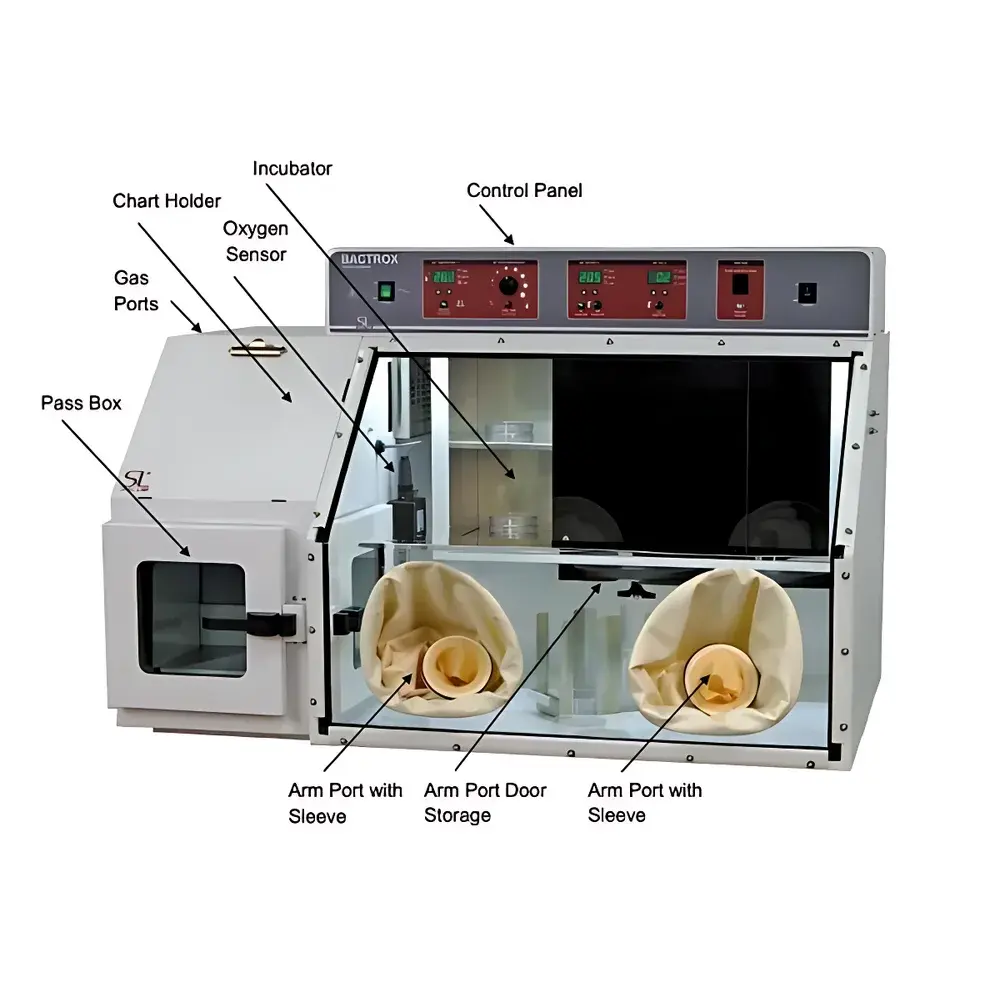
BACTRON X-2 Microaerophilic Incubator Workstation
| Origin | USA |
|---|---|
| Manufacturer Type | Authorized Distributor |
| Origin Category | Imported |
| Model | BACTRON X-2 |
| Price Range | USD 13,500 – 67,500 (FOB) |
| Temperature Control Range | Ambient +5°C to 70°C |
| Temperature Uniformity & Stability | ±0.5°C at 37°C |
| Humidity Control Range | Ambient +5°C to 70°C (via integrated humidity management system) |
| O₂ Control Range | 1–20% (v/v), adjustable in 0.1% increments |
| CO₂ Control Range | 0–15% (v/v), programmable |
| Chamber Volume | Sealed Transfer Lock: 14 L |
| Working Area | 388 L |
| Culture Chamber | 48 L |
| Sample Capacity | Up to 300 standard Petri dishes (with 7 removable stainless-steel dish racks) |
| Dehumidification & Condensate Management | Active condensate controller with drainless operation |
| Transfer Cycle Time (Vacuum Purge) | ≤60 s per cycle |
| Pressure Regulation | Integrated constant-pressure quad-port manifold with automatic overpressure venting |
Overview
The BACTRON X-2 Microaerophilic Incubator Workstation is an engineered environmental control platform designed for reproducible cultivation of microaerophilic and capnophilic organisms—including Helicobacter pylori, Campylobacter jejuni, Neisseria spp., and certain primary mammalian cell lines requiring sub-atmospheric oxygen tension. Unlike conventional anaerobic chambers or static gas jars, the BACTRON X-2 employs a dynamic, closed-loop gas mixing and monitoring architecture based on electrochemical O₂ sensors, infrared CO₂ detection, and precision mass flow controllers. It maintains stable microaerobic atmospheres (1–20% O₂, 0–15% CO₂) while simultaneously regulating temperature (Ambient +5°C to 70°C) and mitigating condensation via active humidity management—without external humidification reservoirs or steam injection. Its dual-chamber architecture isolates operator interaction from the culture environment, minimizing gas exchange perturbation during routine handling.
Key Features
- True microaerophilic control: Independent, real-time regulation of O₂ (1–20%, ±0.2% accuracy) and CO₂ (0–15%, ±0.3% accuracy) using calibrated electrochemical and NDIR sensors
- Dual-zone thermal management: Separate PID-controlled heating circuits for the 48 L culture chamber and 388 L operator work area, each with independent digital display and alarm thresholds
- Vacuum-assisted transfer lock: 14 L sealed airlock with programmable purge cycles (≤60 s), capable of achieving <10 ppm residual O₂ prior to sample introduction
- Glove-free operation: Ergonomic rubber sleeve interface enables direct manual manipulation without compromising atmospheric integrity or requiring glove training
- Condensate suppression system: Integrated thermoelectric dehumidifier and surface-heated chamber walls prevent condensation formation on viewing panels and interior surfaces—eliminating drip contamination risk and manual wiping
- Structural integrity: Reinforced polycarbonate-acrylic viewing dome with tempered resin-coated surface resists abrasion and maintains optical clarity under continuous UV sterilization cycles
- Safety redundancy: Dual independent overtemperature cutoffs—one electronic (PID-based), one mechanical (bimetallic)—trigger audible/visual alarms and cut power to all heating elements
- Pressure-stabilized environment: Constant-pressure quad-port manifold automatically vents excess gas when internal pressure exceeds ±5 mbar, preserving setpoint gas ratios during frequent access
Sample Compatibility & Compliance
The BACTRON X-2 supports ISO 11133:2014-compliant media validation workflows and aligns with CLSI M45-A3 guidelines for microaerophilic organism isolation. Its chamber geometry accommodates standard 100 mm Petri dishes (up to 300 units), multi-well plates (6–96-well), tissue culture flasks (T25–T225), and custom bioreactor inserts. All wetted materials comply with USP Class VI biocompatibility standards; stainless-steel racks and chamber surfaces are electropolished for ISO 14644-1 Class 5 cleanability. The system supports GLP/GMP documentation requirements through optional audit-trail-enabled firmware (21 CFR Part 11 compliant with electronic signature module).
Software & Data Management
The embedded microprocessor interface provides real-time graphing of O₂, CO₂, temperature, and pressure across configurable time intervals (1 min to 24 h). Logged data export is supported via USB 2.0 (CSV format) or optional Ethernet connectivity with Modbus TCP protocol for integration into LIMS or SCADA systems. Firmware includes user-level access control (three-tier permissions), event-driven alarm logging (including door-open duration, gas deviation >±0.5%, temperature excursion >±1.0°C), and automatic calibration reminder scheduling aligned with ISO/IEC 17025 metrological traceability protocols.
Applications
- Clinical microbiology: Isolation and subculture of fastidious pathogens from gastric biopsies, stool, and blood cultures
- Vaccine development: Propagation of attenuated strains requiring precise redox tuning
- Host-pathogen interaction studies: Co-culture of epithelial cells with microaerophilic bacteria under physiologically relevant O₂ gradients
- Antibiotic susceptibility testing (AST): MIC determination under standardized microaerobic conditions per EUCAST recommendations
- Probiotic strain banking: Long-term maintenance of obligate microaerophiles without cryopreservation-induced viability loss
- Regulatory testing: USP , EP 2.6.27, and JP 17 compliance for sterility and growth promotion testing
FAQ
What gas supply requirements does the BACTRON X-2 have?
It requires two independent, oil-free, medical-grade gas sources: compressed nitrogen (≥99.998% purity) and carbon dioxide (≥99.9% purity). Optional integrated gas generators are available for N₂ and CO₂ to eliminate cylinder dependency.
Can the system be validated for GMP environments?
Yes—when equipped with IQ/OQ documentation packages and 21 CFR Part 11 firmware, it meets FDA and EMA expectations for equipment qualification in pharmaceutical microbiology labs.
How is humidity controlled without liquid reservoirs?
Humidity is managed passively via chamber wall temperature profiling and actively via thermoelectric condensate extraction—maintaining relative humidity between 40–80% RH without introducing waterborne contaminants.
Is remote monitoring supported?
Standard USB data export is included; Ethernet-enabled remote diagnostics and real-time parameter streaming require the optional Network Interface Module (NIM-2X).
What maintenance intervals are recommended?
O₂ sensor calibration every 6 months; CO₂ sensor verification annually; vacuum pump oil change every 1,000 operating hours; full system performance verification per ISO 13485 Annex A every 12 months.





