
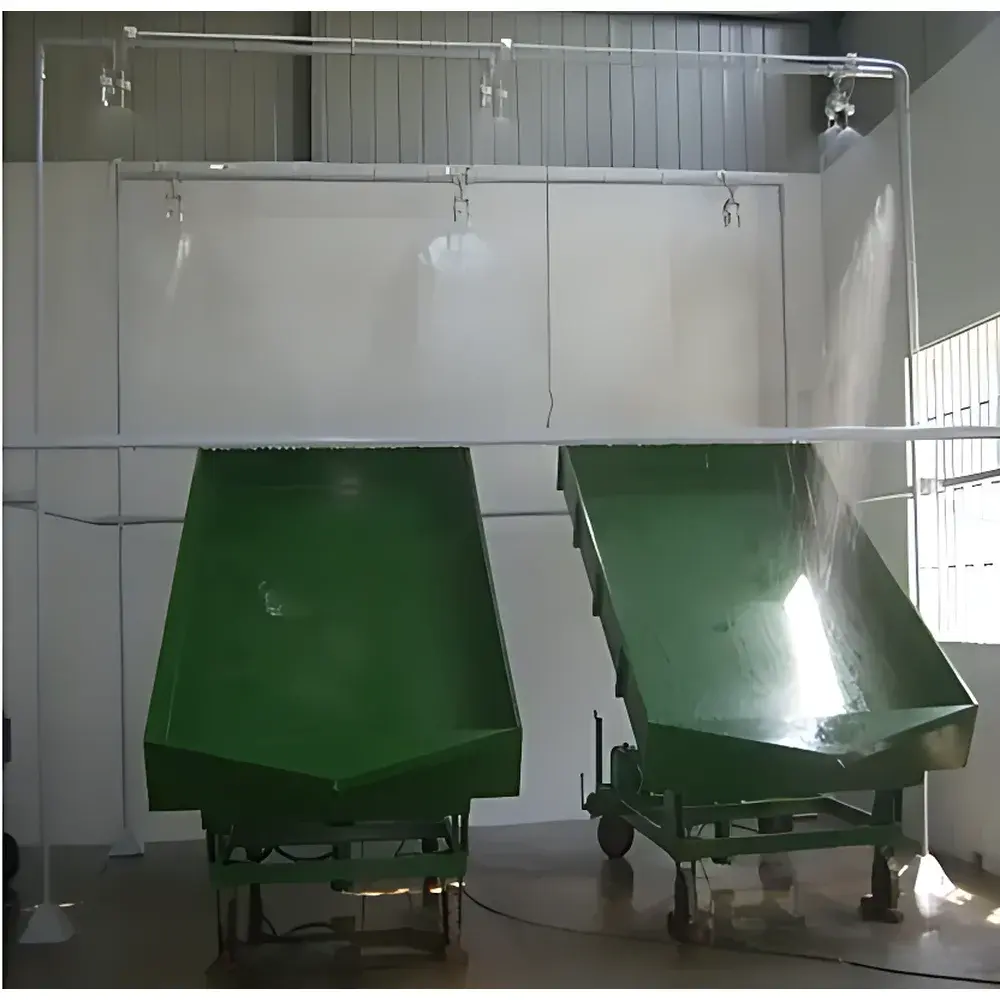
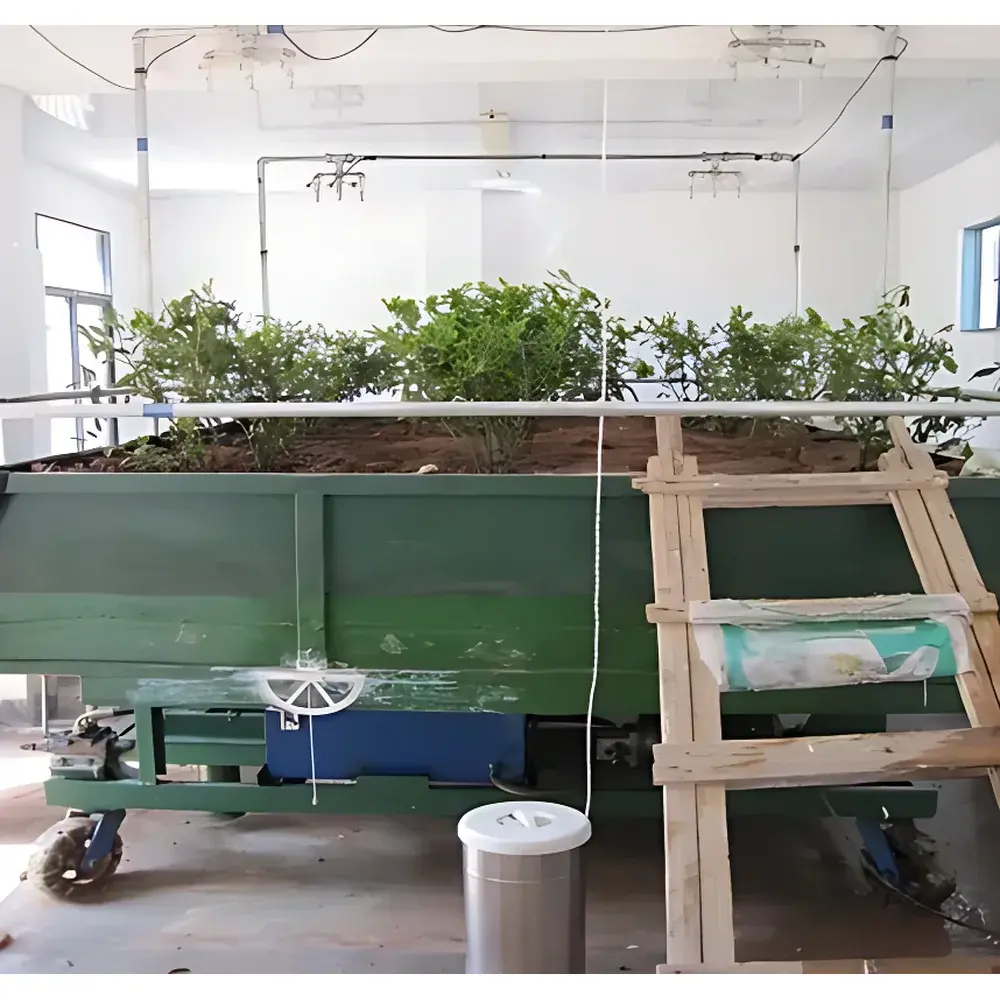
RZL01 Mobile Adjustable-Slope Steel Flume System for Subsurface Flow Measurement
| Origin | Beijing |
|---|---|
| Manufacturer Type | Distributor |
| Origin Category | Domestic |
| Model | RZL01 |
| Quotation | Upon Request |
| Instrument Type | Soil Moisture / Matric Potential Analyzer |
| Slope Adjustment Range | 0–30° |
| Actuation | Electric Motor-Driven Screw Mechanism |
| Modular Partitioning | Configurable into 2 or 4 laterally isolated test sections |
| Drainage | Perforated base for subsurface flow collection |
| Mobility | Integrated wheeled chassis for field and lab relocation |
Overview
The RZL01 Mobile Adjustable-Slope Steel Flume System is an engineered experimental platform designed for controlled, reproducible investigation of subsurface flow dynamics, infiltration partitioning, and sediment transport under variable topographic and hydrological conditions. Based on the principle of physically scaled overland–subsurface flow coupling, the system enables quantitative analysis of soil water redistribution, lateral percolation pathways, and interflow generation across defined slope gradients. Unlike static flumes or fixed-angle lysimeters, the RZL01 integrates real-time slope modulation—mechanically actuated via a precision lead-screw drive—to simulate natural terrain variability without requiring structural reconfiguration. Its design adheres to fundamental hydromechanical principles underlying the Richards equation and Darcy’s law, supporting both steady-state and transient flow characterization in structured and unstructured soils. The system is explicitly intended for use in soil physics laboratories, erosion research facilities, and watershed-scale process modeling validation studies.
Key Features
- Electrically actuated slope adjustment (0–30°) with bidirectional motor control: clockwise rotation increases incline; counterclockwise decreases it—enabling precise, repeatable gradient programming without manual intervention.
- Modular lateral partitioning: the flume base can be subdivided into two or four independent, vertically sealed compartments using removable stainless-steel baffles—allowing simultaneous multi-treatment experiments (e.g., contrasting soil textures, amendments, or vegetation covers) under identical hydraulic forcing.
- Perforated stainless-steel base plate (1.2 mm diameter holes, 15 mm spacing) facilitates controlled drainage of subsurface flow into calibrated collection troughs, enabling volumetric quantification of interflow and percolation rates.
- Mobile wheeled chassis with locking casters ensures rapid deployment across laboratory floors, greenhouse bays, or outdoor rainfall simulator facilities—minimizing setup time and spatial constraints.
- Structural modularity: the flume channel and support frame are decoupled components—permitting customization of channel dimensions (length, width, depth) per user-defined experimental requirements while preserving mechanical integrity and alignment accuracy.
- Corrosion-resistant construction: all load-bearing and fluid-contact surfaces fabricated from 304 stainless steel; powder-coated mild steel frame ensures long-term durability under repeated wet–dry cycling and chemical exposure.
Sample Compatibility & Compliance
The RZL01 accommodates a broad range of soil media—including sandy loams, clay-rich aggregates, biochar-amended substrates, and vegetated sod blocks—without compromising hydraulic continuity or boundary condition fidelity. Its open-top geometry supports direct instrumentation integration: tensiometers, time-domain reflectometry (TDR) probes, capacitance sensors, and miniaturized piezometers may be inserted at standardized vertical profiles (0–30 cm depth) across multiple transects. The system complies with ASTM D5859–22 (Standard Guide for Field Testing of Infiltration Rates), ISO 21268–2 (Soil Quality – In Situ Determination of Saturated Hydraulic Conductivity), and supports GLP-aligned data acquisition when paired with validated sensor networks and timestamped logging protocols. All mechanical adjustments meet ISO 9001-certified assembly tolerances (±0.3° angular repeatability; ±0.5 mm positional stability under 100 kg loading).
Software & Data Management
While the RZL01 operates as a hardware platform without embedded firmware, it is fully compatible with industry-standard environmental data acquisition systems (e.g., Campbell Scientific CR1000X, Delta-T Devices DL6, or LabVIEW-based DAQ configurations). Slope position feedback is provided via integrated rotary encoder output (1024 PPR resolution), enabling closed-loop control and synchronized logging of inclination angle alongside moisture, temperature, and outflow volume datasets. Exported CSV or TDMS files conform to FAIR data principles (Findable, Accessible, Interoperable, Reusable) and support downstream processing in MATLAB, Python (pandas, SciPy), or R for hydrograph separation, Hortonian vs. Dunne runoff analysis, and parameter estimation in HYDRUS-1D or WEPP models. Audit trails for slope configuration changes are recordable within compliant LIMS environments satisfying FDA 21 CFR Part 11 requirements when used in regulatory soil–water interaction studies.
Applications
- Quantifying the effect of slope gradient on subsurface flow fraction and travel time distribution in heterogeneous soils.
- Evaluating the efficacy of soil conservation practices (e.g., contour tillage, cover cropping, terracing) on interflow suppression and sediment yield reduction.
- Calibrating and validating distributed hydrological models (e.g., SWAT, MIKE SHE) using high-resolution, process-level flume data.
- Studying preferential flow development under simulated rainfall–infiltration–redistribution sequences.
- Assessing root-zone water retention and lateral redistribution in agroecological buffer zone designs.
- Supporting pedotransfer function development through controlled, multi-replicate infiltration–drainage experiments.
FAQ
Can the RZL01 be used outdoors under natural rainfall conditions?
Yes—the structural rigidity and corrosion-resistant materials permit extended outdoor deployment; however, optional weatherproof canopy integration is recommended for sensor protection and evaporation control.
Is slope calibration traceable to national standards?
Angular positioning is verified using a NIST-traceable digital inclinometer (±0.1° accuracy); factory calibration certificates are provided with each unit.
What is the maximum recommended soil depth for stable operation?
For optimal mechanical stability and uniform stress distribution, soil column height should not exceed 30 cm above the perforated base—consistent with standard USDA-NRCS soil column testing protocols.
Does the system include data acquisition hardware?
No—the RZL01 is a standalone physical platform; users select and integrate compatible sensors and DAQ systems based on project-specific resolution, sampling frequency, and compliance needs.
Are custom flume dimensions available beyond standard offerings?
Yes—channel length (2–6 m), width (0.5–1.2 m), and sidewall height (0.3–0.6 m) are fully customizable during order specification, subject to structural feasibility review.
Related Products







