
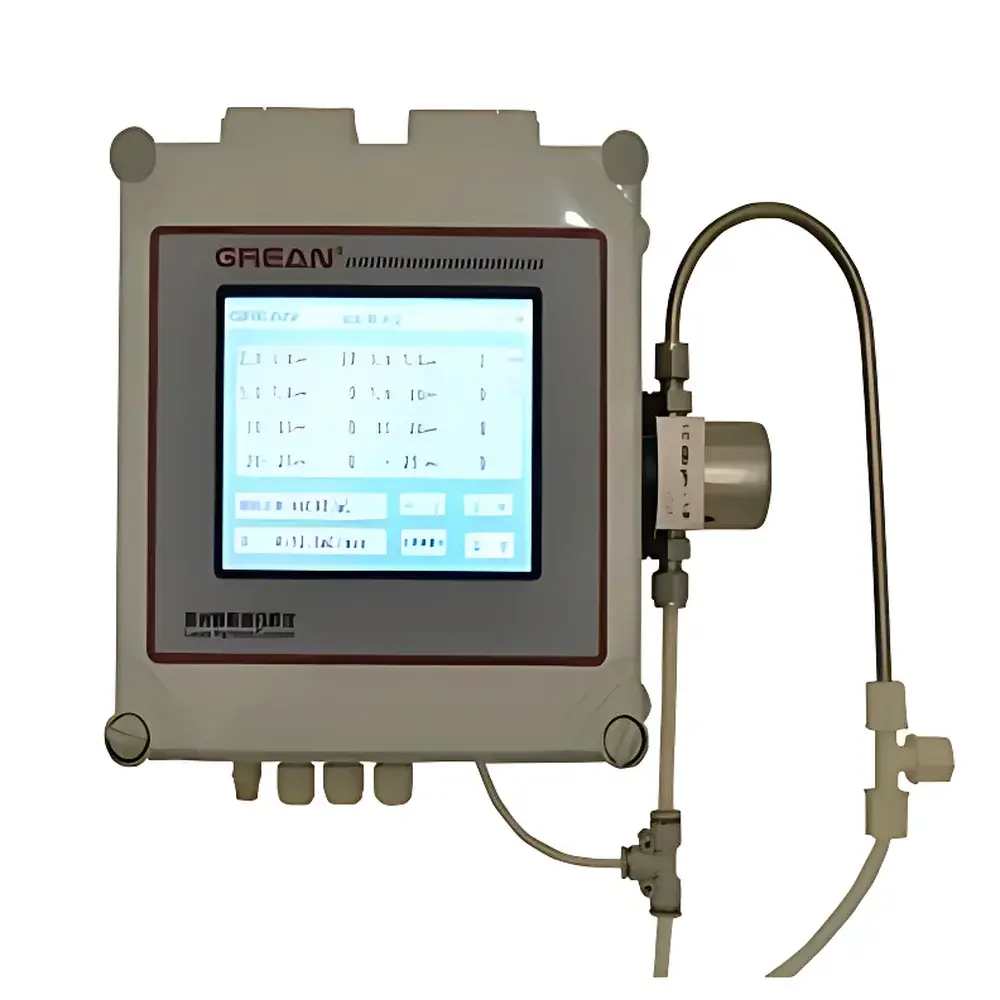
GR1501 Online Laser Particle Analyzer
| Origin | Beijing |
|---|---|
| Manufacturer Type | Distributor |
| Origin Category | Domestic |
| Model | GR1501 |
| Pricing | Upon Request |
| Instrument Type | Online |
Overview
The GR1501 Online Laser Particle Analyzer is an industrial-grade, real-time suspended solids monitoring instrument engineered for continuous, in-line measurement of particle size distribution (PSD) in water matrices. It operates on the principle of laser light extinction (absorption and scattering) combined with high-sensitivity photodetection and digital pulse-height analysis. As water flows through a precisely calibrated optical detection zone, particles ≥2 µm intercept the collimated laser beam, generating measurable signal pulses proportional to their cross-sectional area. The system classifies particles into eight user-defined size channels spanning 2–400 µm, enabling quantitative enumeration—not just turbidity estimation—of particulate load. Unlike conventional nephelometric or absorption-based turbidimeters, the GR1501 delivers granulometric resolution critical for process control in drinking water treatment, filtration performance validation, and regulatory risk assessment related to microbial cysts (e.g., Giardia lamblia and Cryptosporidium spp.). Its design aligns with U.S. EPA Method 180.1 and supports compliance-driven applications where particle count data serve as a surrogate indicator for pathogen removal efficiency, particularly across rapid sand or membrane filtration units.
Key Features
- True online operation with integrated flow cell and self-contained sampling loop (60 mL/min nominal flow rate, ±2% volumetric accuracy)
- Dual-mode particle counting: cumulative total count and channel-specific counts across eight programmable size bins (2–400 µm)
- High-resolution optical detection with ≤9% coefficient of variation at 2 µm and ≤5% at 10 µm, validated per ISO 21501-4 calibration protocols
- Robust photodetector architecture delivering >99.9% counting efficiency for particles ≥2 µm and >98% at 1.5 µm
- Onboard flash memory storing >60,000 timestamped records with full audit trail (date, time, channel counts, flow-compensated concentration, alarm status)
- Industrial-grade environmental tolerance: operating temperature range 5–40 °C; storage range −40 to +65 °C; non-condensing humidity 18–80% RH
- Comprehensive alarm framework including total particle count threshold alarms and individual channel over-limit alerts, configurable via touchscreen interface
Sample Compatibility & Compliance
The GR1501 is optimized for low-to-moderate turbidity waters (0.01–100 NTU equivalent), including raw surface water, settled effluent, filtered drinking water, and distribution system samples. It is not intended for highly viscous, aerated, or chemically aggressive streams without pre-conditioning. The analyzer meets electromagnetic compatibility requirements per IEC 61326-1 and carries CE marking for use in industrial environments. While not certified under FDA 21 CFR Part 11, its data logging architecture—including immutable timestamps, operator ID tagging (via optional network login), and exportable CSV/Excel-compatible logs—supports GLP/GMP-aligned quality systems. Its particle sizing correlation with EPA/600/SR97/025 enables direct linkage to filtration log-removal performance reporting required by the U.S. Long Term 2 Enhanced Surface Water Treatment Rule (LT2ESWTR).
Software & Data Management
The GR1501 ships with proprietary Windows-based analysis software supporting bidirectional RS232/RS485 communication and optional Modbus RTU integration for SCADA interfacing. Software capabilities include real-time graphical display of histogram distributions, temporal trend overlays of individual channel counts, automated baseline drift correction, and batch export of raw count data with metadata (flow rate, temperature, calibration date). All stored records include embedded checksums to ensure data integrity. Remote firmware updates and configuration backups are supported via secure USB or serial link. Audit logs capture all parameter changes, calibration events, and alarm acknowledgments—essential for internal QA audits and third-party verification.
Applications
- Real-time monitoring of filter effluent for early detection of breakthrough events in municipal drinking water plants
- Validation of granular media filter performance against EPA-defined particle removal benchmarks
- Process optimization of coagulation-flocculation-sedimentation trains using particle count profiles as feedback signals
- Supporting Cryptosporidium risk assessment in source water and treated water per WHO Guidelines for Drinking-water Quality
- Long-term trending of particulate load in distribution networks to identify aging infrastructure or biofilm detachment episodes
- Research applications in hydrology, limnology, and wastewater reuse studies requiring PSD time-series resolution
FAQ
What particle size range does the GR1501 measure?
It detects and classifies particles from 2 µm to 400 µm across eight discrete, user-configurable size channels.
Can the GR1501 be integrated into existing SCADA systems?
Yes—via RS485 serial interface with Modbus RTU protocol support (optional module), enabling seamless data ingestion into industrial control platforms.
Does the instrument require regular recalibration?
Calibration is performed using NIST-traceable polystyrene latex (PSL) microsphere standards; field verification is recommended every 3–6 months depending on operational intensity and water matrix stability.
How is flow rate compensated during particle counting?
The built-in flow sensor continuously measures volumetric throughput (60 mL/min nominal) and applies real-time flow compensation to reported concentrations (counts/mL), ensuring accurate density normalization.
Is the GR1501 suitable for seawater or brackish water applications?
Not without pretreatment—the optical window and wetted materials are rated for freshwater use only; high chloride content may accelerate corrosion and affect optical clarity.







