
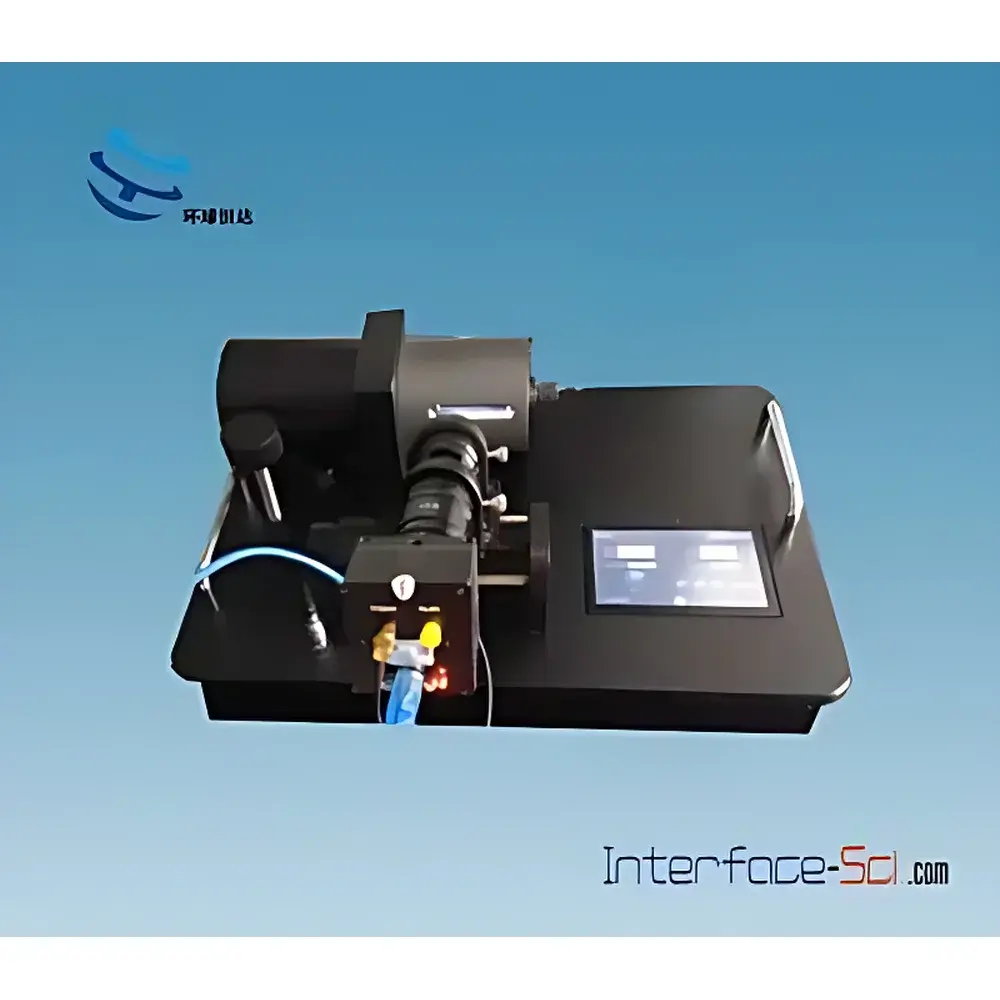
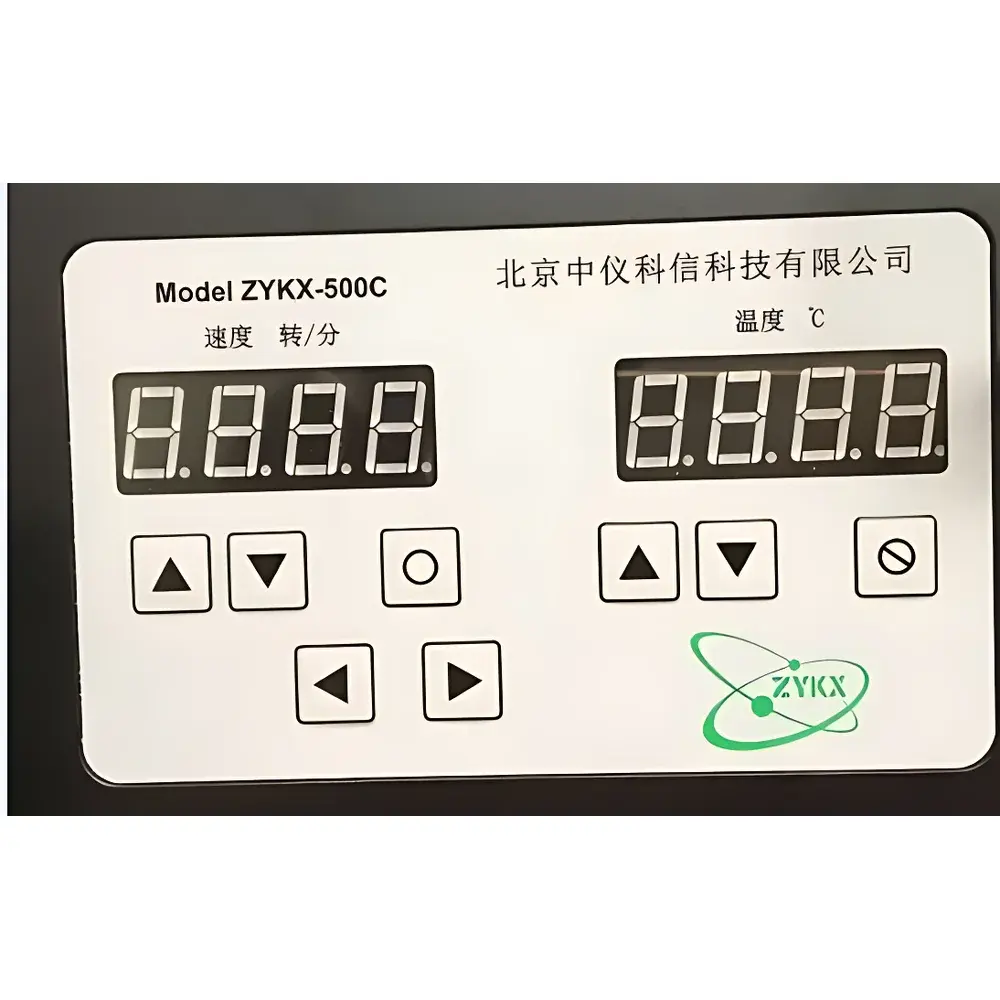
ZYKX500C Automated Spinning Drop Interfacial Tensiometer
| Brand | ZYKX |
|---|---|
| Origin | Beijing, China |
| Model | ZYKX500C |
| Measurement Range | 10⁻⁷–100 mN/m |
| Resolution | 0.001 mm (image) / 0.01 mN/m (tension) |
| Accuracy | ±0.01 mN/m |
| Temperature Control Range | RT+5°C to 95°C |
| Temperature Accuracy | ±0.1°C |
| Rotation Speed | 1,000–10,000 rpm (±5 rpm) |
| Imaging | USB digital CCD, 60 fps, 752×480 px |
| Trigger Mode | RPM-synchronized |
| Power Interface | USB & RS-232 |
| Compliance | ASTM D971, ISO 6295, USP <721>, GLP-ready data logging |
Overview
The ZYKX500C Automated Spinning Drop Interfacial Tensiometer is a precision instrument engineered for high-accuracy measurement of ultra-low interfacial tension (IFT) and surface tension across a dynamic range spanning eight orders of magnitude—from 10⁻⁷ mN/m to 100 mN/m. It operates on the spinning drop principle, a well-established hydrodynamic method grounded in Laplace’s equation and rotational fluid mechanics. In this technique, a denser droplet of one liquid phase is suspended within a less-dense continuous phase inside a rotating quartz capillary tube. Under controlled centrifugal force, the droplet elongates; its shape—quantified via digital image analysis—is directly related to the interfacial tension between the two phases. The ZYKX500C integrates advanced optomechanical design, PID-based thermal regulation, and real-time image processing to deliver reproducible, operator-independent results essential for R&D and quality control in demanding industrial and academic laboratories.
Key Features
- Modular quartz capillary system with quick-release spring-pin mounting—enables rapid, damage-free insertion and ejection of 2 mm, 4 mm, and 6 mm ID tubes; minimizes breakage risk and simplifies cleaning.
- Corrosion-resistant stainless-steel rotor and inner housing—matched thermal expansion coefficients ensure axial stability and long-term mechanical alignment under temperature cycling.
- 7-inch high-resolution capacitive touchscreen interface—supports standalone operation with immediate result display, parameter configuration, and real-time curve visualization without external PC dependency.
- USB-native digital CCD camera (60 fps, 752×480 resolution) with RPM-synchronized triggering—eliminates motion blur at all rotational speeds up to 10,000 rpm; delivers consistent edge contrast for turbid or opaque systems (e.g., polymer-laden EOR brines).
- PITTMAN high-speed servo motor with 500-line optical encoder—provides closed-loop speed control with ±5 rpm accuracy and <0.1% repeatability; supports precise low-speed profiling for metastable interface characterization.
- Integrated PID-controlled electric heating system—stainless-steel jacketed design ensures uniform thermal conduction across the sample cell; supports direct operation from ambient +5°C to 95°C without auxiliary chillers or baths.
- Three-point manual leveling mechanism—adjusts capillary tilt to center the droplet within the optical field of view, critical for accurate ellipse-fitting algorithms.
- Low-noise (<50 dB @ 45°C, 5000 rpm) electromechanical stage—enables silent, vibration-damped positioning during extended time-series measurements.
Sample Compatibility & Compliance
The ZYKX500C accommodates diverse immiscible liquid pairs—including aqueous surfactant solutions vs. crude oil fractions, polymer micelles vs. organic solvents, and bio-based emulsifiers vs. vegetable oils. Its wide IFT range and robust imaging make it suitable for characterizing complex formulations such as microemulsions, nanoemulsions, and thermoresponsive systems. The instrument meets foundational requirements for regulatory-compliant testing environments: data acquisition adheres to ALCOA+ principles (Attributable, Legible, Contemporaneous, Original, Accurate, Complete, Consistent, Enduring, Available); software enforces user-level access controls and audit-trail-enabled operations aligned with FDA 21 CFR Part 11 readiness. Measurement protocols are compatible with ASTM D971 (standard test method for interfacial tension of oil against water by the ring method—adapted for spinning drop validation), ISO 6295 (petroleum products—determination of interfacial tension), and USP (surface and interfacial tension). All raw images are saved in uncompressed BMP format; metadata (timestamp, temperature, rpm, calibration constants) is embedded and preserved.
Software & Data Management
The Windows-based control software provides dual-mode operation—either via local touchscreen or remote PC connection through USB or RS-232. It features an intuitive graphical interface with twelve synchronized image preview windows, overlay-capable curve plotting, and side-by-side image/data comparison. Measurements can be scheduled for time-lapse acquisition (e.g., aging studies), triggered manually, or initiated by temperature ramp events. Each session auto-generates a timestamped folder containing calibrated BMP frames, processed tension values, and intermediate ellipse-fit parameters. Database architecture supports cross-experiment querying by sample ID, operator, date range, or process condition. Export functions include native Excel (.xlsx) with full metadata headers, CSV for LIMS integration, and PDF reports compliant with internal QA documentation standards. Software includes built-in calibration routines for pixel-to-length conversion using certified wire standards (1 mm and 2 mm), ensuring traceability to SI units.
Applications
- Enhanced Oil Recovery (EOR) Research: Quantification of ultra-low IFT (<10⁻³ mN/m) between surfactant-polymer floods and reservoir oils—critical for screening chemical formulations prior to core flooding experiments.
- Colloid & Interface Science: Kinetic analysis of adsorption dynamics, micellization thresholds, and interfacial rheology in mixed surfactant systems.
- Pharmaceutical Formulation: Stability assessment of lipid nanoparticles, liposomes, and self-emulsifying drug delivery systems (SEDDS) under physiological temperature conditions.
- Coatings & Inks: Evaluation of wetting behavior and interfacial compatibility between pigment dispersions and resin matrices.
- Agricultural Chemistry: Optimization of adjuvant efficacy in pesticide emulsions by correlating IFT reduction with foliar retention and penetration rates.
- Food Science: Characterization of protein-stabilized emulsions and interfacial aging in dairy or plant-based analogs.
FAQ
What is the minimum measurable interfacial tension value?
The instrument achieves reliable detection down to 1×10⁻⁷ mN/m under optimized conditions (e.g., high-density contrast, stable rotation, high-magnification imaging).
Can the ZYKX500C operate without a connected computer?
Yes—the integrated touchscreen enables full measurement execution, real-time visualization, and basic data export (USB flash drive) without external computing hardware.
Is external temperature control required?
No—the built-in stainless-steel PID heater covers RT+5°C to 95°C; however, optional integration with an external recirculating chiller or bath is supported via standard fittings for sub-ambient or high-precision thermal profiles.
How is image focus maintained during long-duration tests?
The optical path uses fixed-focus lensing matched to the standard capillary dimensions; focus calibration is performed once per tube batch using the included wire standards—no active autofocus mechanism is employed, ensuring mechanical stability and zero drift.
Are software updates and technical support available internationally?
ZYKX provides firmware and software patches via secure download portal; remote diagnostics and application support are offered in English with documented SLAs for enterprise customers.



