
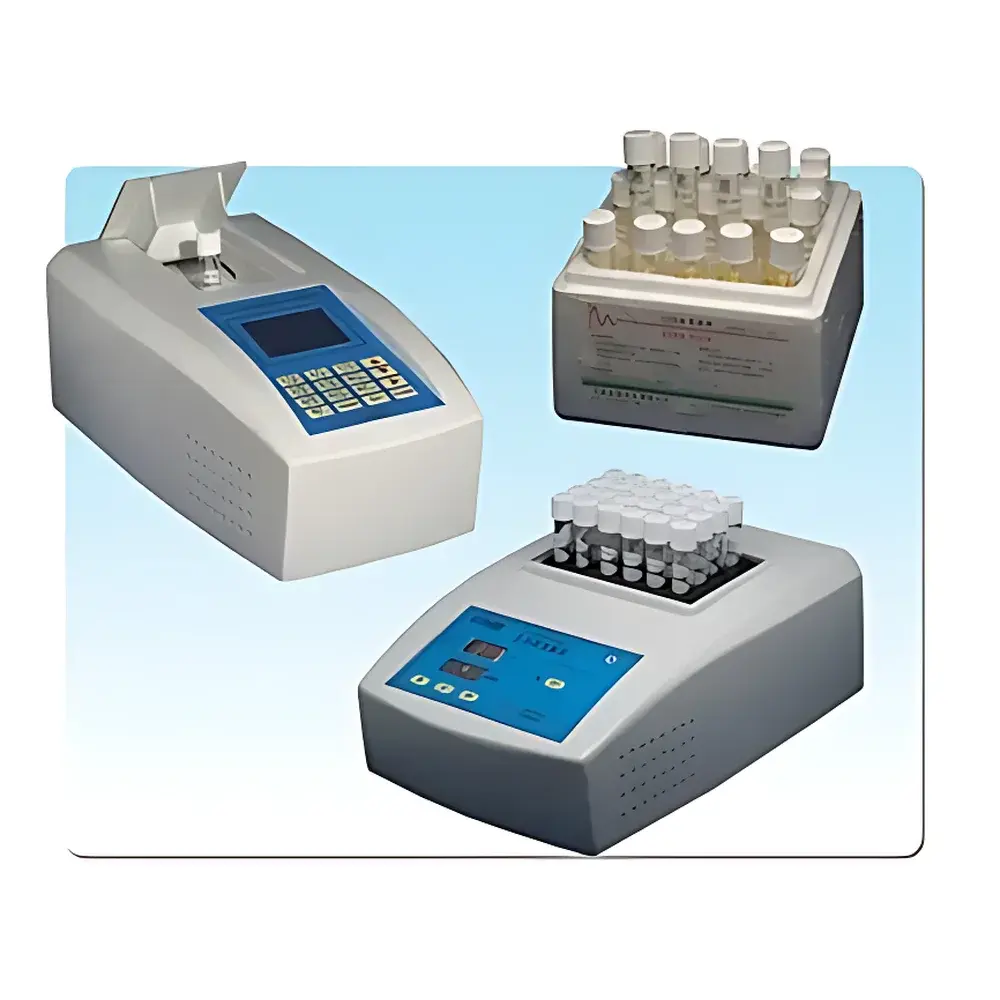
ET-1151M Multi-Parameter Water Quality Analyzer for COD, Total Nitrogen (TN), Total Phosphorus (TP), and Ammonia-N
| Key | Origin: Beijing, China |
|---|---|
| Manufacturer Type | Authorized Distributor |
| Product Origin | Domestic (China) |
| Model | ET-1151M |
| Price Range | USD 1,400–2,800 |
| Instrument Type | Benchtop Laboratory Analyzer |
| Wavelengths | 420 nm, 610 nm |
| COD Range (Standard Method) | 15–150 mg/L |
| COD Range (Rapid Method) | 100–1,000 mg/L |
| TN Range | 0–150 mg/L |
| TP Range | 0.05–20 mg/L |
| NH₃-N Range | 0.10–60.0 mg/L |
| Accuracy | ±8% |
| Repeatability | RSD ≤3% |
| LOD (COD) | 0.1 mg/L |
| Measurement Time (Rapid COD) | 20 min total (incl. digestion & photometry) |
| Batch Capacity | 1 or 20 samples per run |
| Light Source | High-Stability LED |
| Wavelength Accuracy | ±2 nm |
| Photometric Stability | ΔA < 0.005 in 20 min |
| Display Modes | Absorbance, Transmittance, Concentration |
| Auto-Wavelength Selection | Yes |
| Power Supply | 220 V AC, 50 Hz |
| Operating Temp. | 5–50 °C |
| Relative Humidity | 20–85% RH |
Overview
The ET-1151M Multi-Parameter Water Quality Analyzer is a microprocessor-controlled, dual-wavelength (420 nm and 610 nm) benchtop spectrophotometer engineered for precise, standardized quantification of key water quality parameters—including Chemical Oxygen Demand (COD), Total Nitrogen (TN), Total Phosphorus (TP), Ammonia-N (NH₃-N), and Fluoride—in laboratory environments. It operates on established colorimetric principles compliant with ISO 6060 (COD), ISO 11905-1 (TN), ISO 6878 (TP), and ISO 7150-1 (NH₃-N), enabling traceable, reproducible results without reliance on external calibration standards for routine analysis. The instrument integrates programmable method selection, internal calibration curve storage (up to six preloaded curves), and user-defined curve import—supporting both rapid (15-min digestion) and conventional (2-h digestion) COD protocols. Its optical architecture employs stable LED light sources with narrow-band interference filters, minimizing spectral drift and ensuring long-term photometric integrity across repeated measurement cycles.
Key Features
- Dual-wavelength capability (420 nm and 610 nm) enables simultaneous optimization for distinct analyte chemistries: Cr(VI)/Cr(III) redox detection for COD, yellow nitrophenol complex for TN, blue phosphomolybdate for TP, and green salicylate-hypochlorite complex for NH₃-N.
- Pre-programmed, validated analytical methods for COD, TN, TP, NH₃-N, and Fluoride—each aligned with internationally recognized reaction kinetics and stoichiometry.
- Auto-wavelength selection eliminates manual filter changes; the system automatically engages the optimal wavelength based on the selected test protocol.
- Integrated photometric readout modes: absorbance (A), transmittance (%T), and direct concentration (mg/L), with real-time unit conversion and linear/nonlinear curve fitting options.
- Robust thermal management and LED-based illumination ensure <0.005 A photometric drift over 20 minutes—critical for high-reproducibility batch analysis under GLP-compliant workflows.
- Support for both single-sample and 20-sample batch processing via compatible 16×100 mm digestion/cuvette tubes—enabling throughput scalability without hardware modification.
Sample Compatibility & Compliance
The ET-1151M is validated for use with drinking water, municipal wastewater, surface water, and common industrial effluents. All measurement protocols adhere to fundamental principles outlined in ISO, APHA Standard Methods (23rd ed.), and Chinese national standards (HJ/T 399–2007 for COD; HJ 636–2012 for TN; HJ 671–2013 for TP; HJ 535–2009 for NH₃-N). While not certified to FDA 21 CFR Part 11 out-of-the-box, the instrument’s firmware supports audit-trail-capable data logging when paired with optional PC software—facilitating alignment with GLP/GMP documentation requirements. Reagent compatibility includes factory-prepackaged, stabilized reagent kits (e.g., dichromate-based COD digestants, persulfate/TiCl₃ for TN oxidation, ascorbic acid/molybdate for TP, and sodium salicylate/hypochlorite for NH₃-N), all supplied in sealed, light-protected vials to ensure shelf-life stability and inter-lot consistency.
Software & Data Management
The analyzer features an embedded LCD interface with full Chinese/English bilingual menus and real-time numeric display of temperature, time, absorbance, and calculated concentration. Raw photometric data and final results are stored internally (up to 500 records) with timestamp, operator ID field, and method identifier. Optional USB export enables transfer of CSV-formatted datasets to LIMS or Excel for statistical evaluation (e.g., RSD, recovery %, control charting). When used with the companion ET-3150B digestion block—programmable from 0 to 1860 minutes and ±1 °C temperature accuracy—the system forms a complete, closed-loop analytical workflow meeting ISO/IEC 17025 traceability expectations for environmental testing laboratories.
Applications
- Regulatory compliance monitoring for municipal wastewater treatment plants (WWTPs) under national discharge permits.
- Process control and optimization in industrial pretreatment units (e.g., electroplating, food processing, pharmaceutical manufacturing).
- Environmental impact assessment (EIA) field labs requiring portable yet lab-grade precision.
- Academic and research laboratories conducting nutrient cycling studies, eutrophication modeling, or method validation experiments.
- Third-party testing facilities performing accredited analyses per CNAS-CL01 (equivalent to ISO/IEC 17025).
FAQ
Does the ET-1151M require external calibration with NIST-traceable standards?
No—preloaded calibration curves are factory-verified using certified reference materials (CRMs) traceable to national metrology institutes. However, periodic verification using CRM spikes (e.g., potassium hydrogen phthalate for COD, ammonium chloride for NH₃-N) is recommended per ISO/IEC 17025 Clause 7.7.
Can the instrument store custom calibration curves for non-standard matrices?
Yes—up to six user-defined curves can be imported via USB or manually entered using slope/intercept values derived from matrix-matched standard additions.
Is the ET-3150B digestion block mandatory for operation?
It is required for all digestion-dependent methods (COD, TN, TP, NH₃-N); however, the ET-1151M spectrophotometer module may be used independently for pre-digested or direct-read assays (e.g., fluoride with SPADNS reagent).
What is the expected lifetime of the LED light source?
Rated for >100,000 hours of continuous operation with negligible intensity decay—eliminating routine lamp replacement and associated recalibration downtime.
How does the system handle interferences from chloride or turbidity?
For COD, the standard method includes mercury sulfate masking for Cl⁻ up to 2,000 mg/L. Turbidity correction is supported via dual-beam baseline subtraction at reference wavelengths where analyte absorbance is negligible.







