
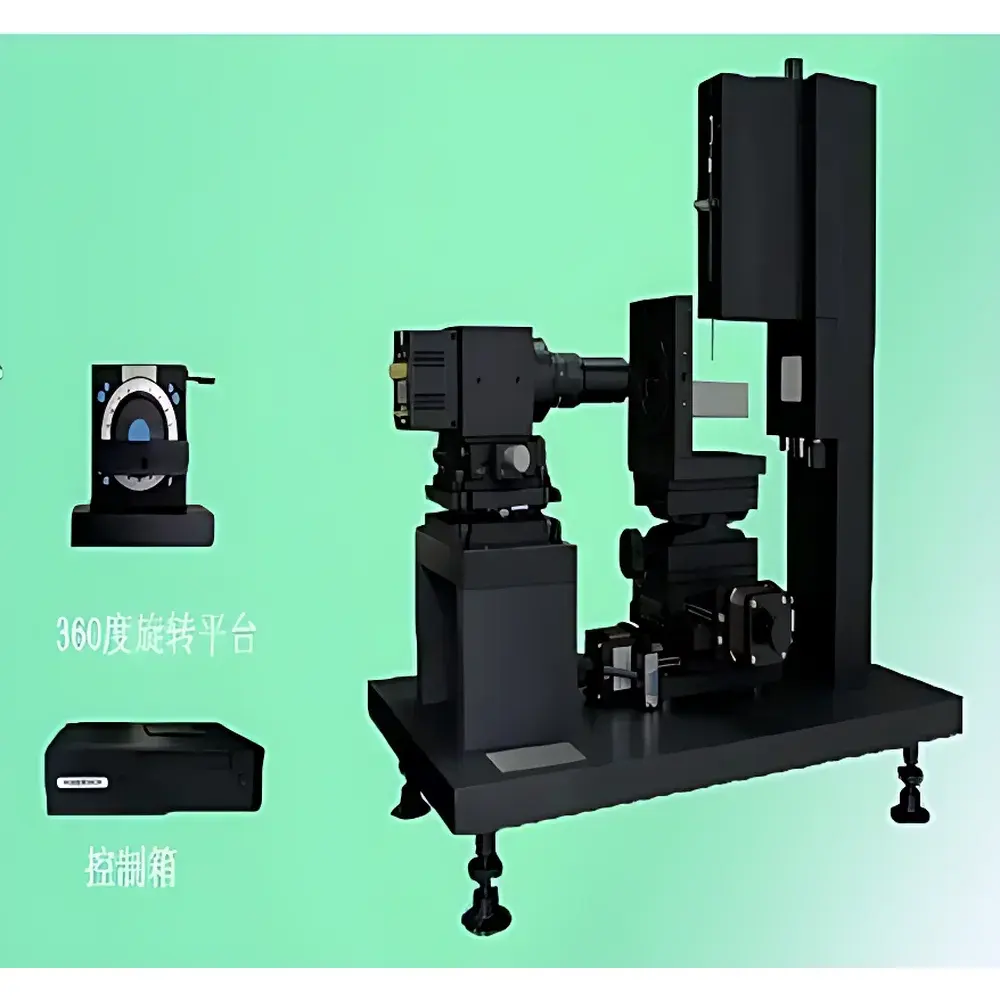
PowerTop JC2000F Dynamic Contact Angle & Roll-off Angle Analyzer
| Origin | Beijing, China |
|---|---|
| Manufacturer Type | Authorized Distributor |
| Product Origin | Domestic (China) |
| Model | JC2000F |
| Price Range | USD 7,000–14,000 |
| Instrument Category | Dynamic Contact Angle Analyzer |
| Form Factor | Benchtop Laboratory System |
| Contact Angle Measurement Range | 0–180° |
| Contact Angle Accuracy | ±0.1° or ±0.5° |
| Roll-off Angle Resolution | 0.2° |
| Sample Stage Dimensions | 70 mm × 70 mm |
| Optical Magnification | 0.7×–4.5× (continuous zoom) |
| Image Resolution | 50–318 pixels/mm |
| Surface/Interfacial Tension Range | 0–1000 mN/m |
| Stage Translation | Manual X/Y/Z (50 mm × 50 mm × 45 mm, 0.1 mm resolution) |
| Droplet Dispensing Precision | ±0.1 µL |
| CCD | USB 2.0 industrial camera, 700 TV lines, 25 fps (optional high-speed upgrade available) |
| Illumination | Adjustable monochromatic LED cold light source |
| Software Capabilities | Advancing/receding angle tracking, left/right asymmetry analysis, Owens–Wendt surface energy calculation, curvature correction for convex/concave substrates |
Overview
The PowerTop JC2000F Dynamic Contact Angle & Roll-off Angle Analyzer is a precision benchtop instrument engineered for quantitative characterization of solid–liquid interfacial wettability under controlled dynamic conditions. It operates on the fundamental principles of optical goniometry and gravitational tilt-based droplet mobility assessment. By combining high-resolution video capture with motorized or manually actuated stage inclination, the system enables simultaneous measurement of advancing contact angle (θA), receding contact angle (θR), contact angle hysteresis (Δθ = θA − θR), and roll-off angle—the critical tilt angle at which a sessile droplet begins to translate across an inclined substrate. These parameters collectively define the thermodynamic and kinetic components of surface wetting behavior, making the JC2000F indispensable for R&D in functional coatings, anti-fouling surfaces, microfluidic device design, and formulation science where interfacial stability and liquid mobility are performance-critical.
Key Features
- Full-range dynamic contact angle measurement (0–180°) with dual-angle acquisition (advancing and receding) synchronized to stage tilt motion
- High-precision mechanical tilt platform calibrated to 0.2° roll-off angle resolution, enabling reliable detection of subtle differences in surface heterogeneity and chemical gradient effects
- Continuous optical zoom system (0.7×–4.5×) paired with a 700-line USB 2.0 industrial CCD camera (25 fps standard, optional high-speed variant available) for stable droplet contour tracking during dynamic events
- Manual three-axis sample stage (X/Y/Z) with 0.1 mm positional repeatability and integrated leveling feet for precise horizontal alignment—critical for minimizing gravitational distortion in sessile drop analysis
- Adjustable monochromatic LED backlight with manual lens positioning (±10 mm in vertical and axial directions, ±0.1 mm resolution) to optimize contrast for low-contrast or translucent samples
- Integrated syringe-based dispensing system with ±0.1 µL volumetric control, supporting repeatable droplet deposition across diverse surface chemistries and topographies
Sample Compatibility & Compliance
The JC2000F accommodates flat, rigid specimens up to 70 mm × 70 mm and thicknesses compatible with its 45 mm Z-axis travel range. It supports non-temperature-controlled analysis of polymers, metals, ceramics, thin films, textiles, and porous membranes. While not equipped with active thermal regulation, its optical and mechanical architecture complies with foundational metrological practices outlined in ASTM D7334 (“Standard Practice for Surface Wettability of Coated Surfaces by Contact Angle Measurement”) and ISO 19403-2 (“Paints and varnishes — Determination of contact angle”). Data acquisition and processing workflows are structured to support GLP-aligned documentation requirements, including timestamped image capture, metadata logging (operator ID, sample ID, environmental notes), and audit-ready export formats (CSV, PNG, AVI). Though not FDA 21 CFR Part 11 certified out-of-the-box, the software architecture permits integration into validated laboratory information management systems (LIMS) via standardized data exchange protocols.
Software & Data Management
The proprietary imaging analysis suite provides six distinct contact angle calculation algorithms—including tangent-based half-angle, height-based half-angle, automated edge-detection fitting, five-point polynomial interpolation, left/right asymmetry comparison, and curvature-corrected fitting for convex or concave substrates. Dynamic measurements are triggered automatically upon stage tilt initiation, capturing sequential frames at user-defined intervals (1–3600 s). Surface free energy is computed using the Owens–Wendt two-liquid method; additional models (e.g., Wu harmonic mean, van Oss–Chaudhury–Good) are available as licensed modules. All raw images, processed profiles, and numerical outputs are stored in hierarchical project folders with embedded EXIF-style metadata. Software updates are delivered free of charge via secure download portal, ensuring long-term compatibility with evolving Windows OS versions and peripheral drivers.
Applications
The JC2000F serves cross-disciplinary research and quality control functions in sectors where interfacial performance dictates product functionality. In automotive R&D, it quantifies hydrophobicity retention of windshields after weathering and assesses paint adhesion stability under simulated rain-splash conditions. In agrochemical development, it evaluates leaf-wetting efficiency of pesticide formulations on waxy or hairy plant cuticles. In electronics manufacturing, it characterizes solder mask wettability and conformal coating uniformity on PCB substrates. In biomedical materials science, it validates anti-thrombogenic surface modifications of catheters and stents. Additional use cases include optimization of superhydrophobic textile finishes, evaluation of self-cleaning concrete additives, screening of nanocoating durability under cyclic humidity exposure, and interfacial tension profiling of oil–surfactant systems in enhanced oil recovery studies.
FAQ
What is the difference between roll-off angle and contact angle hysteresis?
Roll-off angle reflects macroscopic droplet mobility governed by surface topography and chemical heterogeneity, while contact angle hysteresis (θA − θR) quantifies the energy barrier to three-phase line advancement—both are complementary metrics for assessing practical wetting resistance.
Can the JC2000F measure contact angles on curved or irregular surfaces?
Yes—the software includes curvature correction algorithms for convex and concave substrates, enabling accurate contact angle determination on lenses, fibers, or microstructured surfaces when combined with appropriate focal plane adjustment.
Is temperature control available as an option?
No—the standard JC2000F operates at ambient laboratory temperature. For thermal-dependent wettability studies, external environmental chambers may be integrated with custom mounting fixtures.
How is calibration performed for angular accuracy?
The system uses NIST-traceable angular reference standards (certified wedge gauges) and pixel-scale calibration targets to validate both optical magnification consistency and mechanical tilt encoder linearity before each measurement session.
Does the software support automated batch processing of multiple samples?
Yes—project templates allow pre-definition of measurement sequences, droplet volumes, tilt rates, and analysis protocols, enabling unattended operation across multi-sample test series with consistent parameter application.



