
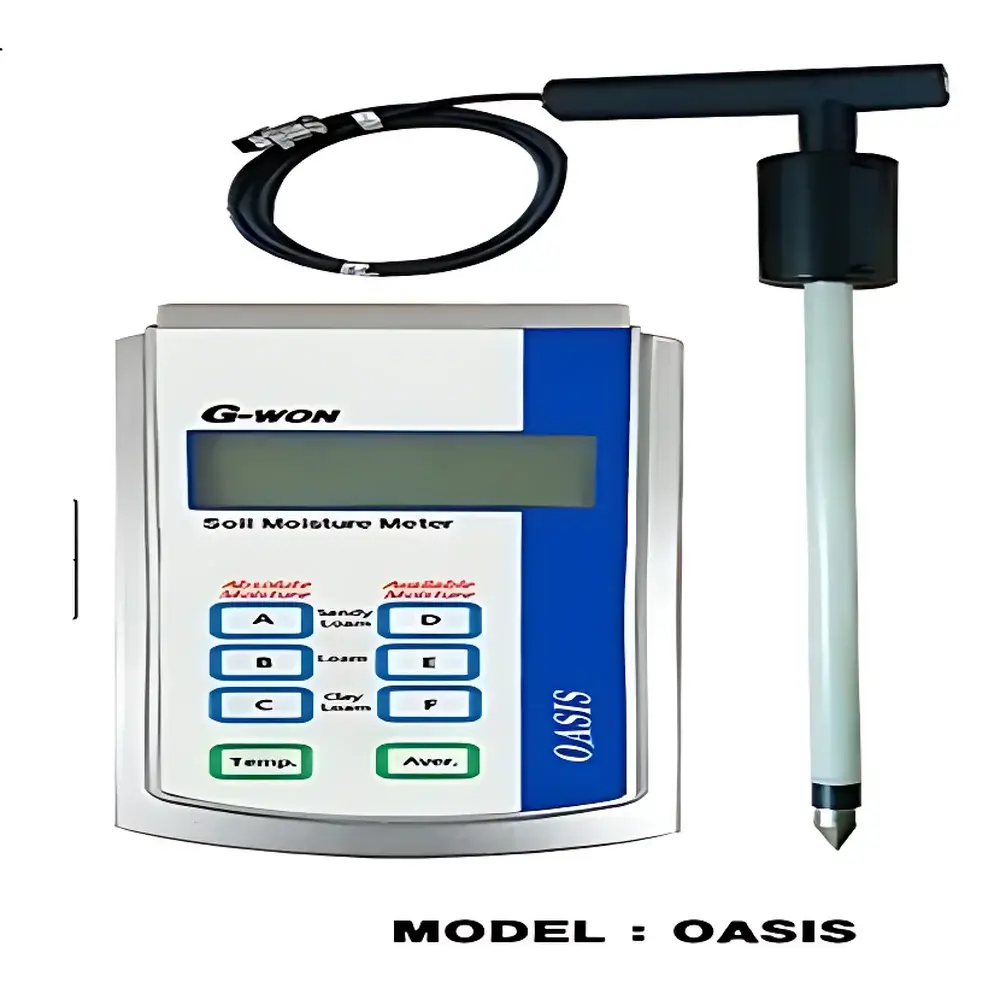
OASIS GMK-770S Soil Moisture and Temperature Analyzer
| Origin | Beijing, China |
|---|---|
| Manufacturer Type | Distributor |
| Regional Origin | Domestic (China) |
| Model | OASIS GMK-770S |
| Pricing | Upon Request |
| Instrument Category | Soil Moisture / Water Potential Analyzer |
| Measurement Principle | Capacitance-based Dielectric Sensing |
| Soil Types Supported | Sandy Loam, Loam, Clay Loam |
| Absolute Moisture Range | 7.0–35.0% w/w |
| Resolution | 1% |
| Accuracy | ±3% |
| Measurement Time | ~10 s |
| Temperature Compensation | Automatic |
| Display | Large LCD with Dual-Parameter Readout |
| Power Supply | 9 V alkaline battery (IEC 6LR61) |
| Dimensions (W×L×H) | 85 × 170 × 36 mm |
| Sensor Probe Length | 480 mm |
| Net Weight | ~2.0 kg |
Overview
The OASIS GMK-770S Soil Moisture and Temperature Analyzer is a handheld, field-deployable instrument engineered for rapid, in-situ assessment of soil water content and temperature using capacitance-based dielectric sensing. It operates on the principle that the dielectric permittivity of soil—strongly correlated with volumetric water content—changes predictably with moisture levels. By applying a high-frequency alternating electric field across a calibrated sensor probe inserted into the soil, the device measures the resulting capacitance shift and converts it into absolute moisture percentage (w/w), corrected in real time for ambient temperature fluctuations. Unlike gravimetric or neutron scattering methods, this non-destructive, battery-powered analyzer enables immediate on-site quantification without sample extraction or laboratory processing. Its dual-parameter output—simultaneous display of absolute moisture and empirically derived effective moisture—supports both quantitative analysis and qualitative soil condition classification (e.g., dry, moderately dry, moist), making it suitable for agricultural monitoring, irrigation scheduling, ecological field studies, and environmental impact assessments.
Key Features
- Capacitance-based sensing architecture with automatic temperature compensation for improved field reproducibility
- Dual-mode readout: simultaneous display of absolute moisture (% w/w) and effective moisture (categorized index)
- Soil-type-specific calibration modes via dedicated buttons (A–C for absolute moisture; D–F for effective moisture) corresponding to clay content ranges: sandy loam (<12.5% clay), loam (12.5–25%), clay loam (25–37.5%), and heavy clay loam (37.5–50%)
- Large, high-contrast LCD screen optimized for outdoor visibility under variable lighting conditions
- Real-time averaging function to reduce measurement variability across heterogeneous soil profiles
- Low-battery indicator and auto-power-off to extend operational life per 9 V alkaline cell
- Compact, ruggedized housing (85 × 170 × 36 mm) with 480 mm stainless-steel probe designed for repeated insertion into cultivated or undisturbed soils
- No external software or PC connection required for basic operation—fully self-contained measurement workflow
Sample Compatibility & Compliance
The GMK-770S is validated for use in mineral soils within defined textural classes: sandy loam, loam, and clay loam. It is not intended for organic soils (e.g., peat), saline soils (>4 dS/m EC), or frozen ground, where dielectric behavior deviates significantly from calibration assumptions. While the instrument does not carry formal ISO/IEC 17025 accreditation, its measurement methodology aligns with ASTM D5859-18 (Standard Guide for Field Measurement of Soil Moisture Content Using Capacitance Sensors) and supports data collection practices consistent with GLP-compliant environmental monitoring protocols. Calibration traceability is maintained through factory-set reference curves mapped to standard soil moisture reference materials. Users are advised to perform periodic field verification using gravimetric validation at representative sites.
Software & Data Management
The GMK-770S operates as a standalone field instrument with no embedded memory or digital data logging capability. All measurements are displayed in real time and must be manually recorded by the user. No proprietary software, drivers, or cloud connectivity are provided. This design prioritizes operational simplicity, reliability in remote settings, and compliance with environments where electronic data transmission is restricted or impractical. For integration into larger monitoring networks, users may pair the device with third-party field notebooks, mobile apps, or GIS-enabled tablets for manual entry and geotagging. The absence of electronic data storage ensures full compliance with local data sovereignty requirements and eliminates concerns related to FDA 21 CFR Part 11 electronic record integrity—though audit trails must be maintained externally via written logbooks.
Applications
- Agricultural irrigation management: Determining optimal watering thresholds based on real-time soil moisture status and texture-specific effective moisture thresholds
- Ecological field surveys: Monitoring soil moisture dynamics across transects or microhabitats in grassland, forest, or riparian restoration projects
- Construction and civil engineering: Verifying compaction moisture content during earthwork quality control (within specified textural limits)
- Educational field labs: Teaching principles of soil physics, water retention, and sensor-based environmental measurement
- Green infrastructure maintenance: Assessing substrate moisture in green roofs, bioswales, and rain gardens to guide maintenance interventions
FAQ
What soil types is the GMK-770S calibrated for?
It is calibrated for mineral soils classified as sandy loam, loam, and clay loam—defined by clay content ranges of <12.5%, 12.5–25%, and 25–37.5%, respectively. Heavy clay loam (37.5–50% clay) is supported via Button C/F, but accuracy decreases above 50% clay.
Does the device measure volumetric or gravimetric moisture?
The reported absolute moisture value is expressed as weight percent (g water / 100 g dry soil), i.e., gravimetric moisture content. Conversion to volumetric units requires concurrent bulk density measurement.
Is temperature measurement independent of moisture sensing?
Yes—the integrated thermistor provides a separate, compensated soil temperature reading (°C) referenced to the probe tip location, unaffected by dielectric signal processing.
Can measurements be exported digitally?
No. The GMK-770S has no data port, memory, or wireless interface. All readings must be transcribed manually.
How often should the sensor probe be cleaned?
After each use in fine-textured or high-organic soils, wipe the probe with a soft cloth and mild detergent; avoid abrasive cleaning agents that may damage the epoxy-coated electrodes.







