
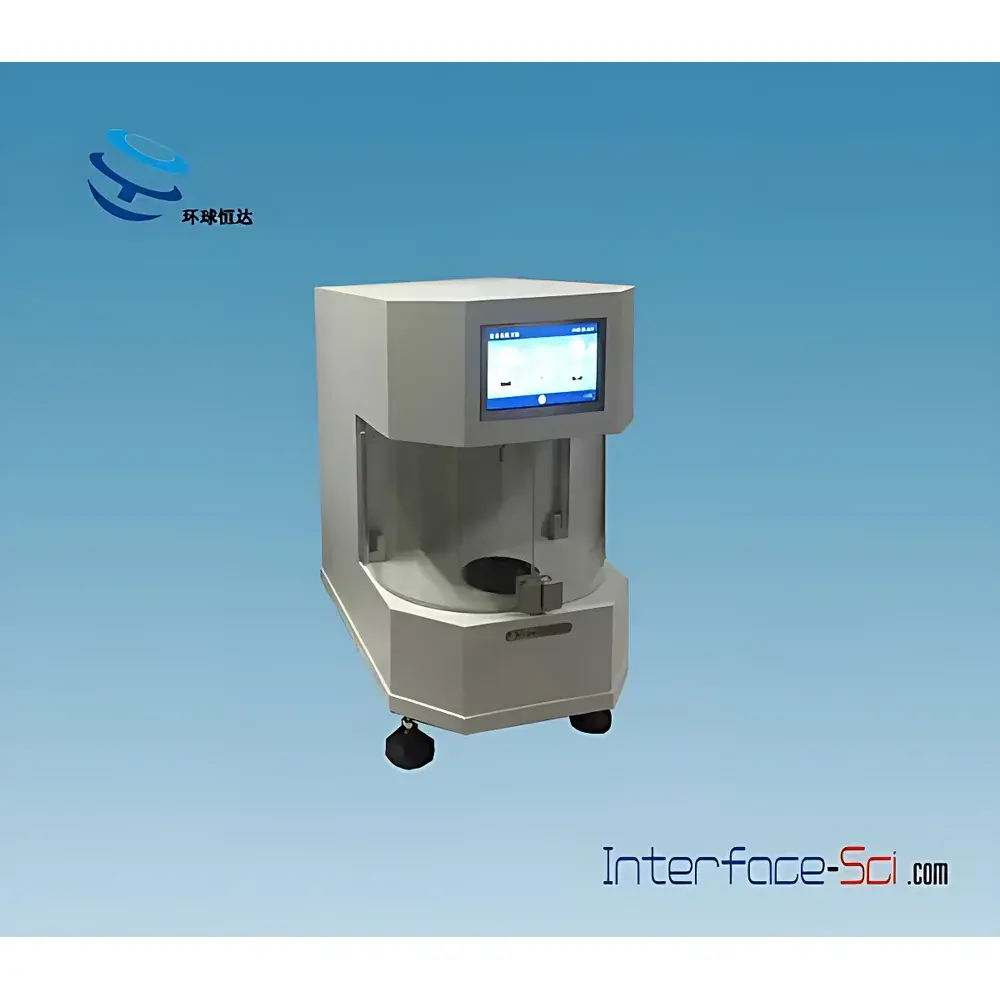
Interface JK99F Fully Automated Surface Tensiometer
| Brand | Interface |
|---|---|
| Origin | Beijing, China |
| Model | JK99F |
| Measurement Range | 0–999.99 mN/m |
| Resolution & Sensitivity | 0.001 mN/m |
| Accuracy | ±0.01 mN/m |
| Measurement Methods | Du Noüy Ring Method & Wilhelmy Plate Method |
| Sample Elevation Range | 0–50 mm |
| Elevation Precision | 0.1 µm |
| Mass Measurement Range | 0–150 g (0.1 mg resolution) |
| Sampling Time | Ring method: 20–150 s |
| Plate method | 1–5 s |
| Power Supply | AC 220 ±5 V, <150 W |
| Operating Humidity | 30–85% RH |
| Compliance | SY/T 5370–1999 |
Overview
The Interface JK99F Fully Automated Surface Tensiometer is a precision instrument engineered for the quantitative determination of surface tension (liquid–air interface) and interfacial tension (liquid–liquid interface) using two standardized physical methods: the Du Noüy ring method and the Wilhelmy plate method. Based on force-balance principles in static or quasi-static conditions, the JK99F measures the vertical force exerted by the liquid interface on a calibrated platinum probe—either a ring or a rectangular plate—as it interacts with the sample surface. This gravimetric approach adheres to thermodynamic definitions of interfacial free energy per unit area (mN/m), enabling traceable, SI-aligned measurements critical for R&D and quality control laboratories. Designed for compliance with SY/T 5370–1999—a Chinese petroleum industry standard aligned with ASTM D971 and ISO 6295 methodologies—the JK99F delivers high reproducibility across diverse fluid systems, including viscous formulations where dynamic effects and meniscus stability are critical. Its fully automated mechanical architecture eliminates operator-induced variability in immersion depth, withdrawal speed, and zero-point referencing.
Key Features
- Integrated high-precision electromechanical system featuring a stepper motor-driven vertical stage with 0.1 µm positioning resolution and noise-minimized motion profile.
- Dual-method capability: simultaneous support for both Du Noüy ring and Wilhelmy plate techniques—each with method-specific calibration routines and real-time force curve acquisition.
- High-stability microbalance based on a 0.1 mg resolution electromagnetic force compensation sensor (1/10,000 accuracy class), factory-calibrated with certified stainless-steel weights.
- Intuitive 7-inch capacitive touchscreen interface with embedded firmware for autonomous operation—no external PC required for routine measurements.
- Automatic zeroing function with configurable intervals (e.g., pre-measurement, post-immersion, or periodic drift correction), enhancing long-term measurement stability.
- Optimized probe geometry and thermal management to minimize convection artifacts and ensure consistent meniscus formation across temperature-sensitive samples.
- Modular platinum accessories: corrosion-resistant Pt/Ir alloy ring (diameter 19.2 mm, wire diameter 0.3 mm) and Wilhelmy plate (10 mm × 20 mm, edge-wetted perimeter calibrated to ±0.02 mm).
Sample Compatibility & Compliance
The JK99F accommodates a broad spectrum of Newtonian and non-Newtonian liquids—including crude oils, surfactant micellar solutions, polymer melts, inks, coatings, agrochemical emulsions, and pharmaceutical formulations—with validated performance up to 150 mPa·s viscosity. Both measurement modes comply with internationally recognized test protocols: the ring method follows ASTM D971 (standard test method for interfacial tension of oil against water by the ring method) and ISO 6295 (petroleum products—determination of interfacial tension—ring method); the plate method aligns with ISO 1409 (plastics—determination of surface tension of plastics by the Wilhelmy plate method) and USP guidelines for interfacial characterization of excipients. Instrument firmware supports audit trails, user access levels, and electronic signature logging—enabling alignment with GLP and GMP documentation requirements under FDA 21 CFR Part 11 when operated in networked environments with validated software extensions.
Software & Data Management
Onboard firmware includes built-in calculation engines implementing Young–Laplace corrections, buoyancy compensation, and Harkins–Jordan ring calibration factors. Raw force–time curves are stored with metadata (operator ID, timestamp, ambient temperature/humidity, method selection, probe serial number). Export formats include CSV and PDF reports compliant with laboratory information management system (LIMS) ingestion standards. Optional PC-based software provides advanced features: batch processing, statistical trend analysis (X-bar/R charts), comparative overlay of multiple surface pressure isotherms, and export to Excel-compatible templates for regulatory submission packages. All calibration parameters—including ring perimeter, plate perimeter, and density-dependent correction coefficients—are digitally archived and version-controlled within the instrument’s secure memory.
Applications
- Tertiary oil recovery research: quantifying interfacial tension reduction during chemical flooding (e.g., alkali-surfactant-polymer floods) to optimize surfactant selection and concentration.
- Formulation science: evaluating surfactant efficiency, critical micelle concentration (CMC), and formulation stability in detergents, personal care products, and food emulsions.
- Coatings & inks: correlating surface tension with substrate wettability, leveling behavior, and defect formation (e.g., cratering, orange peel).
- Fuel & lubricant development: assessing additive performance in reducing interfacial instability between hydrocarbon phases and water contaminants.
- Pesticide adjuvant screening: measuring dynamic surface tension changes during spray droplet formation and leaf surface spreading kinetics.
- Academic research: fundamental studies of Langmuir monolayers, nanoparticle–interface interactions, and temperature-dependent interfacial thermodynamics.
FAQ
What standards does the JK99F comply with?
The JK99F conforms to SY/T 5370–1999 and supports method execution aligned with ASTM D971, ISO 6295, ISO 1409, and USP . Full traceability is maintained via NIST-traceable calibration weights and documented uncertainty budgets.
Can the JK99F measure interfacial tension between two immiscible liquids?
Yes—both the platinum ring and platinum plate methods are validated for liquid–liquid interfacial tension measurement, provided the lower-phase density exceeds that of the upper phase and interfacial equilibration time is respected.
Is temperature control integrated into the JK99F?
The base unit does not include active temperature regulation; however, it is compatible with external Peltier-controlled sample stages or thermostatted environmental chambers (operating range: 5–60 °C) via analog I/O interfaces.
How often must the platinum probes be cleaned or recalibrated?
Platinum probes require cleaning after each sample series using chromic acid solution or oxygen plasma, followed by DI water rinse and ethanol drying. Calibration verification is recommended before each analytical session using standard reference liquids (e.g., pure water at 20 °C = 72.75 mN/m).
Does the instrument support Good Manufacturing Practice (GMP) workflows?
With optional software licensing and network integration, the JK99F supports 21 CFR Part 11–compliant electronic records, role-based access control, and full audit trail generation—including all parameter changes, measurement events, and calibration actions.



