
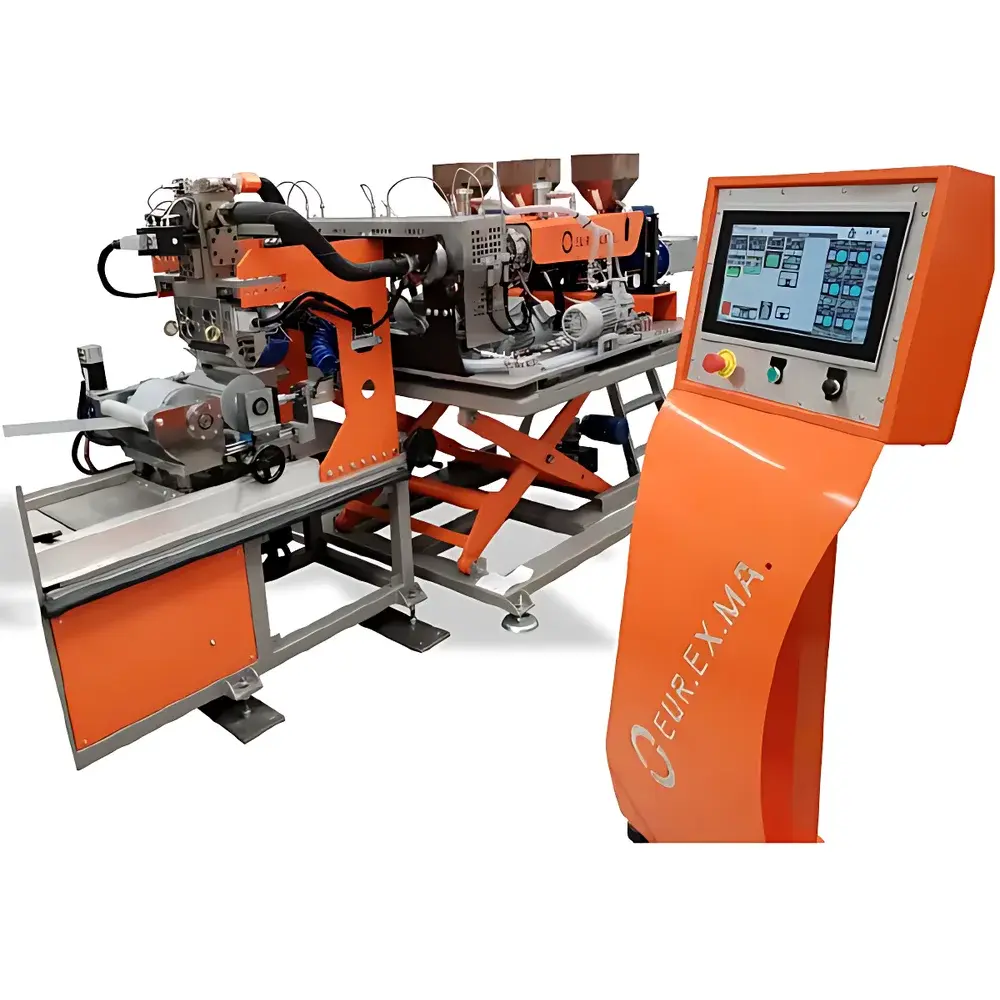
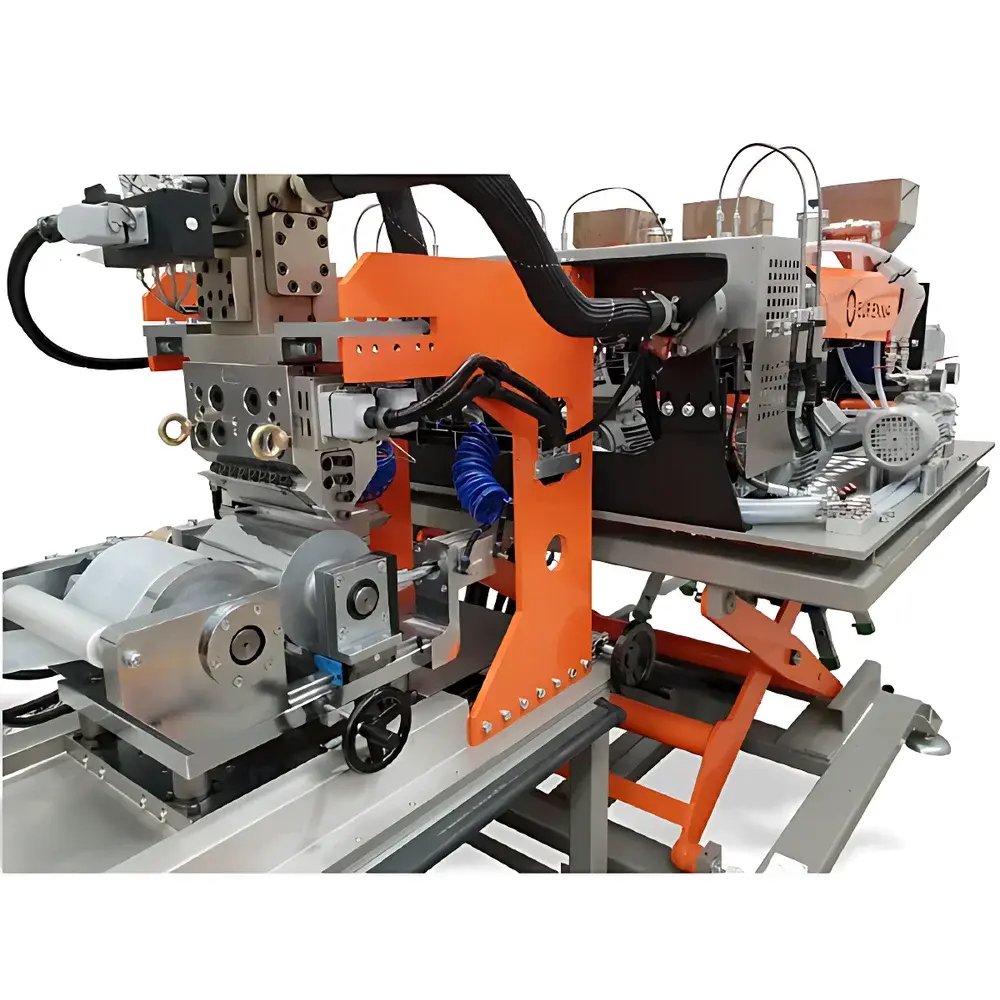
Minicast Coex Multi-Layer Cast Film Line
| Brand | EUROTECH |
|---|---|
| Origin | Italy |
| Manufacturer Type | Authorized Distributor |
| Origin Category | Imported |
| Model | Minicast Coex |
| Price Range | USD 42,000 – 70,000 |
Overview
The Minicast Coex Multi-Layer Cast Film Line is a compact, laboratory-scale coextrusion casting system engineered for R&D, formulation validation, and pilot-scale process development in polymer science and advanced packaging materials engineering. Unlike conventional industrial cast film lines, the Minicast Coex operates on the principle of precision melt extrusion followed by quenching on a highly polished, temperature-controlled chill roll—enabling rapid solidification of molten polymer layers into dimensionally stable, optically clear films. Its core architecture integrates multiple single-screw extruders feeding into a multi-manifold coextrusion die block, where layered melt streams are laminated under controlled shear and pressure prior to casting. Designed specifically for rubber, thermoplastic elastomer (TPE), polyolefin, and barrier polymer systems, this line supports up to seven distinct functional layers—each independently metered, temperature-regulated, and rheologically matched—to replicate commercial multilayer architectures such as PE/EVOH/PE, PET/ADHESIVE/ALUMINUM/ADHESIVE/PE, or bio-based PLA/PBAT blends.
Key Features
- Modular coextrusion die block with configurable layer count (up to 7 layers), available in both fixed-geometry and adjustable-layer variants to accommodate varying interfacial adhesion requirements and layer thickness ratios.
- Interchangeable extruder modules—compatible with 16 mm to 25 mm screw diameters—allow rapid reconfiguration for different polymer viscosities, thermal stability profiles, and throughput demands (0.1–5 kg/h per extruder).
- Integrated chill roll system with ±0.3 °C temperature uniformity across width, surface finish <0.05 µm Ra, and variable speed control (0.1–10 m/min) to optimize crystallinity, haze, and residual stress distribution.
- Self-configuring automation software that detects connected extruders, die configuration, and downstream modules (e.g., electrostatic pinning, corona treater, or gravimetric winding station) via CANopen communication protocol—eliminating manual parameter mapping during hardware reconfiguration.
- Stainless-steel frame with ISO Class 7 cleanroom-compatible enclosure options, CE-compliant safety interlocks, and integrated melt pressure transducers (±0.5% FS accuracy) at each die manifold entry.
Sample Compatibility & Compliance
The Minicast Coex accommodates a broad spectrum of thermoplastic and thermoplastic elastomeric materials—including LDPE, LLDPE, HDPE, PP, PS, PET, PA6, EVOH, TPU, SEBS, and biodegradable polymers such as PHA and PCL—provided they exhibit melt flow indices (MFI) between 0.5 and 50 g/10 min (ASTM D1238, 190 °C/2.16 kg). All wetted components contacting polymer melt are constructed from AISI 316L stainless steel or nitrided tool steel (HV ≥900), ensuring corrosion resistance and minimal metal ion leaching during high-temperature processing. The system conforms to EN 61000-6-2 (EMC immunity), EN 61000-6-4 (EMC emission), and meets essential health and safety requirements under EU Machinery Directive 2006/42/EC. Optional IQ/OQ documentation packages support GLP-compliant validation in regulated environments.
Software & Data Management
The embedded control platform runs on a real-time Linux OS with deterministic I/O response (<1 ms cycle time) and provides synchronized acquisition of 128+ process variables—including barrel zone temperatures, screw RPM, melt pressure, chill roll surface temperature, web tension, and layer thickness (via optional IR thickness gauge interface). All data are timestamped with UTC synchronization and stored in vendor-agnostic HDF5 format, enabling direct import into MATLAB, Python (Pandas/H5Py), or LIMS platforms. Audit trails comply with FDA 21 CFR Part 11 requirements when configured with role-based user authentication, electronic signatures, and immutable log archiving. Remote monitoring and diagnostics are supported via secure TLS 1.3-enabled OPC UA server (IEC 62541), allowing integration into Industry 4.0 MES infrastructures.
Applications
- Rapid screening of multilayer adhesive compatibility and interlayer delamination thresholds under accelerated thermal cycling (−40 °C to +85 °C).
- Development of ultra-thin barrier films (<15 µm total thickness) for pharmaceutical blister packaging, requiring precise control of EVOH or SiOx layer integrity.
- Process window mapping for coextruded TPO automotive interior skins—evaluating surface gloss, mar resistance, and weld line strength as functions of layer sequence and quench rate.
- Validation of recycling-compatible multilayer structures, including compatibilizer dosage optimization and phase morphology characterization via in-line FTIR coupling.
- Academic research on structure–property relationships in gradient-index optical films, where refractive index modulation is achieved through controlled compositional layering.
FAQ
What is the minimum layer thickness achievable with the Minicast Coex system?
Typical single-layer thickness ranges from 2.5 µm to 100 µm depending on polymer rheology, line speed, and chill roll temperature—verified using calibrated laser micrometers traceable to NIST standards.
Can the system be upgraded from a 3-layer to a 7-layer configuration post-purchase?
Yes—modular die blocks and extruder mounting interfaces are standardized; upgrades require only mechanical retrofitting of the manifold stack and firmware revalidation.
Is offline rheological data export supported for correlation with capillary rheometer results?
Yes—melt pressure, temperature, and volumetric flow rate data are exported in CSV and HDF5 formats, enabling direct calculation of apparent viscosity, Bagley correction, and Trouton ratio per ASTM D3835.
Does the system support nitrogen purging for oxygen-sensitive polymers?
Optional inert gas shrouds are available for all extruder hoppers, feed throats, and die manifolds, with integrated O2 monitoring down to 10 ppm (electrochemical sensor).
What level of operator training is required to achieve GMP-compliant operation?
EUROTECH provides a 3-day on-site qualification workshop covering SOP development, calibration procedures, preventive maintenance scheduling, and audit readiness preparation—certified per ISO/IEC 17025 competency criteria.
Related Products





