
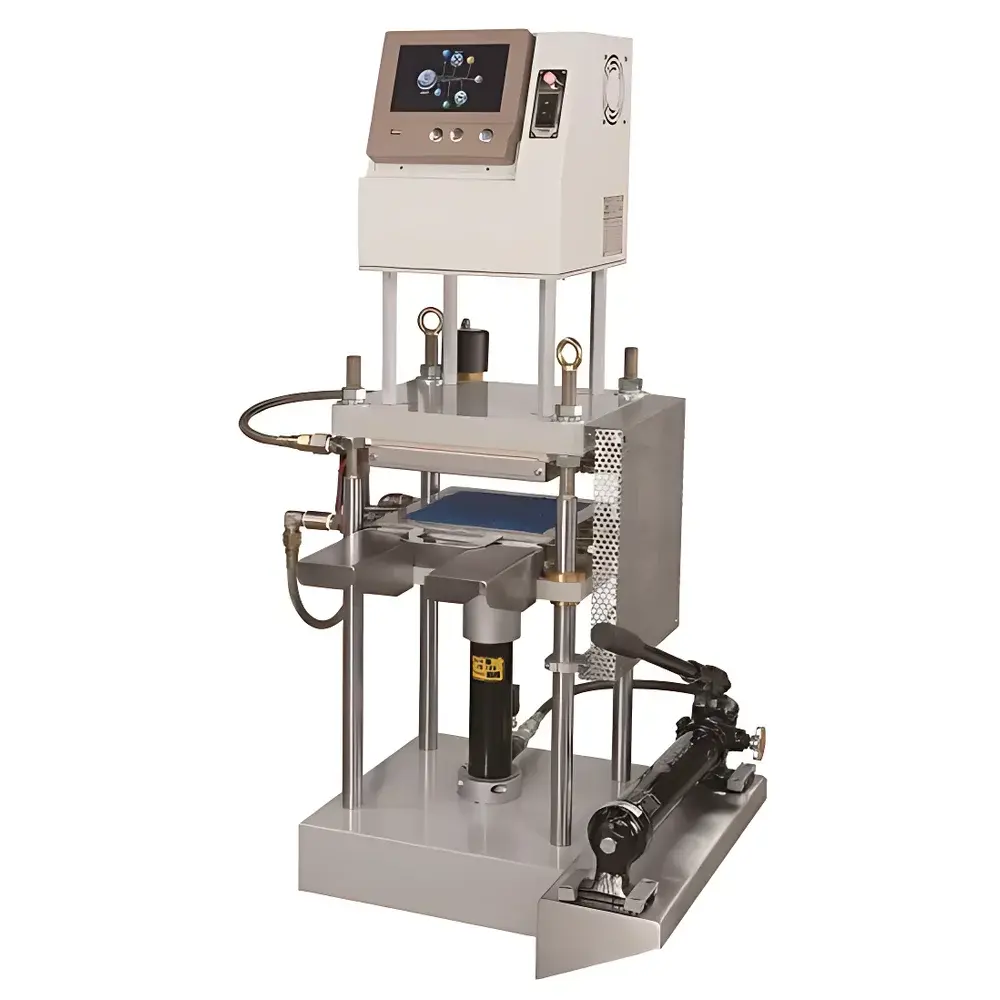
Cometech QC-677A Manual Hydraulic Hot Press for Rubber & Plastic Vulcanization Testing
| Brand | Cometech |
|---|---|
| Model | QC-677A |
| Origin | Taiwan |
| Heating Plate Dimensions | 25×25 cm (10–20 ton), 30×30 cm (30–50 ton) |
| Adjustable Platen Gap | 60–100 mm |
| Temperature Range | Ambient to 300 °C |
| Max. Pressure Capacity | 10 / 20 / 30 / 50 metric tons (tonf, SI) |
| Heating Rate | ~50 °C/min (50 °C → 150 °C in ≈18 min) |
| Cooling Options | Optional water-cooled circuit (150 °C → 60 °C in ≈10 min) or external chiller (~15 °C/min avg.) |
| Control Interface | 7-inch capacitive touchscreen with real-time force/temperature display and curve plotting |
| Power Supply | Single-phase 220 V, 50/60 Hz |
| Compliance | Designed for ASTM D5345, ISO 34-1, ISO 6502, and rubber compounding R&D workflows requiring GLP-aligned process traceability |
Overview
The Cometech QC-677A Manual Hydraulic Hot Press is an engineered laboratory-scale vulcanization press designed for precise, repeatable thermal compression molding of elastomeric and thermoplastic compounds. It operates on a fundamental principle of controlled heat transfer and mechanical consolidation: two independently heated platens apply calibrated hydraulic pressure to a sample confined within a precision-machined mold cavity, enabling crosslinking (vulcanization) or thermoplastic flow under defined time–temperature–pressure (TTP) profiles. Unlike fully automated production presses, the QC-677A prioritizes operator-controlled reproducibility for R&D, quality assurance, and pre-production sample generation—particularly where material batch validation, color matching, physical property correlation, or formulation screening demands strict adherence to standardized test protocols such as ASTM D5345 (Standard Test Method for Determining Optimum Cure Time of Rubber Compounds Using a Moving Die Rheometer) and ISO 6502 (Rubber — Determination of Vulcanization Characteristics with the Moving Die Rheometer). Its manually actuated hydraulic system ensures deterministic force application without servo-induced variability, while its dual-zone heating architecture maintains ±1.5 °C uniformity across the platen surface per ISO 18894 calibration guidelines.
Key Features
- Manually operated hydraulic system with calibrated pressure gauge and mechanical locking mechanism—eliminates electronic control drift and ensures consistent force delivery across repeated cycles.
- Dual independent heating plates with PID-controlled solid-state relays, supporting temperature setpoints from ambient to 300 °C with ramp-and-soak capability and real-time deviation monitoring.
- Adjustable platen gap (60–100 mm) accommodates varying mold stack heights and enables fine-tuning of compression ratio for low-viscosity compounds or thick-section samples.
- F1C-series dedicated controller featuring a 7-inch industrial-grade capacitive touchscreen interface; displays live force (kN, tonf, lbf), temperature (°C/°F), elapsed time, and dynamic cure curve overlays using embedded trend logging.
- Modular cooling options: integrated water-circulation loop (for rapid cooldown between cycles) or compatibility with external industrial chillers (rated ≥3 kW cooling capacity) to meet high-throughput lab requirements.
- Pre-configured unit conversion engine supporting 12 pressure units (bar, MPa, psi, kgf/cm²), 6 area formats (cm², in², m²), and 9 force standards (kN, N, lbf, tonf SI/long/short)—essential for multi-regional compliance reporting.
Sample Compatibility & Compliance
The QC-677A supports standard and custom molds up to 300 mm × 300 mm footprint, including supplied 200 × 200 × 2 mm and 250 × 250 × 2 mm flat-plate dies compliant with ASTM D3182 and ISO 37 specimen geometry requirements. It is routinely deployed in rubber compound development labs for generating cured slabs used in tensile, hardness, tear, and rebound testing. The system meets foundational design criteria for Good Laboratory Practice (GLP) environments: all temperature and force parameters are digitally logged with timestamped metadata, and the F1C controller supports optional audit-trail export (CSV/Excel) for FDA 21 CFR Part 11–aligned documentation. While not a certified GMP manufacturing device, its mechanical stability, thermal repeatability, and manual operation mode align with ICH Q5E recommendations for comparability studies during raw material or process change assessments.
Software & Data Management
The embedded F1C controller runs a deterministic real-time OS with no external OS dependencies. All operational data—including force vs. time, temperature vs. time, and derived cure state indicators (e.g., t₉₀, minimum torque, scorch time)—are stored locally in non-volatile memory with configurable sampling intervals (100 ms to 5 s). Export is supported via USB 2.0 port to FAT32-formatted drives; files include header metadata (operator ID, test ID, mold ID, ambient RH/T, calibration date). No cloud connectivity or proprietary software installation is required—raw CSV files integrate natively with MATLAB, Python pandas, or LIMS platforms. For regulated environments, optional firmware enables digital signature capture and user-level access control (admin/operator modes), satisfying basic 21 CFR Part 11 authentication and record retention prerequisites.
Applications
- Rubber formulation optimization: generating standardized cure curves to determine optimal sulfur accelerator systems and evaluate scorch safety.
- Thermoplastic sheet lamination: consolidating multilayer polymer films under controlled dwell time and pressure for peel strength evaluation.
- Composite prepreg consolidation: preliminary hot-press trials for carbon-fiber/epoxy layups prior to autoclave qualification.
- Color and gloss standardization: producing uniform reference plaques for spectrophotometric or gloss meter calibration across production lines.
- Raw material lot release: verifying batch-to-batch consistency of polymer viscosity, filler dispersion, or crosslink density via post-press physical testing.
- Academic polymer science research: investigating structure–property relationships in novel elastomers, biopolymers, or recycled plastic blends under programmable TTP conditions.
FAQ
Is the QC-677A compliant with ASTM D5345 or ISO 6502?
Yes—the press provides the stable thermal and mechanical boundary conditions required by both standards when paired with appropriate molds and calibrated force/temperature sensors. It does not replace a moving-die rheometer but serves as the upstream sample preparation platform essential for comparative vulcanizate analysis.
Can the controller store multiple test recipes?
Yes—the F1C interface supports up to 99 named test profiles, each storing independent temperature ramps, dwell times, pressure targets, and cooling triggers.
What maintenance is required for long-term accuracy?
Annual verification of platen parallelism (±0.02 mm/m), thermocouple calibration against NIST-traceable references, and hydraulic oil replacement every 24 months are recommended per Cometech’s service bulletin QB-677A-MNT-2023.
Does the system support vacuum-assisted molding?
No—vacuum ports or chamber integration are not part of the standard configuration. However, third-party vacuum mold inserts can be mechanically mounted if internal venting paths are preserved.
Is technical support available outside Taiwan?
Cometech authorizes regional service partners in North America, EU, and APAC regions; remote diagnostics and firmware updates are supported via secure SSH tunnel upon customer registration.






