
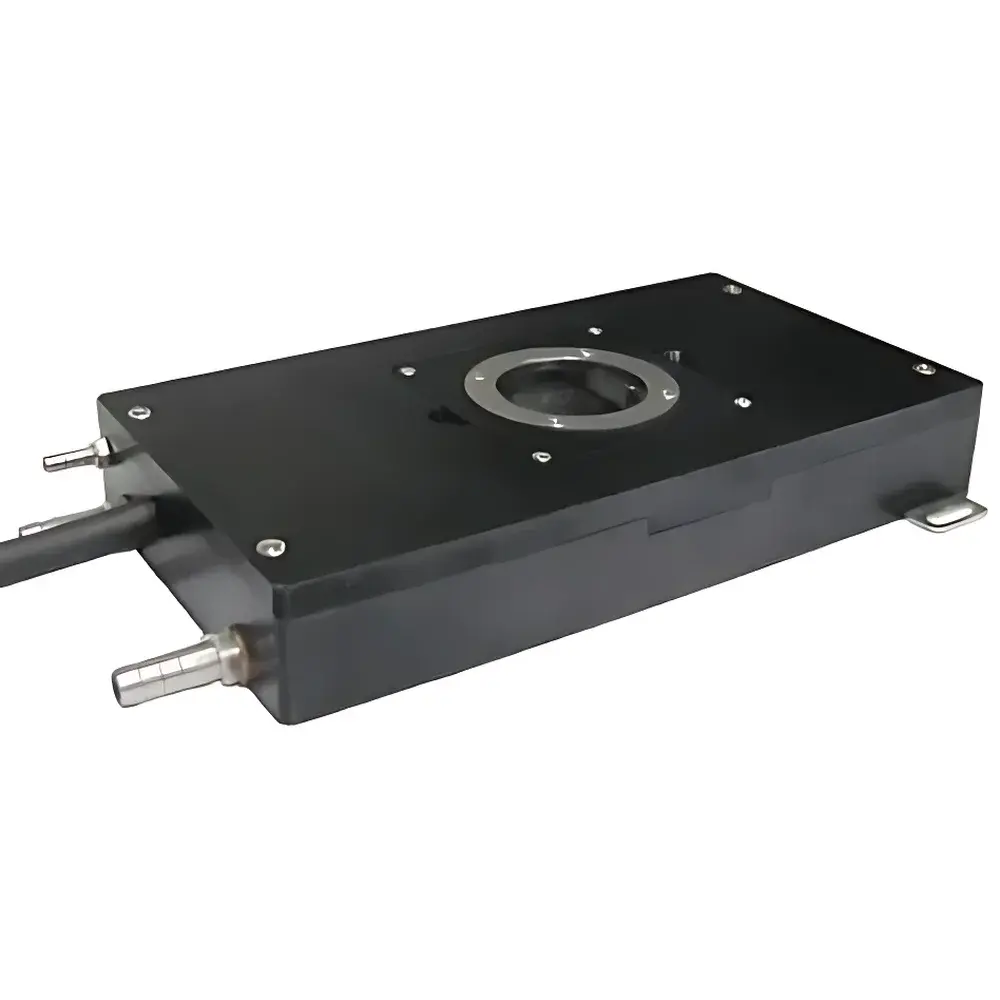
MicrOptik MTS120CD Large-Sample Chamber Cryo-Heating Stage
| Brand | MicrOptik |
|---|---|
| Origin | Netherlands |
| Model | MTS120CD |
| Temperature Range | −20 °C to +120 °C |
| Temperature Resolution | 0.1 °C |
| Temperature Stability (with MTDC600 controller) | ±0.1 °C at 100 °C |
| Heating/Cooling Rate | Adjustable up to 30 °C/min |
| Control Algorithm | Dual-mode PID-PID switching |
| Sensor Type | RTD (Pt100) |
| Sample Cavity Dimensions | 80 × 55 × 9.5 mm |
| Reflected Light Aperture | 50 mm (customizable) |
| Transmitted Light Aperture | 5 mm (customizable) |
| Inert Gas Port | Optional |
| Mechanical Footprint | As per MTS120CD dimensional drawing |
Overview
The MicrOptik MTS120CD is a precision-engineered large-sample chamber cryo-heating stage designed for in situ optical characterization under tightly controlled thermal conditions. It operates on the principle of resistive heating combined with thermoelectric (Peltier) cooling, enabling bidirectional temperature modulation across a wide operational envelope—from −20 °C to +120 °C—while maintaining high spatial and temporal thermal uniformity within the sample zone. Its open-top, low-profile architecture integrates seamlessly into upright and inverted optical microscopes, spectroscopic setups (including FTIR, Raman, and UV-Vis), and interferometric platforms. Unlike compact-stage alternatives, the MTS120CD prioritizes volumetric accessibility: its 80 × 55 × 9.5 mm cavity accommodates bulky or multi-component specimens—including wafer fragments, encapsulated liquid crystal cells, food matrix cross-sections, or photovoltaic device stacks—without compromising optical path integrity. The stage’s mechanical design minimizes thermal drift-induced image shift (<0.5 µm/°C), ensuring stable focus and registration during time-resolved imaging or spectral acquisition.
Key Features
- Wide thermal operating range (−20 °C to +120 °C) with sub-degree stability: Achieves ±0.1 °C control accuracy at 100 °C when paired with the dedicated MTDC600 digital temperature controller.
- Dual-mode PID-PID switching algorithm: Dynamically optimizes response during ramp-up, dwell, and cooldown phases—reducing overshoot and accelerating thermal equilibration.
- Optically optimized aperture configuration: Standard 50 mm reflected-light access and 5 mm transmitted-light window preserve NA compatibility for high-magnification objectives; both apertures support customization to match objective working distance and condenser geometry.
- Inert atmosphere integration: Optional gas inlet/outlet ports enable purging with N₂ or Ar to suppress oxidation, moisture condensation, or photochemical side reactions during elevated-temperature measurements.
- RTD-based closed-loop sensing: Platinum resistance thermometer (Pt100) embedded adjacent to the sample mount delivers traceable, linear feedback with <0.05 °C long-term repeatability.
- Modular mechanical interface: Standard SM1 (1.035″-40) and M27×0.75 threading enables direct mounting to translation stages, kinematic bases, or custom optical breadboards without adapter plates.
Sample Compatibility & Compliance
The MTS120CD supports heterogeneous sample geometries common in materials science and industrial R&D—such as polymer films on quartz substrates, solder-joint cross-sections, frozen emulsions in capillary cells, or perovskite solar cell modules. Its cavity depth (9.5 mm) permits vertical stacking of optical elements (e.g., polarizers, waveplates) beneath the specimen. All wetted surfaces are passivated stainless steel or anodized aluminum, compliant with ISO 14644-1 Class 5 cleanroom handling protocols. The system meets CE marking requirements for electromagnetic compatibility (EN 61326-1) and low-voltage safety (EN 61010-1). When operated with validated MTDC600 firmware, it supports audit-trail-enabled temperature logging aligned with GLP and GMP documentation workflows.
Software & Data Management
The MTDC600 controller communicates via USB 2.0 or RS-232 and is compatible with MicrOptik’s StageControl Suite (Windows/Linux), which provides programmable ramp-hold-cool sequences, real-time temperature vs. time plotting, and CSV export of timestamped sensor data. Third-party integration is supported through ASCII command protocol (SCPI-like syntax) for LabVIEW, Python (PySerial), MATLAB, and EPICS IOC environments. All temperature setpoints and actual readings are logged with millisecond resolution and synchronized to external triggers (TTL input), enabling correlation with camera frame timestamps or spectrometer acquisition events. Data files include embedded metadata (controller firmware version, calibration certificate ID, operator ID) to satisfy FDA 21 CFR Part 11 electronic record requirements when used in regulated QC laboratories.
Applications
- Materials Science: Phase transition analysis of shape-memory alloys, thermal expansion coefficient mapping of composites, and crystallization kinetics in amorphous polymers.
- Liquid Crystal Research: Observation of nematic-isotropic transitions, domain reorientation under electric field + thermal stress, and electro-optic hysteresis profiling.
- Food Science: Monitoring starch gelatinization, fat crystallization/melting, and Maillard reaction onset in model systems using polarized light microscopy.
- Photovoltaics: In situ evaluation of thermal degradation mechanisms in perovskite thin films and interfacial delamination in tandem cell architectures.
- Pharmaceutical Solid-State Chemistry: Hydrate/dehydrate transitions, polymorphic interconversion, and excipient compatibility screening under controlled humidity (when coupled with environmental enclosure).
FAQ
What optical configurations is the MTS120CD compatible with?
It is engineered for standard upright and inverted microscope frames (Olympus BX/IX, Nikon Eclipse, Zeiss Axio series), confocal laser scanning systems, and macro-scale optical benches with collimated illumination paths.
Can the stage be used under vacuum?
No—the MTS120CD is rated for ambient pressure only; vacuum operation requires custom sealing and modified thermal management not provided in the standard configuration.
Is the MTDC600 controller included by default?
Yes, the MTDC600 digital temperature controller is supplied as part of the complete MTS120CD system and is required for full specification performance.
How is thermal uniformity verified across the sample cavity?
MicrOptik provides a factory calibration report documenting axial/radial temperature gradients measured using a 5-point micro-thermocouple array at three setpoints (−20 °C, 25 °C, 100 °C); typical uniformity is ≤±0.3 °C over the central 60% of the cavity.
Does the stage support motorized Z-axis focusing integration?
While the MTS120CD itself is manually focused, its mechanical footprint and mounting threads are fully compatible with third-party piezoelectric or stepper-driven focus actuators (e.g., Thorlabs MAX312D, Prior ProScan III) via standard cage-system adapters.





