
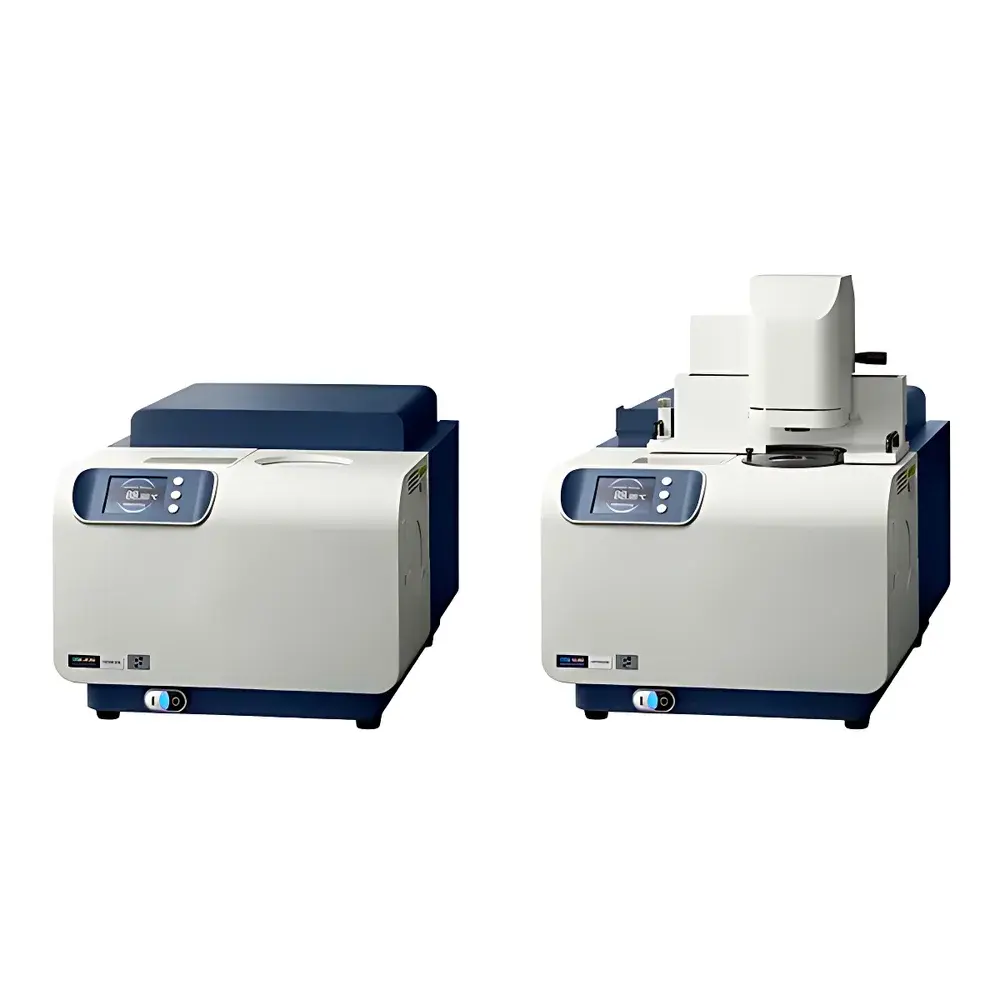
Hitachi NEXTA DSC Series Differential Scanning Calorimeter
| Brand | Hitachi |
|---|---|
| Model | DSC600 / DSC200 |
| Instrument Type | Differential Scanning Calorimeter (DSC) |
| Sample Throughput | Multi-sample simultaneous measurement |
| Origin | Imported |
| Manufacturer Status | Original Equipment Manufacturer (OEM) |
| Application Scope | Polymer, Pharmaceutical, Chemical, Petrochemical, Food, and Metallic Materials Characterization |
| RealView® Imaging System | Integrated 20-MP camera with 50× digital zoom and 1.2 µm pixel resolution |
| Polarized Light Capability | Optional polarized optical module for birefringence and crystalline orientation analysis |
| Data Export Formats | CSV, Excel (.xlsx), plain text |
| Barcode Integration | Supported for automated method and sample metadata ingestion |
| Software Compliance | Audit-trail enabled |
Overview
The Hitachi NEXTA DSC Series is a high-precision differential scanning calorimeter engineered for quantitative thermal transition analysis based on heat flow differentials between sample and reference under controlled temperature programs. Operating on the principle of symmetric twin-furnace compensation and high-stability thermocouple arrays, the system delivers exceptional baseline flatness (< ±0.01 µW over 0–300 °C) and thermal sensitivity (detectable enthalpy change < 0.1 µJ), enabling reliable detection of subtle endothermic and exothermic events—including glass transitions (Tg), melting onset (Tm), cold crystallization, solid-solid phase transformations, and oxidative induction time (OIT). Designed for both routine QC laboratories and advanced R&D environments, the DSC600 and DSC200 models share a common modular architecture but differ in thermal resolution, furnace stability, and imaging integration capability—making them suitable across industries governed by ASTM E794, ISO 11357, USP <1151>, and ICH Q5E thermal stability assessment guidelines.
Key Features
- World-class baseline stability achieved through dual-symmetric furnace design and active temperature gradient compensation
- High-resolution RealView® real-time observation system: 20-megapixel CMOS camera synchronized with temperature/time stamps, enabling direct correlation of morphological changes (e.g., spherulite growth, melt front propagation, delamination) with thermal events
- Optional RealView® Polarized Module: Enables birefringence mapping, crystal orientation analysis, and anisotropic domain identification in polymers, liquid crystals, and multilayer films—with calibrated retardation quantification and polarizer rotation control
- Modular hardware expansion: Late-stage integration of autosampler (up to 48 positions), UV-curable cell holders, high-pressure cells (up to 10 MPa), and humidity-controlled chambers
- Intuitive yet scalable software interface: Supports both guided workflow mode for operators and scriptable advanced analysis mode for method development and custom peak deconvolution
- FDA 21 CFR Part 11-compliant software architecture with electronic signatures, audit trail logging, and role-based access control
Sample Compatibility & Compliance
The NEXTA DSC series accommodates standard hermetic and vented aluminum pans (40 µL), high-pressure stainless-steel cells, fiber-optic coupled crucibles for photo-DSC, and custom-designed holders for thin films or powders. It complies with international thermal analysis standards including ISO 11357-1 through -7 (plastics), ASTM E1269 (heat capacity), ASTM E1356 (glass transition), and ICH Q1A(R2)/Q5E for pharmaceutical stability studies. All instrument configurations support GLP and GMP documentation requirements, with full traceability from raw heat flow data to final report generation—including calibration certificate linkage, sensor drift monitoring, and thermal lag correction algorithms validated per NIST SRM 3451.
Software & Data Management
The NEXTA Analysis Suite provides integrated acquisition, processing, and reporting functions within a single platform. Measurement conditions—including ramp rates (0.01–100 °C/min), hold times, purge gas flow (N2, He, air), and atmosphere switching sequences—are programmable via graphical method editor. Barcode scanners auto-populate sample IDs, batch numbers, and associated SOP references directly into the measurement queue. Up to 5,000 samples can be queued with metadata preloaded from CSV templates. Processed results—including peak temperatures, enthalpies, onset values, and kinetic parameters (e.g., Ozawa-Flynn-Wall analysis)—are exportable in CSV, Excel (.xlsx), and plain-text formats. All raw DSC thermograms are stored in vendor-neutral HDF5 format, preserving full time-temperature-heatflow resolution for retrospective reprocessing.
Applications
- Pharmaceutical: Polymorph screening, amorphous content quantification, excipient compatibility assessment, and lyophilized product stability profiling
- Polymers: Crystallinity determination (via fusion enthalpy), Tg mapping across copolymer compositions, crosslink density estimation, and aging-induced degradation kinetics
- Electronics: Thermal reliability evaluation of encapsulants, solder pastes, and underfill materials under thermal cycling protocols
- Food Science: Fat crystallization behavior, starch gelatinization enthalpy, and shelf-life prediction via oxidative stability testing
- Metals & Alloys: Solidus/liquidus determination, precipitation heat effects in age-hardening alloys, and intermetallic phase formation analysis
FAQ
What distinguishes the DSC600 from the DSC200 model?
The DSC600 features enhanced thermal resolution (0.001 °C temperature increment), extended temperature range (−150 to 700 °C), and native integration of the RealView® Polarized Module—whereas the DSC200 targets cost-optimized routine analysis with a −90 to 500 °C range and optional RealView® add-on capability.
Is the RealView® system compatible with all DSC measurement atmospheres?
Yes—the quartz viewport and inert-gas purged optical path allow operation under nitrogen, argon, oxygen, or air without image degradation or lens fogging.
Can the software generate IQ/OQ/PQ validation documentation?
Yes—the system includes preconfigured validation templates aligned with ASTM E1505 and ISO/IEC 17025, supporting instrument qualification packages with automated test scripts and electronic signature capture.
Does the autosampler support non-standard crucible types?
Standard autosamplers accept 40 µL aluminum pans; custom adapters are available for sealed gold pans, high-pressure cells, and fiber-optic sample holders upon request.
How is data integrity ensured during long-term unattended runs?
Continuous checksum verification, redundant storage buffers, and automatic recovery checkpoints prevent data loss—even during power interruption or network disconnection—ensuring complete thermogram integrity across multi-day experiments.



