
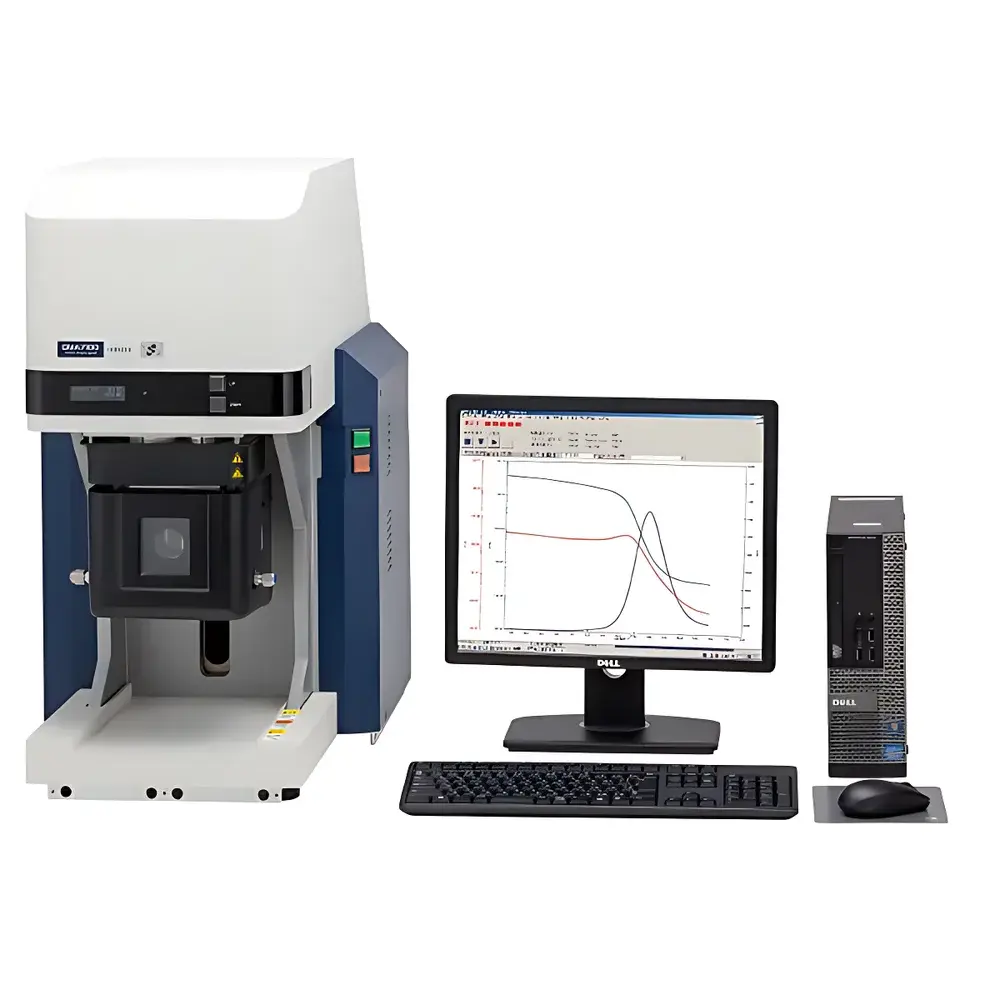
Hitachi NEXTA DMA 200 Dynamic Mechanical Analyzer
| Brand | Hitachi |
|---|---|
| Origin | Imported |
| Manufacturer | Hitachi High-Tech Corporation |
| Instrument Type | Dynamic Mechanical Analyzer (DMA/DMTA) |
| Temperature Range | −150 °C to 600 °C |
| Frequency Range | Sinusoidal mode: 0.01–200 Hz |
| Composite waveform mode | simultaneous 5 frequencies |
| Compliance | ASTM D4065, ISO 6721, ISO 11357-4, USP <1031>, FDA 21 CFR Part 11 ready (with optional audit trail module) |
Overview
The Hitachi NEXTA DMA 200 is a high-precision dynamic mechanical analyzer engineered for rigorous characterization of viscoelastic behavior in polymeric, composite, ceramic, and metallic materials under controlled thermal and mechanical stimuli. Operating on the principle of forced oscillatory deformation—applying a sinusoidal stress (or strain) while monitoring the resulting strain (or stress) response—the instrument quantifies storage modulus (E′), loss modulus (E″), and tan δ as functions of temperature, time, and frequency. Its calibrated thermal chamber delivers exceptional stability across a broad operational range from −150 °C to 600 °C, enabling studies of glass transitions, secondary relaxations, crosslink density, cure kinetics, and thermo-oxidative degradation. Designed for reproducibility in regulated environments, the NEXTA DMA 200 meets foundational requirements for GLP-compliant testing and supports traceable calibration protocols aligned with ISO/IEC 17025 laboratory practices.
Key Features
- Intuitive Guided Workflow: On-screen graphical setup wizard—illustrated with annotated schematics—walks users step-by-step through fixture selection, parameter definition (temperature ramp rate, frequency sweep, static force), and measurement initiation, minimizing operator-dependent variability.
- Real-Time Lissajous Monitoring: Built-in phase-resolved visualization displays instantaneous stress–strain hysteresis loops during acquisition, allowing immediate assessment of linearity, damping behavior, and sample slippage or fracture onset.
- Ergonomic Sample Handling System: Redesigned dual-axis sample stage features single-screw clamping and rail-guided jaw translation, eliminating misalignment risks inherent in multi-point fixation. Fixture interchangeability supports tension, bending, shear, and compression geometries without tool reconfiguration.
- Energy-Efficient Cryogenic Cooling: Integrated low-consumption liquid nitrogen delivery system reduces LN₂ usage by ≥30% versus prior-generation Hitachi DMA platforms, lowering operational cost and extending hold times at sub-ambient temperatures without compromising thermal homogeneity.
- Modular Expansion Architecture: Optional RealView™ optical module enables synchronized high-resolution video capture of sample deformation (up to 60 fps), supporting qualitative correlation between macroscopic strain fields and quantitative modulus trends.
Sample Compatibility & Compliance
The NEXTA DMA 200 accommodates specimens ranging from thin films (≥10 µm thickness) to bulk rods (≤10 mm diameter), including thermoplastics, thermosets, elastomers, fiber-reinforced composites, biomedical hydrogels, and inorganic glasses. Standard fixtures comply with ASTM D7028 (for polymer matrix composites) and ISO 11357-4 (for determination of dynamic mechanical properties). All firmware and data handling modules are architected to support 21 CFR Part 11 compliance when deployed with electronic signature and audit trail add-ons—ensuring data integrity for pharmaceutical excipient qualification, medical device material validation, and automotive OEM specification reporting.
Software & Data Management
Control and analysis are performed via Hitachi’s proprietary TA-Link™ software suite, which provides ISO 17025-aligned metadata tagging (operator ID, instrument serial number, calibration certificate IDs, environmental logs). Raw time-domain waveforms and frequency-domain spectra are stored in vendor-neutral HDF5 format, enabling third-party scripting (Python/Matlab) for advanced modeling (e.g., time–temperature superposition, Williams–Landel–Ferry fitting). Automated report generation includes customizable templates compliant with internal QA forms, ASTM test reports, and regulatory submission packages (e.g., CMC sections in IND/NDA dossiers).
Applications
- Quantification of storage/loss moduli across Tg transitions in engineering thermoplastics (e.g., PEEK, PEI) and biodegradable polymers (PLA, PHA)
- Evaluation of plasticizer migration kinetics in PVC formulations using frequency-sweep tracking of E′/tan δ shifts over accelerated aging cycles
- Assessment of crosslink density evolution during epoxy cure via isothermal frequency sweeps at fixed degrees of conversion
- Thermo-mechanical stability profiling of battery separator membranes under simulated charge–discharge thermal cycling
- Viscoelastic fingerprinting of hydrogel-based drug delivery matrices for release mechanism correlation
FAQ
What is the maximum static preload capacity for tension-mode measurements?
The NEXTA DMA 200 supports up to 25 N static force in tension configuration, adjustable in 0.1 N increments with closed-loop load cell feedback.
Does the system support time–temperature superposition (TTS) analysis natively?
Yes—TA-Link™ includes automated WLF and Arrhenius shift factor calculation, master curve construction, and confidence interval estimation per ISO 11357-4 Annex B.
Can I export raw waveform data for custom FFT processing?
Absolutely—time-stamped voltage signals from both actuator and transducer channels are accessible in ASCII and HDF5 formats, preserving full 16-bit resolution and sampling fidelity.
Is ISO 17025 calibration documentation included with shipment?
Each unit ships with a factory-issued calibration certificate covering temperature uniformity, frequency accuracy, force sensitivity, and displacement linearity—traceable to NIST and JCSS standards.
How does the system handle thermal lag compensation during rapid heating ramps?
Embedded PID-controlled furnace algorithms dynamically adjust power output based on real-time thermocouple feedback from both chamber wall and sample-stage locations, limiting thermal gradient-induced artifacts to ≤0.3 °C across the sample zone at 20 °C/min ramp rates.



