
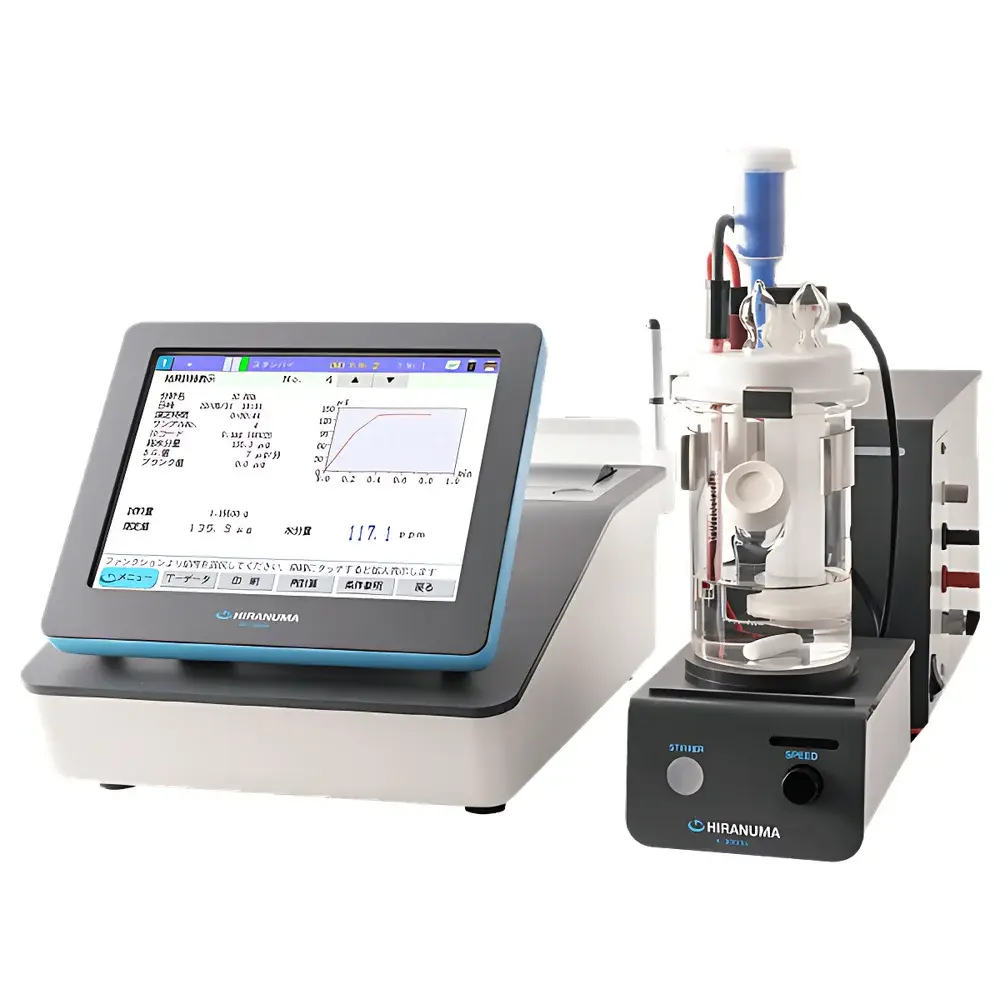
Hiranuma MOICO-A19 Coulometric Karl Fischer Moisture Analyzer
| Brand | Hiranuma |
|---|---|
| Origin | Japan |
| Model | MOICO-A19 |
| Titration Method | Fully Automated Coulometric Titration |
| Instrument Type | Coulometric Karl Fischer Moisture Analyzer |
| Display | 8.4-inch Color TFT Touchscreen with 16-Step Tilt Adjustment |
| Data Storage | USB Flash Drive Interface |
| Output | Built-in 58-mm Thermal Printer |
| Simultaneous Analysis | Up to 4 Independent Moisture Determinations |
| Stirrer Speed Control | 40 Adjustable Steps via LED Indication |
| Electrolytic Cell | Single-Chamber Coulometric Cell (No Catholyte or Diaphragm Required) |
| Status Indication | Tri-color LED + Dual-color Operation LED |
| Audio Guidance | Integrated Voice Prompt System |
| Blank Subtraction | Rapid Automatic Blank Compensation |
Overview
The Hiranuma MOICO-A19 is a high-precision coulometric Karl Fischer moisture analyzer engineered for trace-level water quantification in demanding laboratory and quality control environments. Based on the electrochemical principle of coulometric titration—where iodine is generated *in situ* via controlled electrolysis of iodide ions—the MOICO-A19 delivers exceptional sensitivity, reproducibility, and stability for samples containing water concentrations from 1 µg to 100 mg (equivalent to ~0.1 ppm to 100% w/w, depending on sample mass and matrix). Unlike volumetric KF systems, the coulometric mode eliminates reagent standardization and pipetting variability, making it ideal for low-moisture applications such as pharmaceutical excipients, lithium battery materials, polymer resins, and high-purity solvents. Its single-chamber electrolytic cell architecture eliminates the need for catholyte solution and physical diaphragms, reducing maintenance overhead, reagent consumption, and blank contribution—critical factors in GLP-compliant moisture testing workflows.
Key Features
- 8.4-inch full-color TFT touchscreen with intuitive icon-driven navigation and real-time parameter visualization—enabling rapid method setup, calibration verification, and result review without external PCs.
- 16-step adjustable tilt mechanism allows ergonomic positioning for seated or standing operation; mechanical lock ensures stable viewing angle during extended analyses.
- Integrated voice guidance system provides audible status updates (e.g., “Electrolysis started”, “Endpoint detected”, “Printer ready”)—enhancing operational awareness in shared lab spaces or when monitoring multiple instruments.
- Tri-color status LED plus dual-color operation LED offers at-a-glance remote monitoring of instrument state (standby, active titration, error), supporting unattended overnight runs and multi-station oversight.
- 40-step stirrer speed control, displayed via dynamic LED bar graph, enables precise optimization of mixing efficiency across viscous, heterogeneous, or volatile samples—minimizing endpoint drift and improving repeatability.
- Built-in 58-mm thermal printer outputs compliant hard-copy reports including date/time stamp, sample ID, water content (µg, %, ppm), drift value, titration curve summary, and operator ID—satisfying internal audit and regulatory documentation requirements.
- USB mass storage interface supports direct export of raw data files (.csv), method configurations, and audit logs—facilitating traceable data backup and integration into LIMS or electronic lab notebooks (ELN).
Sample Compatibility & Compliance
The MOICO-A19 accommodates a broad range of solid, liquid, and gaseous samples through compatible optional accessories—including oven samplers (for volatiles), gas diffusion cells (for dissolved water in gases), and solid injection ports (for hygroscopic powders). Its coulometric design complies with key international standards governing moisture analysis: ASTM D6304 (Standard Test Method for Determination of Water in Petroleum Products, Lubricating Oils, and Additives by Coulometric Karl Fischer Titration), ISO 15512 (Plastics — Determination of water content), and USP (Water Determination). The instrument’s automatic blank subtraction algorithm and low-drift single-cell design support adherence to ICH Q5C (Stability Testing of Biotechnological/Biological Products) and FDA 21 CFR Part 11–ready data integrity practices when paired with validated software protocols and user access controls.
Software & Data Management
The embedded firmware supports fully customizable method templates—including pre-set titration parameters (current limit, endpoint sensitivity, maximum time), sample weight input logic, and pass/fail criteria based on user-defined specification limits. All analytical events—including method execution, calibration, maintenance actions, and user logins—are timestamped and recorded in an immutable audit trail stored locally on the device and exportable via USB. Data files retain native resolution (e.g., current vs. time, voltage vs. time) for post-acquisition reprocessing. While the MOICO-A19 operates autonomously, its structured CSV output format enables seamless import into statistical process control (SPC) platforms or enterprise QA databases—ensuring alignment with ISO/IEC 17025 documentation requirements for accredited testing laboratories.
Applications
The MOICO-A19 is routinely deployed in regulated and research-intensive settings where accuracy below 10 µg water is essential. Typical use cases include: quantification of residual moisture in freeze-dried biologics and lyophilized APIs per USP ; moisture profiling of NMC and LFP cathode materials prior to cell assembly; water content verification in silicone oils and fluorinated solvents used in semiconductor cleaning; and routine QC of hygroscopic excipients (e.g., microcrystalline cellulose, lactose monohydrate) in solid-dose manufacturing. Its ability to perform up to four simultaneous determinations—when configured with multi-channel evaporator modules—increases throughput in high-volume release testing labs without compromising measurement fidelity.
FAQ
What is the detection limit of the MOICO-A19?
The instrument achieves a lower detection limit of 1 µg water under optimal conditions (low-drift environment, calibrated reagents, proper cell conditioning).
Does the MOICO-A19 require separate catholyte and anolyte solutions?
No—it utilizes a proprietary single-chamber coulometric cell that generates iodine exclusively at the anode, eliminating catholyte handling, diaphragm replacement, and associated cross-contamination risks.
Can the MOICO-A19 be integrated into a laboratory network for centralized data collection?
While the device lacks Ethernet or Wi-Fi connectivity, its USB-based data export supports scheduled batch transfers to networked servers or LIMS via automated scripts or manual synchronization.
Is the thermal printer compatible with continuous label stock?
The built-in printer accepts standard 58-mm thermal paper rolls (max. 40 mm diameter); custom label formats require third-party printing software and external thermal printers.
How frequently must the electrolytic cell be cleaned or regenerated?
Under normal usage with non-aggressive samples, cell maintenance intervals exceed 500 analyses; cleaning involves simple solvent rinsing and drying—no electrode polishing or membrane replacement is required.
Related Products






