
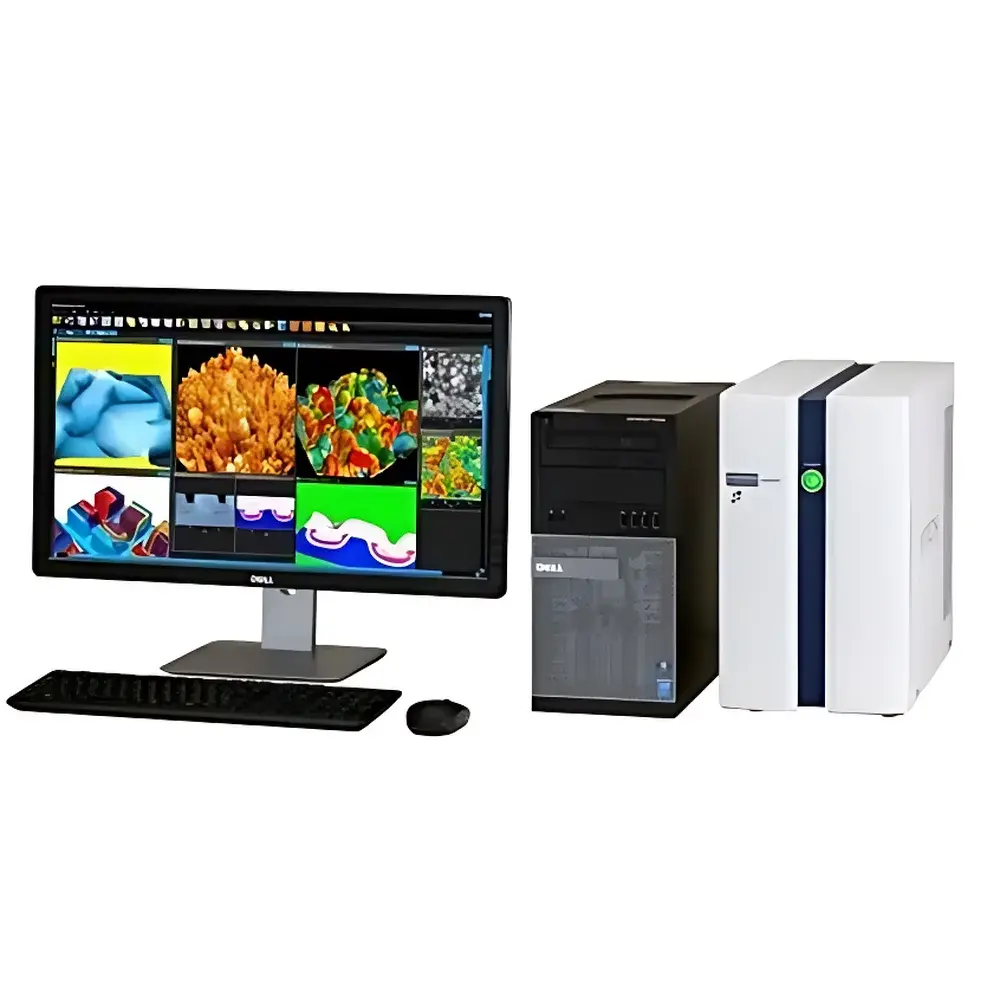
Hitachi AFM5000II with RealTune®II Controller
| Brand | Hitachi |
|---|---|
| Origin | Japan |
| Manufacturer | Hitachi High-Tech Science Corporation |
| Product Type | Atomic Force Microscope (AFM) Controller |
| Model | AFM5000II / RealTune®II |
| Compliance | Designed for ISO/IEC 17025-compliant labs |
| Software Architecture | Windows-based real-time control platform with audit trail capability |
| Control Resolution | Sub-nanometer positioning accuracy |
| Vibration Noise Floor | < 0.1 nm RMS (in closed-loop mode) |
| Sample Stage Travel Range | X/Y: ±25 µm, Z: ±5 µm |
| GUI Framework | Qt-based modular interface with tabbed workflow navigation |
| 3D Rendering Engine | OpenGL-accelerated volumetric reconstruction |
| Data Format | HDF5-compliant binary + metadata-rich XML header |
| Regulatory Alignment | Supports FDA 21 CFR Part 11 electronic signature and ALCOA+ data integrity principles |
Overview
The Hitachi AFM5000II with RealTune®II Controller is a high-precision atomic force microscope control system engineered for nanoscale topographic and nanomechanical characterization in research and quality control environments. Built upon Hitachi High-Tech Science’s proprietary feedback architecture, the controller implements dynamic cantilever parameter optimization using real-time resonance tracking and adaptive gain scheduling—principles rooted in closed-loop piezoelectric actuation theory and contact-mode/non-contact-mode SPM physics. Unlike conventional AFM controllers requiring manual tuning of setpoint, integral gain, and drive amplitude, the AFM5000II autonomously evaluates cantilever eigenfrequency, Q-factor, and tip–sample interaction stiffness to establish optimal operating conditions prior to scan initiation. This eliminates operator-dependent variability and ensures measurement repeatability across diverse sample classes—from soft biological polymers to rigid crystalline thin films—without compromising spatial resolution or signal fidelity.
Key Features
- RealTune®II Adaptive Parameter Optimization: A deterministic algorithm that predicts optimal oscillation amplitude, excitation frequency, and proportional-integral (PI) loop gains by integrating cantilever specifications (resonance frequency, spring constant), scanner dynamics, and surface topography estimates from coarse pre-scan profiling.
- One-Click Measurement Workflow: Reduces setup time from minutes to seconds; initiates full-height, phase, and amplitude channel acquisition with single GUI action—validated on carbon nanotube arrays and pentacene polycrystalline films where conventional tuning induced tip-induced deformation or loss of step-edge contrast.
- Modular Graphical User Interface (GUI): Qt-based interface with role-specific tab navigation (Acquisition, Analysis, Calibration, Export); icon-driven controls minimize cognitive load while preserving access to low-level parameters for advanced users.
- Multi-Channel 3D Fusion Rendering: Overlays topographic height maps with derived property channels (e.g., adhesion, dissipation, modulus) into co-registered volumetric visualizations using OpenGL-accelerated rendering—enabling intuitive correlation between morphology and nanomechanical behavior.
- Integrated Profile & Roughness Analysis Suite: Implements ISO 25178-compliant areal surface texture analysis including Sa, Sq, Sz, and functional parameters (Sk, Spk, Svk); supports cross-sectional line profiling with sub-pixel interpolation and statistical confidence intervals.
- Compact Benchtop Form Factor: Dimensions 220 mm (W) × 500 mm (D) × 385 mm (H); mass ≈ 15 kg—designed for integration into vibration-isolated optical tables, cleanroom gloveboxes, or shared instrumentation suites without structural reinforcement.
Sample Compatibility & Compliance
The AFM5000II controller supports standard commercial cantilevers (Si/SiN, conductive, magnetic, colloidal) and accommodates samples up to 25 mm in diameter mounted on standard stubs or custom holders. Its low-noise analog front-end (< 0.1 nm RMS vertical noise floor in closed-loop operation) enables stable imaging of fragile organic semiconductors, hydrated biomolecules, and polymer blends without mechanical drift or thermal artifact accumulation. The system complies with ISO/IEC 17025 requirements for measurement uncertainty estimation and maintains traceability to NIST-traceable reference standards via integrated calibration routines. All acquired data conform to ALCOA+ principles (Attributable, Legible, Contemporaneous, Original, Accurate) and support 21 CFR Part 11-compliant electronic signatures when deployed with validated LIMS or ELN integrations.
Software & Data Management
Control and analysis are executed through Hitachi’s proprietary software suite, built on a Windows 10/11 LTSB platform with deterministic real-time thread prioritization. Raw data are stored in HDF5 format with embedded metadata (timestamp, instrument ID, environmental conditions, user credentials), ensuring FAIR (Findable, Accessible, Interoperable, Reusable) compliance. Audit trails log all parameter modifications, file exports, and user logins with cryptographic hashing. Batch processing pipelines support automated roughness mapping, grain boundary detection, and force–distance curve fitting using open-source Python libraries (NumPy, SciPy) via documented API hooks—facilitating method transfer and computational reproducibility.
Applications
- Nanoscale metrology of organic photovoltaic active layers (e.g., P3HT:PCBM phase separation)
- Mechanical property mapping of lipid bilayers and extracellular matrix hydrogels
- Defect inspection of epitaxial graphene on SiC wafers
- Surface energy distribution analysis of anti-fouling polymer coatings
- Crystallinity assessment of pharmaceutical co-crystals per ICH Q5A guidelines
- In-process monitoring of atomic layer deposition (ALD) film uniformity
FAQ
Does the AFM5000II controller support third-party cantilevers?
Yes—it accepts standard 125 µm × 125 µm chip-mount cantilevers with resonant frequencies between 15 kHz and 400 kHz and nominal spring constants from 0.01 N/m to 100 N/m.
Is RealTune®II compatible with non-contact and tapping modes?
RealTune®II is optimized for amplitude-modulation (tapping) mode but includes configurable presets for contact, lift, and force spectroscopy modes.
Can the system be integrated into an automated wafer inspection line?
Yes—the controller provides TCP/IP and RS-232 interfaces with SCPI command syntax for OEM integration into SECS/GEM-compliant semiconductor fabs.
What documentation is provided for regulatory audits?
A complete validation package—including IQ/OQ protocols, risk assessments per ISO 14971, and raw data integrity reports—is supplied with each unit.
Is remote diagnostics supported?
Secure remote access is available via TLS-encrypted VNC with two-factor authentication; session logs are retained for 90 days per internal IT policy.





