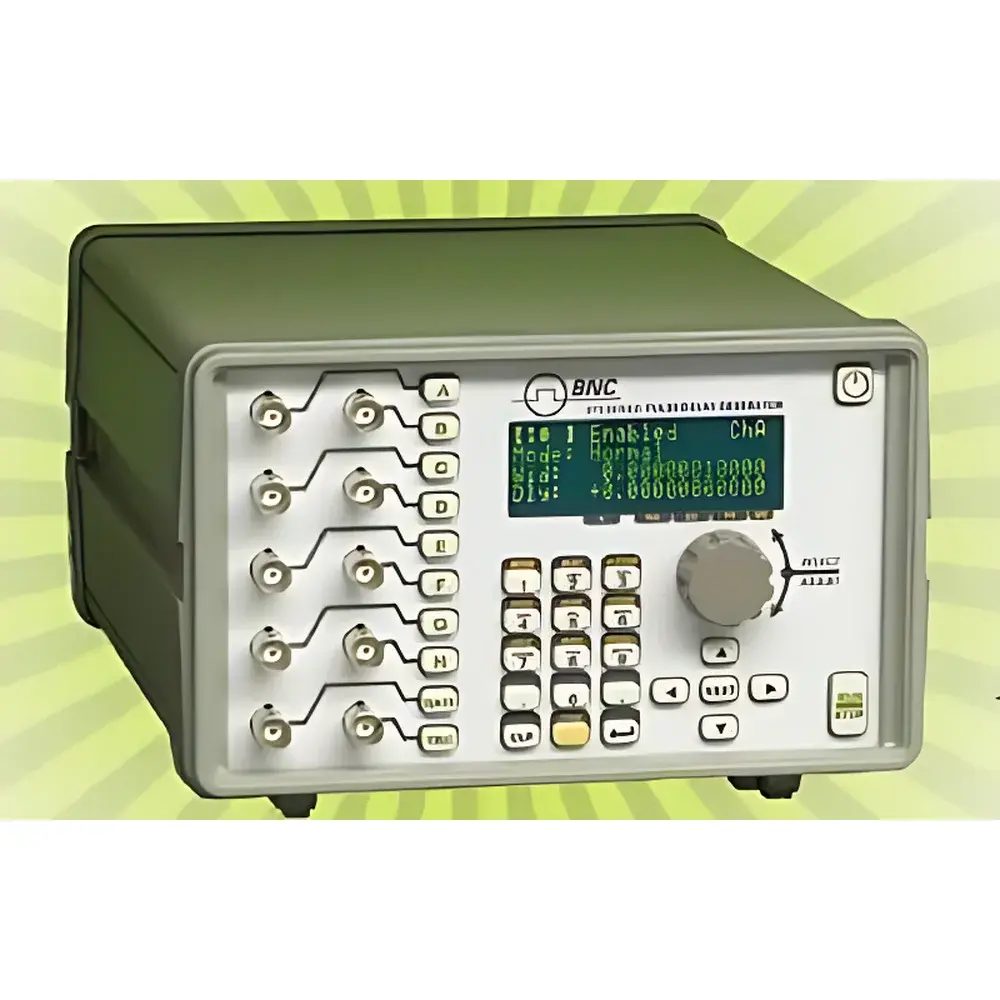
BNC Model 575 Digital Pulse Delay Generator
| Brand | BNC |
|---|---|
| Origin | USA |
| Manufacturer Type | Authorized Distributor |
| Origin Category | Imported |
| Model | 575 |
| Pricing | Upon Request |
| Output Channels | 2 / 4 / 8 |
| Timing Resolution | 50 ps |
| Internal Trigger Jitter | 200 ps |
| External Trigger Jitter | 800 ps |
| Output Types | Electrical (TTL, ECL, NIM, LVDS) and Optical (LED or Laser Diode) |
| Trigger Inputs | Dual-mode — 2-gate, gate+trigger, or 2-trigger configurations |
Overview
The BNC Model 575 Digital Pulse Delay Generator is a high-precision timing instrument engineered for applications demanding sub-nanosecond synchronization, deterministic delay control, and multi-channel temporal coordination. Built upon Berkeley Nucleonics Corporation’s four-decade legacy in precision electronic instrumentation for nuclear science, defense R&D, and advanced physics laboratories, the Model 575 employs FPGA-based digital timing architecture to deliver deterministic, repeatable delays with 50 ps resolution across up to eight independent output channels. Its core functionality relies on digitally synthesized delay paths—free from analog drift or temperature-dependent variation—ensuring long-term stability and traceable timing performance. Unlike conventional analog delay generators, the Model 575 implements fully programmable delay, width, and polarity per channel, enabling complex trigger trees, pump-probe sequencing, time-of-flight calibration, and synchronized stimulus-response protocols essential in semiconductor device characterization, ultrafast laser systems, single-photon detection setups, and time-resolved spectroscopy.
Key Features
- Ultra-fine timing resolution of 50 ps per channel, supporting precise alignment of optical, electrical, and mixed-signal events.
- Low-jitter triggering architecture: internal trigger jitter ≤ 200 ps RMS; external trigger jitter ≤ 800 ps RMS—critical for maintaining signal integrity in high-bandwidth measurement chains.
- Configurable output count: factory-configurable variants support 2, 4, or 8 independent delay channels, each with user-defined delay, pulse width, polarity, and output type.
- Hybrid output capability: simultaneous electrical outputs (TTL, ECL, NIM, LVDS) and optical outputs (via integrated LED or external laser diode drivers), enabling direct interfacing with photodetectors, gated cameras, and optoelectronic test fixtures.
- Dual-input trigger architecture: supports three operational modes—dual-gate (for windowed enable), gate + trigger (for conditional event initiation), or dual-trigger (for differential or coincidence timing)—enhancing flexibility in complex experimental logic.
- Rack-mountable 1U chassis with front-panel LCD interface, USB 2.0, Ethernet (TCP/IP & UDP), and optional GPIB connectivity for seamless integration into automated test environments.
Sample Compatibility & Compliance
The Model 575 is designed for use with semiconductor test platforms requiring deterministic, low-latency stimulus delivery—including wafer-level parametric testers, laser-driven carrier lifetime analyzers, time-domain reflectometry (TDR) systems, and pulsed I-V characterization setups. Its electrical outputs comply with industry-standard logic families (TTL, ECL, NIM) and are impedance-matched to 50 Ω systems. Optical outputs support common pulsed LED and laser diode drivers used in time-correlated single-photon counting (TCSPC) and photoluminescence decay analysis. The instrument meets CE marking requirements for electromagnetic compatibility (EN 61326-1) and safety (EN 61010-1). Firmware supports audit-trail logging and user-access controls compatible with GLP/GMP-aligned laboratory workflows where traceability and procedural integrity are mandated.
Software & Data Management
BNC provides the free, cross-platform BNC Control Suite—a native application supporting real-time parameter configuration, waveform visualization, and script-based automation via Python, LabVIEW, MATLAB, and C/C++ APIs. All delay settings, trigger configurations, and output states are stored in non-volatile memory with timestamped versioning. The Ethernet interface enables remote monitoring and control in distributed lab environments, while USB connection supports firmware updates and configuration backup/restore. Data export options include CSV and XML formats for post-acquisition analysis in third-party tools. For regulated environments, optional firmware extensions provide 21 CFR Part 11–compliant electronic signatures, role-based access control, and immutable audit logs of all configuration changes.
Applications
- Semiconductor transient response testing: generating precisely timed gate pulses for MOSFET/IGBT switching characterization and dynamic on-resistance (RDS(on)) evaluation.
- Pump-probe experiments in ultrafast material science: synchronizing femtosecond laser excitation with delayed probe pulses for carrier dynamics mapping in GaN, SiC, and 2D materials.
- Time-of-flight (ToF) calibration in automated optical inspection (AOI) systems used for defect localization on advanced packaging substrates.
- Multi-channel trigger distribution in high-speed oscilloscope arrays or digitizer clusters for phase-coherent acquisition across >10 GS/s sampling systems.
- Single-photon avalanche diode (SPAD) array gating in quantum sensing platforms requiring <1 ns dead-time control and inter-pixel timing skew compensation.
FAQ
What is the minimum programmable delay step size?
The Model 575 offers a fixed resolution of 50 ps across its full delay range (0–1000 s), with no interpolation or rounding—each setting corresponds to an exact hardware-timed increment.
Can the Model 575 generate bursts or sequences of delayed pulses?
Yes—using the built-in sequence mode, users can define up to 1024 programmable events per channel, including variable delay, width, and repetition rate, enabling complex burst patterns without external controllers.
Is optical output intensity adjustable?
Optical output drive current is configurable in 1 mA steps from 0–200 mA, supporting both low-power LEDs and high-current laser diodes while maintaining specified timing fidelity.
Does the instrument support synchronization to external 10 MHz or 1 PPS references?
Yes—the rear-panel REF IN port accepts 10 MHz sine or CMOS clock inputs, and the unit can be phase-locked to external timing standards for system-wide coherence in metrology-grade installations.
How is calibration maintained over temperature and time?
The Model 575 uses oven-controlled crystal oscillator (OCXO) timing references with ±50 ppb stability over 0–50 °C and annual aging <±100 ppb, eliminating need for routine recalibration under typical lab conditions.